Parable of the Two Sons: Verse, Meaning & Lesson
The Parable of the Two Sons is a short story Jesus told to the religious leaders in Jerusalem, recorded in Matthew 21:28-32. A father asks two sons to go work in his vineyard. One initially refuses but later changes his mind and goes; the other agrees immediately but never shows up. Jesus uses the story to expose the gap between words and actions, and to confront the religious establishment with an uncomfortable truth about their own spiritual condition.
Though brief, this parable carries one of the sharpest rebukes Jesus delivers to the chief priests and elders during His final week in Jerusalem. Understanding its setting, characters, and application reveals why Jesus chose this particular illustration and why it still challenges readers today.
The Verse: Matthew 21:28-32
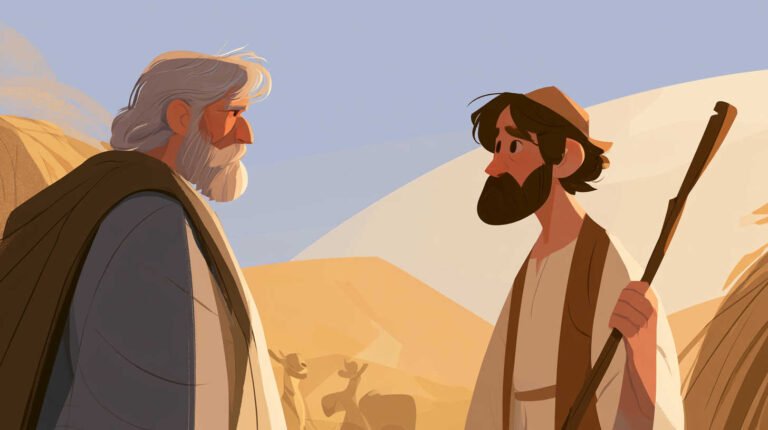
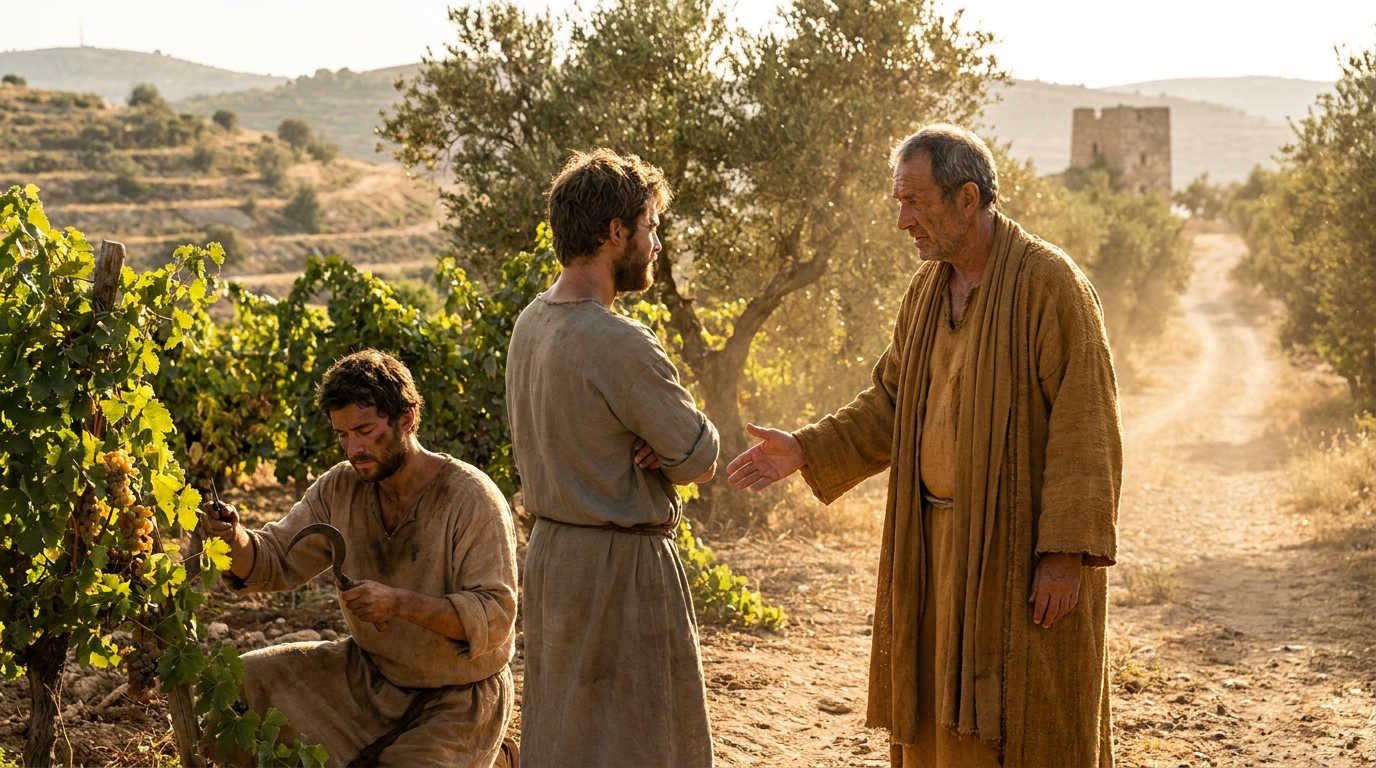
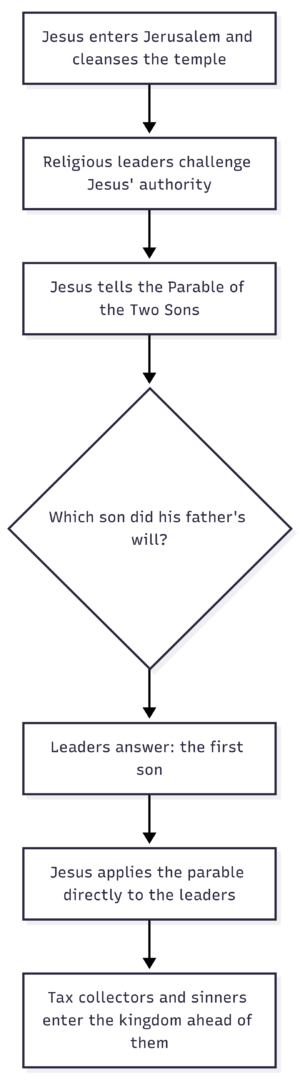
A man had two sons. He went to the first and told him to go work in the vineyard that day. The son initially refused, but afterward changed his mind and went. The father then went to the second son and gave the same instruction. This son answered that he would go, but he never did. Jesus asked the religious leaders which of the two sons had actually done his father’s will. They answered correctly: the first.
Jesus then told them plainly that tax collectors and prostitutes would enter the kingdom of God ahead of them, because those social outcasts had believed John the Baptist’s message of repentance, while the religious leaders had refused to believe even after witnessing the transformation it produced in others.
The Setting: A Confrontation in the Temple
This parable does not exist in isolation. It comes immediately after Jesus’ triumphal entry into Jerusalem, His cleansing of the temple, and His cursing of a fig tree that had leaves but no fruit, a symbolic act pointing to Israel’s outward religious activity without genuine spiritual substance. Immediately before telling this parable, Jesus had been challenged by the chief priests and elders, who demanded to know by what authority He was acting.
Rather than answering their question directly, Jesus told three parables in succession: the Two Sons, the Wicked Tenants, and the Wedding Feast. Each parable was aimed squarely at the religious leadership, and each carried a pointed warning about their rejection of God’s messengers, first John the Baptist and now Jesus Himself.
The Parable of the Two Sons is the first and most direct of the three, using a simple, undeniable illustration to force the leaders into passing judgment on themselves before they realized what was happening.
What the Parable Means
Each character in the story carries a clear symbolic role. The father represents God, who calls every person to active obedience rather than passive agreement. The first son, who initially refuses but later obeys, represents society’s outcasts, tax collectors, prostitutes, and other people considered beyond redemption by the religious establishment, who rejected God’s ways at first but repented after hearing the preaching of John the Baptist and Jesus.
The second son, who agrees immediately but never follows through, represents the chief priests, elders, and Pharisees, who maintained an outward appearance of obedience and religious devotion while refusing to genuinely submit to God’s will or recognize Jesus as the Messiah.
The genius of the parable lies in how Jesus structures the question. He does not ask the leaders to judge tax collectors or prostitutes directly, which might have triggered immediate defensiveness. Instead, He asks a simple, hypothetical question about two sons, and the leaders answer honestly because the answer seems obvious. Only after they commit to their answer does Jesus reveal that they have just condemned their own behavior.
Comparing the Two Sons
| First Son | Second Son |
|---|---|
| Initially says no | Initially says yes |
| Represents tax collectors and sinners | Represents religious leaders |
| Words showed disobedience, actions showed obedience | Words showed obedience, actions showed disobedience |
| Repented after hearing John the Baptist’s message | Refused to repent despite witnessing others transformed |
| Ultimately did the father’s will | Ultimately failed to do the father’s will |
| Enters the kingdom of God | Excluded by their own hypocrisy |
This table captures the parable’s central irony: the son who said the wrong thing did the right thing, while the son who said the right thing did the wrong thing. Jesus consistently teaches that God evaluates obedience by what a person ultimately does, not by the promises they make along the way.
Why the Religious Leaders Missed the Point
The chief priests and elders occupied respected positions in Jewish society. They were well-versed in the law, careful about religious observance, and outwardly devoted to serving God. Their failure was not a lack of religious knowledge, but a refusal to act on the truth once it was presented to them.
When John the Baptist called Israel to repentance, tax collectors and prostitutes, people with far less religious standing, responded with genuine change. The religious leaders, despite seeing this transformation firsthand, refused to reconsider their own position.
This is the same pattern seen throughout Jesus’ ministry: those with the least to lose in terms of reputation were often the quickest to repent, while those with an established public image of righteousness were the most resistant to admitting they needed to change. The parable exposes a specific kind of hypocrisy, not the hypocrisy of secretly living a scandalous life, but the hypocrisy of verbal agreement paired with practical refusal.
Key Lessons From the Parable
Obedience is proven by action, not by words. Making the right promise carries no spiritual value if it is never followed by the right behavior. The parable’s entire point rests on this contrast: intentions and declarations mean nothing without corresponding action.
Repentance is always available, no matter how late. The first son’s initial refusal did not disqualify him from ultimately doing his father’s will. His change of mind and course correction were enough to be credited with obedience. This reflects a consistent biblical theme that it is never too late to turn back toward what is right.
Self-righteousness blinds people to their own need for change. The second son’s confidence in his own agreement kept him from noticing that he never actually followed through. In the same way, assuming one’s own spiritual standing is secure can prevent honest self-examination.
God values authenticity over performance. The parable draws a sharp line between people who look obedient and people who are obedient. A consistent life, even one that started with rebellion, is worth more than a polished outward appearance that never translates into real action.
The kingdom is open to anyone willing to change, regardless of their starting point. The parable does not celebrate the first son’s initial disobedience; it celebrates his willingness to change course. This reframes the story as an invitation rather than simply a rebuke, showing that a person’s past does not determine their future response to God.
The Broader Pattern in Matthew 21
This parable is best understood as the first blow in a three-part sequence Jesus delivers to the temple leadership. Immediately after the Two Sons, Jesus tells the Parable of the Wicked Tenants, describing a vineyard owner whose tenants abuse and kill the servants, and eventually the owner’s son, sent to collect the harvest.
This parable directly foreshadows the religious leaders’ rejection and eventual crucifixion of Jesus. He then tells the Parable of the Wedding Feast, where invited guests refuse to attend a king’s banquet, leading the king to invite strangers off the street instead.
| Parable | Central Warning |
|---|---|
| The Two Sons | Words without action fail to satisfy God’s will |
| The Wicked Tenants | Rejecting God’s messengers leads to judgment |
| The Wedding Feast | Refusing God’s invitation opens the door to unexpected guests |
Read together, these three parables form an escalating warning to Israel’s religious establishment: their outward religious performance had become a substitute for genuine obedience, and that substitution would ultimately cost them their place in God’s kingdom.
A Personal Application Beyond the Original Audience
While the parable was originally aimed at first-century religious leaders, its principle applies well beyond that specific historical confrontation. Anyone can fall into the pattern of the second son: agreeing with what is right in principle while quietly failing to follow through in practice. Likewise, anyone can experience the first son’s arc: initial resistance followed by genuine change of heart and action.
The parable challenges readers to examine the gap, if any, between their stated values and their actual behavior. It also offers reassurance that an initial “no” is not the final word, since a change of direction, however late, still counts as obedience in the eyes of the one who gave the instruction.
Frequently Asked Questions
It appears in Matthew 21:28-32, during Jesus’ final week of ministry in Jerusalem, shortly after His triumphal entry and cleansing of the temple.
The parable teaches that true obedience to God is demonstrated through action rather than verbal agreement, and that repentance, even after initial refusal, is more valuable than empty promises.
The first son, who initially refuses but later obeys, represents repentant sinners such as tax collectors and prostitutes. The second son, who agrees but never follows through, represents the religious leaders who claimed obedience to God but refused to accept Jesus and John the Baptist’s message.
Jesus told this parable in direct response to the chief priests and elders challenging His authority, using the story to expose their hypocrisy and their rejection of both John the Baptist and Himself.
They represent people considered the least righteous in society who, despite their past, repented and believed the message of John the Baptist and Jesus, in contrast to the religious leaders who refused to change despite their outward piety.
It is the first of three parables, followed by the Wicked Tenants and the Wedding Feast, all delivered to the same audience and all warning against rejecting God’s messengers and the consequences of religious hypocrisy.
The Lasting Takeaway
The Parable of the Two Sons draws a permanent line between saying and doing. It rewards the son whose actions eventually matched his father’s request, regardless of his initial resistance, and it condemns the son whose words promised obedience his behavior never delivered.
For readers today, the story remains a direct challenge to examine whether faith is something spoken or something lived, and a reminder that genuine change, no matter how late it comes, is always welcomed.
Please share this Parable of the Two Sons: Verse, Meaning & Lesson with your friends and do a comment below about your feedback.
We will meet you on next article.
Until you can read, Parable of the Two Debtors: Verse, Meaning & Lesson