Joshua Bible Trivia Quiz with Questions & Answers
The Book of Joshua picks up right where Deuteronomy leaves off, following Israel’s new leader as he guides the people across the Jordan River and into a series of military campaigns that bring the Promised Land under their control.
Along the way, the book features some of the Old Testament’s most vivid scenes: a city’s walls collapsing after a week of marching, a spy story involving a scarlet cord, a sun that stands still mid-battle, and a final speech that ends with one of the Bible’s most quoted declarations of loyalty.
This trivia quiz works through the book’s major events, characters, and turning points. Questions are organized into five themed rounds, each followed by an answer and a short explanation, so you can test your knowledge and pick up extra context along the way.
Quick Facts About the Book of Joshua
| Category | Details |
|---|---|
| Position in the Bible | Sixth book of the Old Testament, the first of the historical books |
| Number of chapters | 24 |
| Main leader | Joshua, son of Nun, successor to Moses |
| Joshua’s tribe | Ephraim |
| Central theme | The conquest and division of the Promised Land under God’s guidance |
| Key locations | The Jordan River, Jericho, Ai, Gibeon, Shechem |
| Joshua’s age at death | 110 years |
| Burial place | Timnath-Serah, in the hill country of Ephraim |
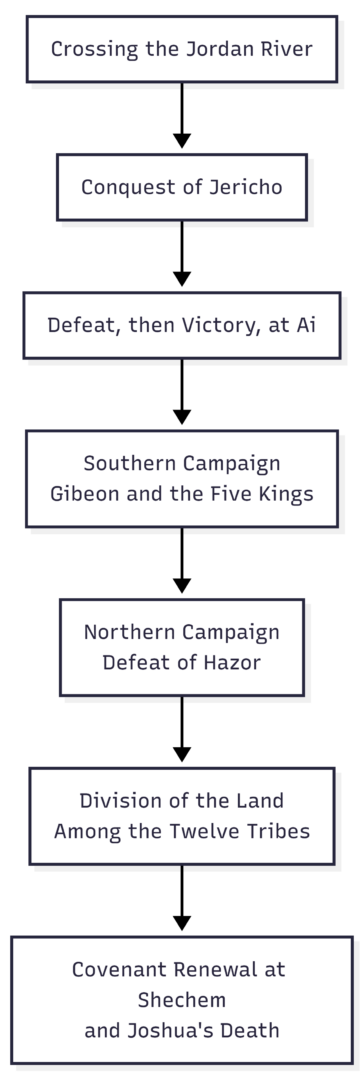
The Shape of the Conquest
The Book of Joshua follows a fairly clear sequence of events, moving from the crossing of the Jordan through a series of military campaigns and ending with the land being divided among the tribes.
Round 1: Joshua’s Call and Crossing the Jordan
Question 1: Who was Joshua’s father, and from which tribe did Joshua come? Joshua was the son of Nun, from the tribe of Ephraim. He had served as Moses’ assistant for years before being chosen to lead Israel after Moses’ death.
Question 2: What does the name “Joshua” mean? “The Lord is salvation.” The same Hebrew name appears in other forms elsewhere in Scripture, including as the basis for the name later rendered as Jesus in the New Testament.
Question 3: What instruction did God repeat to Joshua at the start of the book? To be strong and courageous. This encouragement is tied to a promise that God would be with Joshua just as he had been with Moses, removing any reason for fear.
Question 4: What body of water did the Israelites cross on dry ground to enter the Promised Land? The Jordan River. The crossing echoed the earlier crossing of the Red Sea and served as a clear sign to the people that God’s presence had transferred from Moses to Joshua.
Question 5: Who carried the Ark of the Covenant into the riverbed during the crossing? The priests, from the tribe of Levi. The Ark was carried ahead of the people rather than behind them, leading the way into the riverbed before the water resumed its flow.
Round 2: Rahab and the Fall of Jericho
Question 6: How many spies did Joshua send to scout the city of Jericho, and whose house did they stay in? Two spies were sent, and they stayed in the house of Rahab, a local woman who chose to help them rather than turn them over to the city’s authorities.
Question 7: What did Rahab hide the spies under when searchers came looking for them? Stalks of flax laid out on her rooftop. This quick thinking allowed the spies to avoid detection while the search moved elsewhere in the city.
Question 8: What item did Rahab tie in her window as a sign that her household should be spared? A scarlet cord. This served as the agreed signal between Rahab and the spies, marking her house so that it would be recognized during the coming attack.
Question 9: How many days did the Israelites march around the walls of Jericho before the walls fell, and what were the priests carrying or blowing? Seven days, during which priests carried trumpets made from rams’ horns. On the final day, after multiple laps around the city, a final shout from the people was followed by the collapse of the walls.
Question 10: What was Rahab’s occupation before she helped the Israelite spies? She worked as a prostitute. Despite this background, both Old and New Testament writers later point to her as an example of faith and righteous action because of how she treated the spies.
Round 3: Achan’s Sin and the Battle of Ai
Question 11: What city did the Israelites attack immediately after Jericho, and what happened during their first attempt? Ai. Despite sending only a few thousand men because the city seemed small, the Israelites were unexpectedly defeated, losing dozens of soldiers in the process.
Question 12: What was discovered to be the cause of Israel’s defeat at Ai? One man, Achan, had secretly taken items that were supposed to be devoted entirely to God from the spoils of Jericho, breaking a direct command and bringing consequences on the whole community until the matter was addressed.
Question 13: What punishment did Achan receive once his actions were uncovered? He was stoned, along with the destruction of what he had taken. After this was dealt with, the Israelites were able to attack Ai again and succeeded.
Question 14: Where did the Israelites build an altar to the Lord, following instructions originally given through Moses? On Mount Ebal. Stones were coated with plaster and inscribed with the words of the Law, and the people gathered with half standing on one mountain for blessings and half on a facing mountain for curses.
Question 15: How did the people of Gibeon avoid being attacked by the Israelites? They disguised themselves as travelers from a distant land, using worn-out sacks, patched sandals, and moldy bread to convince Joshua and the Israelites to make a treaty with them rather than fight them.
Round 4: Miracles, Battles, and the Division of the Land
Question 16: During the battle to defend Gibeon, Joshua famously commanded two celestial bodies to stand still. What were they, and where did each stop? The sun and the moon. According to the account, the sun stood still over Gibeon while the moon stood still over the Valley of Aijalon, giving Israel extra daylight to complete the battle.
Question 17: Besides the Israelite army, what natural phenomenon contributed to the defeat of the Amorite kings during this same battle? A hailstorm. Large hailstones are described as killing more of the enemy soldiers than the swords of the Israelite army did.
Question 18: How many cities were designated as Cities of Refuge for people who killed someone unintentionally? Six cities. These locations gave people accused of accidental killing a place to go for protection until their case could be properly judged.
Question 19: Which tribe received no territorial inheritance in the division of the land, because the Lord himself was considered their inheritance? The tribe of Levi. Instead of a single territory, Levites were given towns scattered throughout the other tribes’ lands, reflecting their role in worship and instruction.
Question 20: Which specific region did Caleb request and receive as his inheritance, because of his wholehearted faithfulness? Hebron. Caleb’s request is tied directly back to his earlier role as one of the two faithful spies sent into Canaan decades before.
Round 5: Joshua’s Farewell and Legacy
Question 21: What famous declaration did Joshua make about his own household’s commitment to God? That he and his household would serve the Lord. This statement comes at the end of a larger challenge to the people to choose who they would serve, and it remains one of the most quoted lines from the book.
Question 22: How old was Joshua when he died? 110 years old. His death closes out the book and marks the end of an era of centralized leadership over Israel.
Question 23: Where was Joshua buried after his death? At Timnath-Serah, in the hill country of Ephraim — the same territory that had been given to him as his personal inheritance.
Question 24: At what location did Joshua gather the people to renew their covenant with God near the end of the book? Shechem. This gathering included Joshua’s well-known challenge to the people about which gods they would serve going forward.
Question 25: Near Jericho, Joshua encountered a figure holding a drawn sword. Who was this, and what did Joshua do in response? The Commander of the Lord’s army. In response, Joshua removed his sandals, recognizing that he was standing on holy ground.
Scoring Guide
This quiz contains 25 questions. Give yourself 4 points for each correct answer, for a maximum score of 100.
| Score Range | Result |
|---|---|
| 90–100 | Bible Scholar — you know the conquest narrative in detail |
| 70–89 | Well Versed — a strong grasp of the major events and figures |
| 50–69 | Familiar Reader — solid general knowledge, with a few gaps |
| Below 50 | Time for a Re-Read — Joshua is full of memorable scenes worth revisiting |
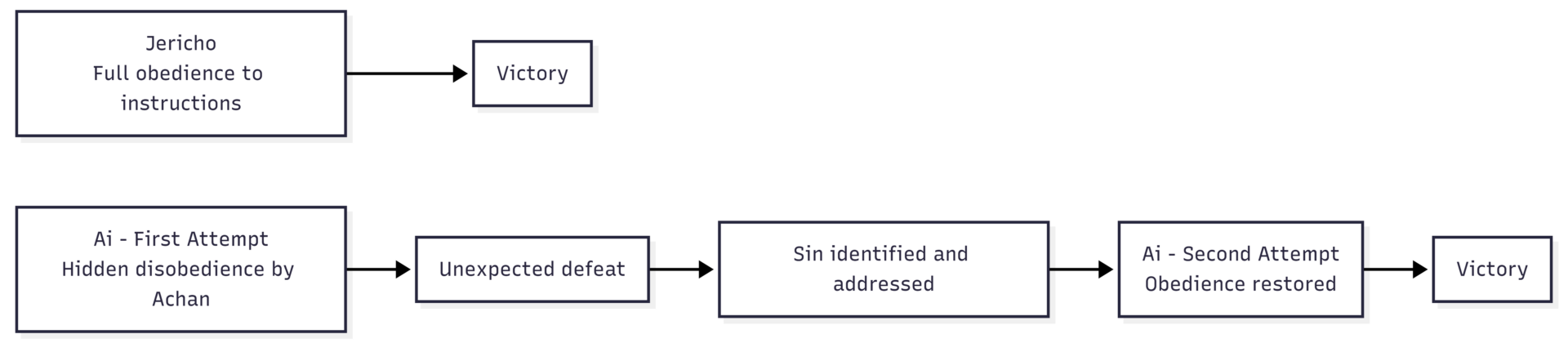
Obedience, Failure, and Recovery: The Pattern at Ai
One of the clearest lessons in the Book of Joshua comes from the back-to-back episodes at Jericho and Ai, which show how closely military outcomes are tied to obedience throughout the book.
Frequently Asked Questions
Both the Old and New Testaments point to Rahab’s actions toward the Israelite spies — sheltering them and helping them escape safely — as evidence of genuine faith, regardless of her earlier occupation. She’s later listed among the ancestors of significant biblical figures.
The event is presented as a direct, dramatic answer to Joshua’s request during a critical battle, extending the available daylight long enough for Israel to secure victory. It’s referenced elsewhere in the Bible as a well-known historical event.
The defeat is tied directly to one person’s disobedience — taking items that were supposed to be set apart entirely for God. The narrative presents this as something that affected the whole community until it was identified and dealt with.
They were designated locations where someone who had killed another person unintentionally could go for protection from immediate retaliation, allowing time for the circumstances to be reviewed before any final judgment.
It ends with the land divided among the tribes, a covenant renewal ceremony at Shechem, and the deaths of Joshua and the priest Eleazar. Without a single successor named, the stage is set for the more decentralized period of leadership described in the Book of Judges.
Final Thoughts
The Book of Joshua moves at a fast pace, covering river crossings, sieges, ambushes, treaties, and land divisions across just 24 chapters. Whether you already knew the story of Jericho’s walls by heart or discovered a few new details about Cities of Refuge or Caleb’s inheritance, the book’s blend of dramatic events and practical instructions makes it one of the most action-packed in the entire Old Testament.
Please share this Joshua Bible Trivia Quiz with Questions & Answers with your friends and do a comment below about your feedback.
We will meet you on next article.
Until you can read, Deuteronomy Bible Trivia Quiz With Questions & Answers