Parable of the Watchful Servants: Verse, Meaning & Lesson
The Parable of the Watchful Servants is one of the most striking teachings Jesus ever gave about spiritual readiness. Found in Luke 12:35-40, it paints a picture of household servants staying awake through the night, dressed and lamps lit, waiting for their master to come home from a wedding banquet.
The story rewards those who stay alert — but it also carries a twist nobody in the original audience would have expected: the master ends up serving the servants himself.
This parable sits inside a longer block of teaching in Luke 12, sandwiched between the Parable of the Rich Fool and further warnings about faithful stewardship. Jesus is not simply telling a nice bedtime story about hardworking employees.
He is preparing His followers — then and now — for a return whose timing nobody can predict, and He is redefining what greatness looks like in God’s kingdom along the way.
The Full Text of Luke 12:35-40
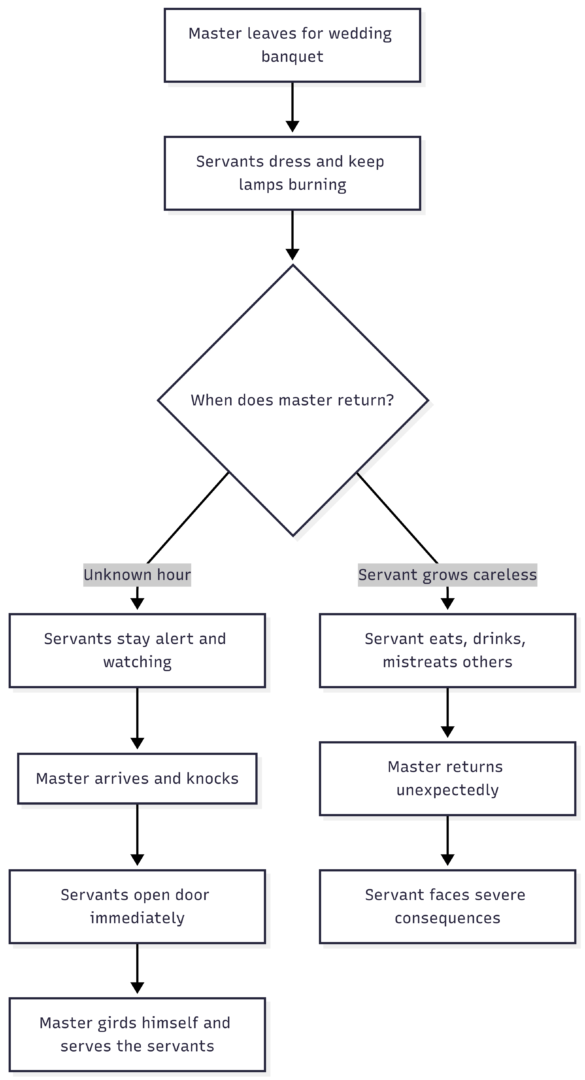
“Be dressed ready for service and keep your lamps burning, like men waiting for their master to return from a wedding banquet, so that when he comes and knocks they can immediately open the door for him. It will be good for those servants whose master finds them watching when he comes.
Truly I tell you, he will dress himself to serve, will have them recline at the table and will come and wait on them. It will be good for those servants whose master finds them ready, even if he comes in the middle of the night or toward daybreak. But understand this: If the owner of the house had known at what hour the thief was coming, he would not have let his house be broken into. You also must be ready, because the Son of Man will come at an hour when you do not expect him.” (Luke 12:35-40, NIV)
Some translations render verse 35 slightly differently — “Be dressed in readiness, and keep your lamps lit” — but the meaning stays consistent across versions: get ready, and stay ready.
Historical and Literary Context
To understand this parable properly, it helps to see what surrounds it. Just before this passage, in Luke 12:22, Jesus tells His disciples not to worry about food or clothing, redirecting their attention from physical anxiety to spiritual priority.
Right before that, in Luke 12:13-21, He tells the Parable of the Rich Fool — a man who built bigger barns to store his wealth, only to die the very night he thought he had it all figured out.
That parable warns against being “worldly minded.” The Parable of the Watchful Servants continues the same thread but flips the warning into a promise: those who are heavenly minded, who stay ready rather than complacent, will be blessed rather than caught off guard.
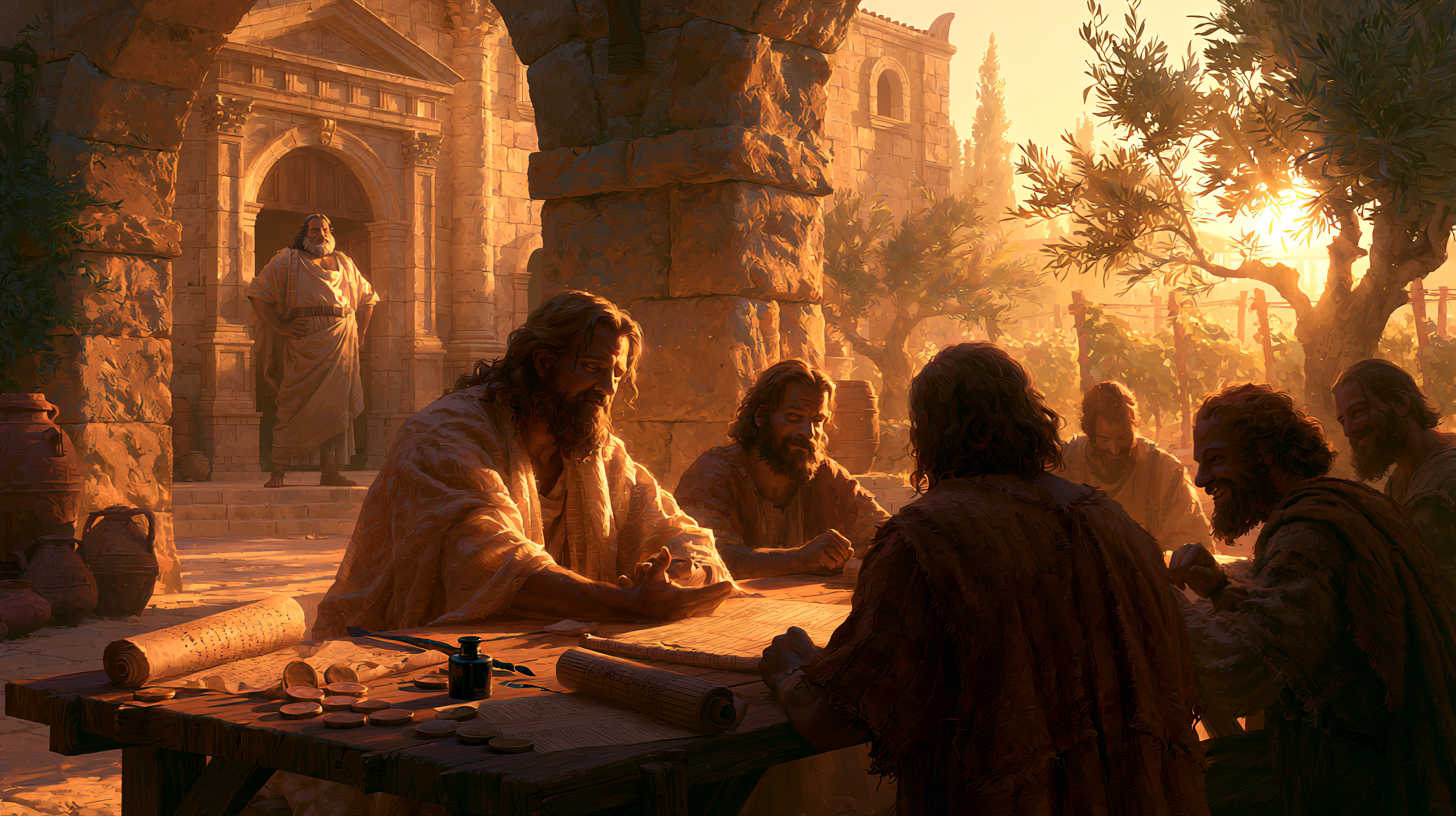
The setting Jesus describes would have been instantly familiar to His audience. In wealthy Roman and Jewish households of the era, servants were expected to anticipate their master’s needs, especially when he was away at a lengthy social event like a wedding banquet, which could stretch on for days.
Nobody knew exactly when the master would walk back through the door — it could be the second watch of the night (roughly 9 p.m. to midnight) or the third watch (midnight to 3 a.m.). A servant’s job was to be ready regardless of the hour.
That uncertainty is the whole engine of the story. The parable isn’t really about household management — it’s about the Second Coming of Jesus Christ, an event whose timing has been debated, guessed at, and mispredicted for two thousand years, yet remains, by design, unknown.
Breaking Down the Parable Verse by Verse
| Verse | Content | Core Idea |
|---|---|---|
| 35 | Be dressed and keep lamps burning | Constant preparation |
| 36 | Wait like servants expecting their master from a wedding banquet | Eager anticipation |
| 37 | Master finds servants watching; he serves them | Reward and role reversal |
| 38 | Blessing repeated even if he comes at an unusual hour | Persistent readiness pays off |
| 39 | If the homeowner knew the thief’s hour, he’d have stayed alert | Contrast: unwelcome surprise |
| 40 | The Son of Man comes when least expected | Direct application to believers |
The Meaning Behind Each Symbol
Jesus rarely tells a parable without embedding several layers of symbolism. Here is what each element represents:
- Dressed in readiness — In the ancient world, long robes had to be tucked into a belt (girded) before any physical work could begin. This represents a believer being prepared for active service, not passive waiting.
- Lamps burning — Small clay oil lamps required regular refilling, wick-trimming, and protection from wind. They symbolize the ongoing discipline of living by God’s Word (Psalm 119:105 calls Scripture “a lamp to my feet and a light to my path”).
- The master — Represents Jesus Christ Himself.
- His return from the wedding banquet — Represents the Second Coming, an event of celebration rather than dread for those who are ready.
- Immediately opening the door — Represents instant, unhesitating readiness with no gap between the master’s arrival and the servant’s response.
- Blessed / watching — The Greek word behind “watching” is gregoreo, meaning to stay awake, alert, and in constant readiness.
- The thief — Represents the unexpected, sudden nature of Christ’s return; this same image reappears in Matthew 24:43-44, 1 Thessalonians 5:2, 2 Peter 3:10, and Revelation 3:3 and 16:15.
- The faithful manager (vv. 42-44) — Represents believers entrusted with responsibility in God’s household while they wait.
Three Marks of a “Good Waiter”
Bible teachers often break the “waiting” imagery in verses 35-36 into three practical characteristics:
- Preparation — Being “dressed ready for service” means removing anything that would slow down immediate action. Spiritually, this means clearing away distractions and sin that would keep a believer from responding quickly to God’s call.
- Maintenance — Keeping lamps burning wasn’t a one-time task; it required ongoing effort. Spiritual readiness is the same — it demands daily habits of prayer, Scripture reading, and obedience rather than a single dramatic decision.
- Expectation — The servants in the story aren’t dreading their master’s return; they are looking forward to it. Genuine readiness flows from love and anticipation, not fear or obligation.
The Shocking Role Reversal
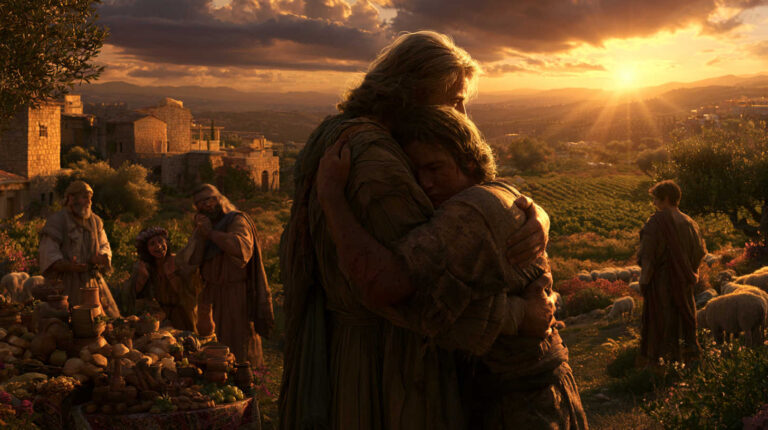
The most memorable detail in this parable is verse 37: the master “will dress himself to serve, will have them recline at the table and will come and wait on them.” In the culture of the time, this was almost unthinkable. Masters did not serve slaves; slaves served masters. Jesus deliberately inverts the expected social order to reveal something essential about His own character and about grace.
This scene foreshadows John 13:4-5, where Jesus actually ties a towel around His waist and washes His disciples’ feet — the same girding language used in Luke 12:35. It also echoes His statement in Mark 9:35 that whoever wants to be first must become “servant of all.” The parable isn’t only about believers watching for Christ; it’s a preview of Christ’s own humility, and a promise that faithful waiting will be met with a reward far greater than anyone would expect — the King Himself serving His people.
Words of Warning: The Thief Illustration
Verses 39-40 switch metaphors abruptly, moving from a beloved master to an unwelcome thief. The contrast is deliberate:
| Master/Servant Image | Owner/Thief Image |
|---|---|
| Represents a welcomed arrival | Represents an unwanted intrusion |
| The master owns the house | The “owner” stands to lose the house |
| Servants are rewarded | The homeowner suffers loss |
| Built on relationship and trust | Built on ignorance and unpreparedness |
The difference between the two pictures is relationship. Servants who know and love their master watch eagerly for him. A homeowner who doesn’t know when a thief is coming has no such eager anticipation — only vulnerability. Jesus is showing that the Second Coming will feel entirely different depending on whether a person is spiritually ready or not: for the prepared, it’s a joyful reunion; for the unprepared, it’s a devastating surprise.
This thief imagery recurs throughout the New Testament, reinforcing how central the theme was to early Christian teaching: Matthew 24:43-44, 1 Thessalonians 5:2, 2 Peter 3:10, Revelation 3:3, and Revelation 16:15 all use the same picture.
Peter’s Question and the Faithful Manager
Immediately after this parable, in Luke 12:41, Peter asks a pointed question: “Lord, are you telling this parable to us, or to everyone?” Jesus doesn’t give him a simple yes or no. Instead, He describes a “faithful and wise manager” whom the master puts in charge of distributing food to the household. If that manager is found doing his job properly when the master returns, he’ll be given even greater responsibility (Luke 12:42-44).
Jesus’s refusal to answer Peter directly seems intentional — the principle applies to everyone with a role to play in God’s household, not just to the original twelve disciples. The passage continues (Luke 12:45-48) with a warning about a servant who assumes his master is delayed, then abuses his fellow servants and indulges himself.
That servant faces severe consequences, and the parable closes with a principle that echoes through the rest of Scripture: “From everyone who has been given much, much will be demanded; and from the one who has been entrusted with much, much more will be asked” (Luke 12:48).
Comparing Similar Parables
The Parable of the Watchful Servants belongs to a family of “wisdom and readiness” parables Jesus told. Comparing them highlights different angles on the same core message.
| Parable | Reference | Main Focus |
|---|---|---|
| The Ten Virgins | Matthew 25:1-13 | Preparedness vs. unpreparedness before a wedding |
| The Talents | Matthew 25:14-30 | Faithful use of what’s entrusted |
| The Rich Fool | Luke 12:13-21 | Danger of worldly-minded security |
| The Wicked Vinedressers | Matthew 21:33-46 | Response to the owner’s returning representatives |
| The Rich Man and Lazarus | Luke 16:19-31 | Consequences of total unpreparedness |
| The Minas | Luke 19:11-27 | Faithfulness while the master is away |
| The Faithful and Evil Servant | Matthew 24:45-51 | Contrast between wise and abusive stewardship |
Each of these stories reinforces the same underlying warning: the timing of Christ’s return is unknown, so faithfulness has to be a constant posture, not a last-minute scramble.
Practical Lessons for Today
1. Faithfulness over inactivity. The parable doesn’t reward servants for guessing the correct hour of the master’s return — it rewards them for staying faithful regardless of how long the wait lasts. Spiritual consistency, not sporadic bursts of devotion, is what’s being commended.
2. Readiness is inward, not just outward. Keeping a lamp lit takes ongoing effort: refilling oil, trimming wicks, guarding against wind. In the same way, spiritual readiness isn’t a one-time decision but a series of daily choices — prayer, honesty, service, and obedience.
3. The unknown timing is intentional. Nobody, throughout history, has correctly predicted the timing of Christ’s return, and Scripture indicates that’s by design. The uncertainty is meant to produce ongoing faithfulness rather than anxious date-setting.
4. Grace flows both ways. The image of the master serving the servants is a picture of grace — a reminder that God’s kingdom operates on different values than the world’s, where status and honor run in reverse of human expectation.
5. Much is expected from those given much. The parable ends with a principle of accountability tied to opportunity and knowledge. Believers who have access to Scripture, teaching, and spiritual community carry a responsibility to live it out.
Frequently Asked Questions
Luke 12:41 shows Peter asking whether the parable was meant for the disciples or for everyone. Jesus’s response implies it applies broadly to His disciples and the crowds gathered around Him.
This surprising role reversal illustrates the humility and grace of Jesus, foreshadowing His later act of washing His disciples’ feet, and shows that faithful waiting is met with abundant, unexpected reward.
The burning lamps symbolize ongoing spiritual vigilance and obedience to God’s Word, referencing Psalm 119:105, which calls Scripture “a lamp to my feet and a light to my path.”
Both parables use the imagery of a wedding and lamps to teach the same core lesson — preparedness for an unexpected arrival — though the Ten Virgins parable focuses more heavily on the consequences of being caught unprepared.
It illustrates the sudden, unpredictable nature of Christ’s Second Coming, a comparison repeated throughout the New Testament in passages like Matthew 24:43-44, 1 Thessalonians 5:2, and Revelation 16:15.
According to the continuation of this teaching in Luke 12:45-48, a servant who assumes the master is delayed and mistreats others while indulging himself faces severe judgment when the master returns unexpectedly.
Please share this Parable of the Watchful Servants: Verse, Meaning & Lesson with your friends and do a comment below about your feedback.
We will meet you on next article.
Until you can read, Parable of the Unjust Steward: Verse, Meaning & Lesson