Celebrating Mothers: Honoring God’s Vision for Women
Motherhood holds a distinct place in Scripture — not as an afterthought, but as a role woven into the biblical narrative from Genesis through the New Testament. From a direct commandment in the Ten Commandments to poetic tributes in Proverbs, the Bible repeatedly affirms the strength, wisdom, and spiritual influence of mothers.
This guide collects the most meaningful Bible verses for honoring mothers, organized by theme, along with practical ways to put them into action — whether for a card, a toast, a church reading, or simply a quiet moment of gratitude.
Why the Bible Elevates Motherhood
Long before any culture wrote laws protecting the family, Scripture had already made honoring parents a foundational command:
Exodus 20:12 (KJV) — “Honour thy father and thy mother: that thy days may be long upon the land which the Lord thy God giveth thee.”
This is one of the Ten Commandments — placed alongside commands against theft, murder, and dishonesty. That placement alone signals how seriously the Bible treats the mother-child relationship: not as a sentimental nicety, but as a moral obligation with lasting consequences attached. The same instruction is repeated in Leviticus 19:3 and Deuteronomy 5:16, underscoring its importance across different books and contexts.
What Does the Bible Say a Mother Is?
Scripture doesn’t define motherhood narrowly. It includes biological mothers, adoptive mothers, spiritual mothers, and women who nurture and guide others without any formal title. The consistent thread across every portrayal is that motherhood involves strength, sacrifice, instruction, and enduring love — qualities the Bible treats as reflections of God’s own character.
Verses on a Mother’s Strength and Dignity
Proverbs 31 offers one of the most detailed portraits of an admirable woman anywhere in ancient literature, and several of its verses are widely used to honor mothers specifically.
Proverbs 31:25 (KJV) — “Strength and honour are her clothing; and she shall rejoice in time to come.”
Proverbs 31:28 (KJV) — “Her children arise up, and call her blessed; her husband also, and he praiseth her.”
The word translated “praise” in this passage doesn’t mean simple flattery — it carries the sense of publicly commending or boasting about someone’s worth. The picture painted is of a woman whose daily labor and character are visible enough that her own family openly acknowledges it, rather than taking it for granted.
Proverbs 31:31 (KJV) — “Give her of the fruit of her hands; and let her own works praise her in the gates.”
In the ancient world, the city gate was where public business and judgments took place — a woman’s works being “praised in the gates” meant her reputation and contribution were recognized in the most public spaces of community life, not just within her own household.
Verses on Faith Passed Through Generations
One of the most striking things Scripture says about mothers is that their influence often outlasts their lifetime, particularly in matters of faith.
2 Timothy 1:5 (KJV) — “When I call to remembrance the unfeigned faith that is in thee, which dwelt first in thy grandmother Lois, and thy mother Eunice; and I am persuaded that in thee also.”
This verse, written by Paul from prison to his protégé Timothy, traces a living faith across three generations of women. It’s a reminder that a mother’s spiritual example doesn’t stop with her own children — it can shape grandchildren and beyond, long after any individual conversation or lesson is forgotten.
Deuteronomy 6:6–7 (KJV) — “And these words… shall be in thine heart: And thou shalt teach them diligently unto thy children, and shalt talk of them when thou sittest in thine house, and when thou walkest by the way.”
This instruction treats spiritual formation as woven into ordinary daily life — mealtimes, walks, bedtime — rather than confined to formal teaching moments. It’s one of the clearest biblical pictures of what intentional, everyday discipleship within a family actually looks like.
Verses on Comfort and Nurture
Scripture repeatedly uses maternal imagery to describe God’s own care — a striking choice, since it means the Bible treats a mother’s comfort as one of the clearest available pictures of divine love.
Isaiah 66:13 (KJV) — “As one whom his mother comforteth, so will I comfort you.”
Isaiah 49:15 (KJV) — “Can a woman forget her sucking child, that she should not have compassion on the son of her womb? yea, they may forget, yet will I not forget thee.”
Isaiah 40:11 (KJV) — “He shall gather the lambs with his arm, and carry them in his bosom, and shall gently lead those that are with young.”
These three verses together form one of the more tender threads in the Old Testament — using a mother’s instinctive protection and memory of her child as the closest available comparison to God’s own faithfulness toward His people.
Verses on Children as a Gift
Psalm 127:3 (KJV) — “Lo, children are an heritage of the Lord: and the fruit of the womb is his reward.”
This verse reframes children not as a burden or an inconvenience to personal ambition, but as something given — a perspective that reshapes how sacrifice and exhaustion in motherhood are understood. The verses that follow (Psalm 127:4–5) compare children to arrows, useful and purposeful, eventually sent out into the world rather than kept indefinitely close.
Psalm 139:13–14 (KJV) — “For thou hast possessed my reins: thou hast covered me in my mother’s womb. I will praise thee; for I am fearfully and wonderfully made.”
This passage is often used to highlight the intimate, intentional nature of a mother’s role from the earliest stage of life — pregnancy itself framed as a place where God is already actively at work.
Verses on a Mother’s Instruction
Proverbs 1:8–9 (KJV) — “My son, hear the instruction of thy father, and forsake not the law of thy mother: For they shall be an ornament of grace unto thy head, and chains about thy neck.”
Proverbs 6:20 (KJV) — “My son, keep thy father’s commandment, and forsake not the law of thy mother.”
Both verses place a mother’s teaching on equal footing with a father’s — an intentional pairing throughout Proverbs that treats maternal wisdom as authoritative, not supplementary.
A Quick-Reference Table of Verses by Theme
| Theme | Key Verse | Reference |
|---|---|---|
| Command to honor mothers | “Honour thy father and thy mother” | Exodus 20:12 |
| Strength and dignity | “Strength and honour are her clothing” | Proverbs 31:25 |
| Public recognition | “Let her own works praise her in the gates” | Proverbs 31:31 |
| Generational faith | “Faith… dwelt first in thy grandmother… and thy mother” | 2 Timothy 1:5 |
| Comfort | “As one whom his mother comforteth, so will I comfort you” | Isaiah 66:13 |
| Children as gift | “Children are an heritage of the Lord” | Psalm 127:3 |
| Instruction | “Forsake not the law of thy mother” | Proverbs 1:8 |
| Formation before birth | “Thou hast covered me in my mother’s womb” | Psalm 139:13 |
| Everyday discipleship | “Talk of them when thou sittest in thine house” | Deuteronomy 6:7 |
| Grandparents’ honor | “Children’s children are the crown of old men” | Proverbs 17:6 |
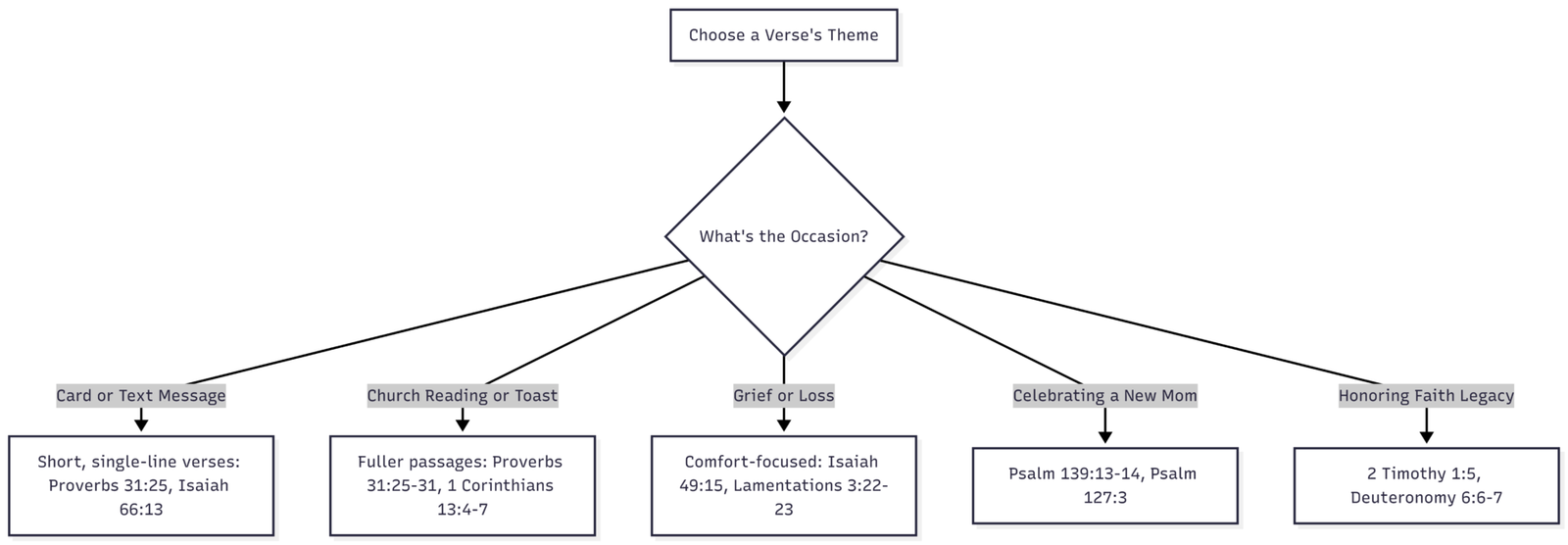
How These Verses Are Commonly Used
Practical Ways to Honor a Mother This Year
Beyond a card or a meal, Scripture-based gestures can carry lasting meaning:
- Write out a full verse by hand. A handwritten passage — such as Proverbs 31:25–31 or 2 Timothy 1:5 — carries more weight than a printed quote, especially framed or included inside a card.
- Share a specific memory tied to a verse. Pairing Isaiah 66:13 (“as a mother comforts her child”) with an actual memory of being comforted makes the verse personal rather than generic.
- Read a passage aloud together. For families that gather on Mother’s Day, reading Proverbs 31:25–31 or Psalm 127 aloud as a group creates a shared moment rather than a private read.
- Acknowledge non-biological mothers. Spiritual mothers, stepmothers, grandmothers, and mother figures often go unacknowledged on a day centered on biological motherhood — verses like Ruth 1:16 (on Ruth’s devotion to Naomi) speak directly to chosen, non-biological family bonds.
- Be sensitive to grief. Mother’s Day can be difficult for those grieving a mother, navigating infertility, or estranged from family. A verse like Isaiah 49:15 or Lamentations 3:22–23, which center on comfort rather than celebration, can be a more appropriate choice in these situations.
A Note for Those Who Find This Day Difficult
Not everyone experiences Mother’s Day as a straightforward celebration. Some are grieving a mother’s death, walking through infertility or pregnancy loss, estranged from family, or longing to become mothers themselves.
Scripture doesn’t ignore this reality — many of its most tender verses about maternal comfort were written specifically in the context of loss, exile, or unmet longing. If this describes your experience this year, verses like Isaiah 49:15 and Lamentations 3:22–23 speak directly into grief rather than past it, and are worth sitting with as much as the more celebratory passages above.
Frequently Asked Questions
Proverbs 31:28 (“Her children arise up, and call her blessed”) and Exodus 20:12 (“Honour thy father and thy mother”) are the two most frequently quoted, one poetic and one commanded.
Ruth 1:16, describing Ruth’s devotion to her mother-in-law Naomi, is commonly used to honor non-biological maternal relationships, along with 1 Thessalonians 2:7, which describes spiritual caregiving in maternal terms.
Isaiah 66:13, Proverbs 31:25, and Psalm 127:3 are all short enough to fit inside a card while still carrying clear meaning on their own.
Proverbs 31:31 (“let her own works praise her in the gates”) and Hebrews 6:10, on God not forgetting labor done in love, are often used to honor the memory of a mother who has died.
A Legacy Worth Celebrating
Whether celebrated with a card, a shared meal, or a quiet prayer, honoring a mother through Scripture connects a single day to something much larger — a pattern the Bible traces across generations, from Eunice to Timothy, from a Proverbs 31 household to a modern kitchen table.
Choose one verse from the list above that best reflects the mother in your life, and let it be more than a quote: let it be the start of a conversation, a memory shared, or a moment of honor that outlasts the day itself.
Please share this Celebrating Mothers: Honoring God’s Vision for Women your friends and do a comment below about your feedback.
We will meet you on next article.
Until you can read, The 22 Most Popular Bible Verses About Love