
The 20 Most Popular Forgiveness Bible Verses
Forgiveness is one of the most repeated themes in Scripture, and also one of the hardest to live out. The Bible speaks to two sides of forgiveness: receiving God’s complete forgiveness for personal sin, and extending that same grace to people who have caused pain. Both sides are inseparable — Scripture consistently ties the forgiveness believers receive to the forgiveness they are called to give.
This guide compiles the 20 most popular Bible verses on forgiveness, organized by theme, with reflection on how each applies to real relationships, resentment, and healing. A quick-reference table, a practical framework for working through unforgiveness, and an FAQ section are included for easy navigation.
Why Forgiveness Is Central to Scripture
Unforgiveness carries a real cost. Bitterness left unaddressed tends to grow, affecting relationships, health, and peace of mind long after the original offense. Scripture treats forgiveness not as an optional virtue but as a core practice of faith, directly connected to a person’s own experience of being forgiven.
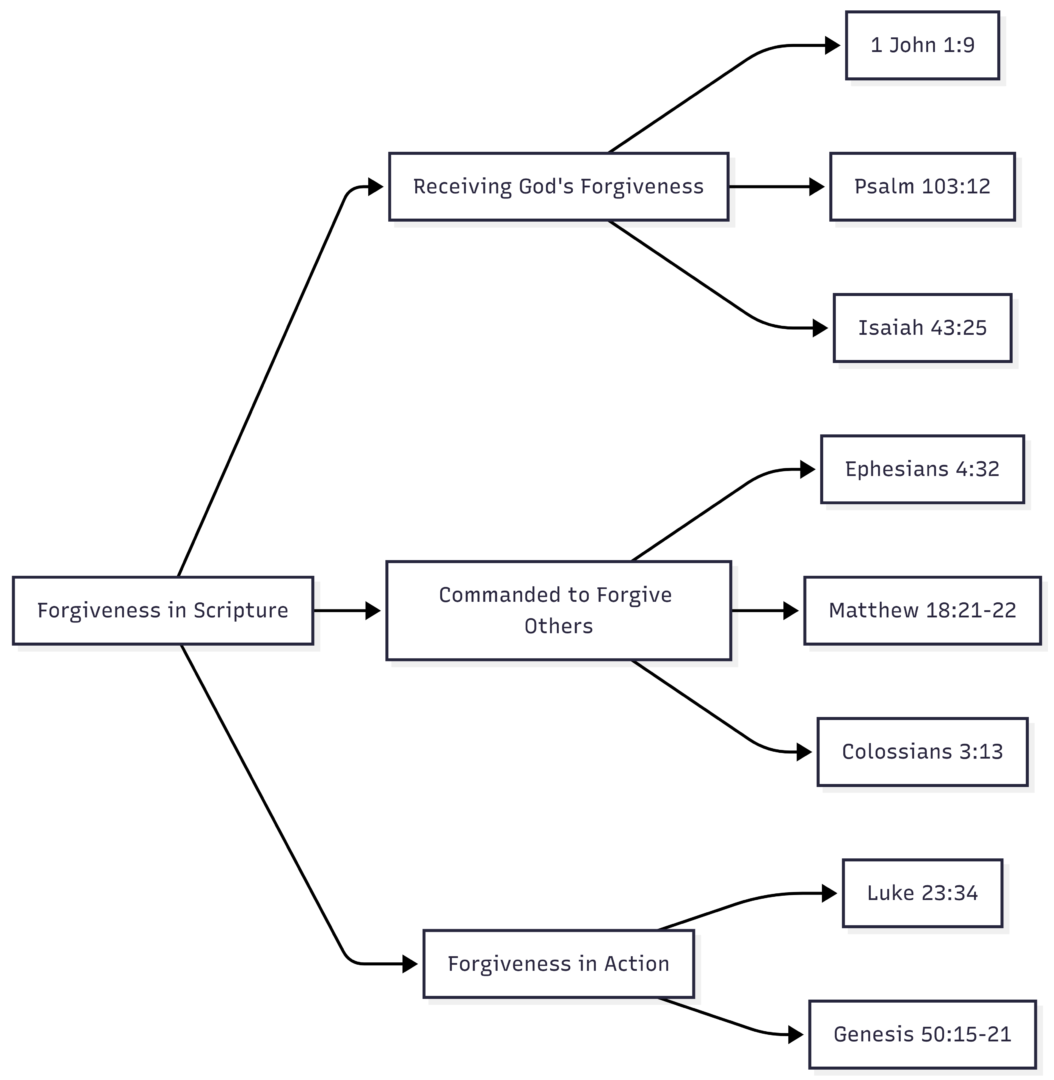
The verses below fall into three broad categories: verses about receiving God’s forgiveness, verses commanding believers to forgive others, and verses that describe forgiveness in action through biblical examples such as Jesus on the cross and Joseph forgiving his brothers.
The 20 Most Popular Forgiveness Bible Verses
Receiving God’s Forgiveness
1. 1 John 1:9
“If we confess our sins, he is faithful and just to forgive us our sins and to cleanse us from all unrighteousness.”
This verse establishes the starting point for forgiveness: acknowledging personal sin before extending grace to others. Confession, not denial, is the doorway to being cleansed.
2. Psalm 103:12
“As far as the east is from the west, so far has he removed our transgressions from us.”
This verse illustrates the completeness of God’s forgiveness using a distance that has no fixed endpoint, unlike north and south, which eventually meet at the poles.
3. Isaiah 43:25
“I, even I, am he who blots out your transgressions, for my own sake, and remembers your sins no more.”
God’s forgiveness includes forgetting, not just pardoning. This verse challenges the instinct to hold onto guilt long after it has been addressed.
4. Ephesians 1:7
“In him we have redemption through his blood, the forgiveness of our trespasses, according to the riches of his grace.”
This verse ties forgiveness directly to Christ’s sacrifice, framing it as something purchased rather than earned through personal effort.
5. Isaiah 1:18
“Though your sins are like scarlet, they shall be as white as snow; though they are red as crimson, they shall be like wool.”
A vivid image of complete transformation, this verse reassures that no sin is too significant to be fully forgiven.
6. Micah 7:18-19
“You will again have compassion on us; you will tread our sins underfoot and hurl all our iniquities into the depths of the sea.”
This verse reinforces the permanence of God’s forgiveness, describing sin as being discarded rather than merely set aside.
Commanded to Forgive Others
7. Ephesians 4:32
“Be kind to one another, tenderhearted, forgiving one another, as God in Christ forgave you.”
This verse links kindness and forgiveness directly to the model of Christ, making forgiveness a response to grace already received rather than a favor extended from a position of superiority.
8. Colossians 3:13
“Bearing with one another and, if one has a complaint against another, forgiving each other; as the Lord has forgiven you, so you also must forgive.”
This verse assumes ongoing conflict is part of relationships and frames patience and forgiveness as the expected response, not the exception.
9. Matthew 6:14-15
“For if you forgive others their trespasses, your heavenly Father will also forgive you, but if you do not forgive others their trespasses, neither will your Father forgive your trespasses.”
One of the most direct statements in Scripture, this verse ties personal forgiveness of others to a person’s own relationship with God.
10. Matthew 18:21-22
“I do not say to you seven times, but seventy-seven times.”
When asked for a specific limit on forgiveness, Jesus responds with a number meant to communicate no limit at all, rather than a literal count.
11. Luke 17:3-4
“If your brother sins, rebuke him, and if he repents, forgive him… you must forgive him.”
This verse pairs forgiveness with accountability, showing that forgiveness does not require ignoring wrongdoing, but responding to repentance with grace.
12. Mark 11:25
“And whenever you stand praying, forgive, if you have anything against anyone, so that your Father also who is in heaven may forgive you your trespasses.”
This verse connects forgiveness directly to prayer, suggesting it should be a regular, ongoing practice rather than a one-time decision.
13. Luke 6:37
“Forgive, and you will be forgiven.”
This short, direct statement reinforces the reciprocal nature of forgiveness found throughout the Gospels.
Forgiveness in Action and Practical Application
14. Luke 23:34
“Father, forgive them, for they know not what they do.”
Spoken by Jesus during his crucifixion, this verse models forgiveness extended toward people who were not seeking it and had shown no remorse.
15. Luke 7:47
“Her sins, which are many, are forgiven — for she loved much. But he who is forgiven little, loves little.”
This verse suggests that a deep awareness of one’s own forgiveness produces a greater capacity to love and forgive others.
16. 2 Corinthians 2:5-8, 10
“You should rather turn to forgive and comfort him… Anyone whom you forgive, I also forgive.”
Paul’s instruction to the Corinthian church models forgiveness as a communal responsibility, not just an individual one.
17. Genesis 50:15-21
“Do not fear, for am I in the place of God?… You meant evil against me, but God meant it for good.”
Joseph’s response to his brothers, who had sold him into slavery years earlier, is one of the clearest biblical examples of forgiveness offered despite significant, prolonged harm.
18. Proverbs 17:9
“Whoever would foster love covers over an offense, but whoever repeats the matter separates close friends.”
This verse addresses a practical relational pattern: repeatedly bringing up past offenses damages relationships more than the original offense itself.
19. Romans 12:19
“Do not take revenge, my dear friends, but leave room for God’s wrath, for it is written: ‘It is mine to avenge; I will repay,’ says the Lord.”
This verse redirects the desire for retribution, placing judgment in God’s hands rather than the offended person’s.
20. Proverbs 28:13
“Whoever conceals their sins does not prosper, but the one who confesses and renounces them finds mercy.”
This verse closes the loop between receiving and extending forgiveness, showing that honesty about wrongdoing — one’s own — is a prerequisite for mercy.
Quick Reference Table
| # | Reference | Category | Core Message |
|---|---|---|---|
| 1 | 1 John 1:9 | Receiving | Confession brings cleansing |
| 2 | Psalm 103:12 | Receiving | Complete removal of sin |
| 3 | Isaiah 43:25 | Receiving | Sins remembered no more |
| 4 | Ephesians 1:7 | Receiving | Redemption through grace |
| 5 | Isaiah 1:18 | Receiving | Full transformation |
| 6 | Micah 7:18-19 | Receiving | Sins cast away permanently |
| 7 | Ephesians 4:32 | Commanded | Forgive as Christ forgave |
| 8 | Colossians 3:13 | Commanded | Bear with one another |
| 9 | Matthew 6:14-15 | Commanded | Reciprocal forgiveness |
| 10 | Matthew 18:21-22 | Commanded | Limitless forgiveness |
| 11 | Luke 17:3-4 | Commanded | Forgiveness with accountability |
| 12 | Mark 11:25 | Commanded | Forgiveness during prayer |
| 13 | Luke 6:37 | Commanded | Forgive to be forgiven |
| 14 | Luke 23:34 | In Action | Forgiveness without remorse shown |
| 15 | Luke 7:47 | In Action | Awareness produces love |
| 16 | 2 Corinthians 2:5-10 | In Action | Communal forgiveness |
| 17 | Genesis 50:15-21 | In Action | Forgiveness after prolonged harm |
| 18 | Proverbs 17:9 | Practical | Let go rather than repeat offenses |
| 19 | Romans 12:19 | Practical | Leave revenge to God |
| 20 | Proverbs 28:13 | Practical | Confession before mercy |
A Practical Framework for Working Through Unforgiveness
Forgiveness is rarely a single decision made once and never revisited; it is often a process, especially after deep hurt. The following framework, grounded in the verses above, offers a starting point:
| Step | Action | Supporting Verse |
|---|---|---|
| 1 | Acknowledge personal need for forgiveness first | 1 John 1:9 |
| 2 | Name the specific hurt honestly, without minimizing it | Psalm 38:3-4 |
| 3 | Choose to release the desire for revenge | Romans 12:19 |
| 4 | Extend forgiveness even without an apology | Luke 23:34 |
| 5 | Avoid repeating the offense to others or in your own mind | Proverbs 17:9 |
| 6 | Revisit the decision to forgive as needed, especially in prayer | Mark 11:25 |
This process does not require forgetting that harm occurred, nor does it require restoring a relationship to its previous state, especially in situations involving ongoing abuse or danger. Forgiveness releases a person from the burden of resentment; it does not obligate continued exposure to harm. Anyone navigating forgiveness in the context of abuse or an unsafe relationship should seek guidance from a trusted counselor, pastor, or professional alongside prayer and reflection.
Frequently Asked Questions
Not necessarily. Forgiveness addresses the internal release of resentment and the choice not to seek revenge. Reconciliation involves restoring a relationship and requires safety, trust, and often repentance from the offending party. Scripture calls for forgiveness in all cases, but reconciliation is not always appropriate or safe.
Luke 23:34, where Jesus forgives those crucifying him without any expression of remorse from them, is the clearest model of forgiveness extended independent of an apology.
Matthew 18:21-22 addresses this directly. When Peter asks whether seven times is sufficient, Jesus responds with “seventy-seven times,” a number meant to signal there is no practical limit rather than a literal count to track.
Isaiah 43:25 and Hebrews 8:12 both describe God not only forgiving sin but choosing not to remember it, illustrating a complete rather than partial pardon.
Start by acknowledging the depth of the hurt honestly rather than minimizing it, then work through forgiveness as an ongoing process rather than a single moment, using verses like Romans 12:19 and Mark 11:25 as anchors. Speaking with a counselor or pastor alongside this process can also provide helpful support, especially after significant trauma.
Final Thoughts
Forgiveness runs through the entire narrative of Scripture, from the earliest accounts of reconciliation between siblings to Christ’s own words from the cross. These 20 verses offer both the theological foundation for why forgiveness matters and practical guidance for extending it, even when it feels far from natural. Returning to these verses regularly, rather than only in moments of crisis, builds a steady framework for releasing resentment and walking in the same grace that has already been extended.
Please share this The 20 Most Popular Forgiveness Bible Verses with your friends and do a comment below about your feedback.
We will meet you on next article.
Until you can read, The 20 Most Popular Favorite Bible Verses for Women