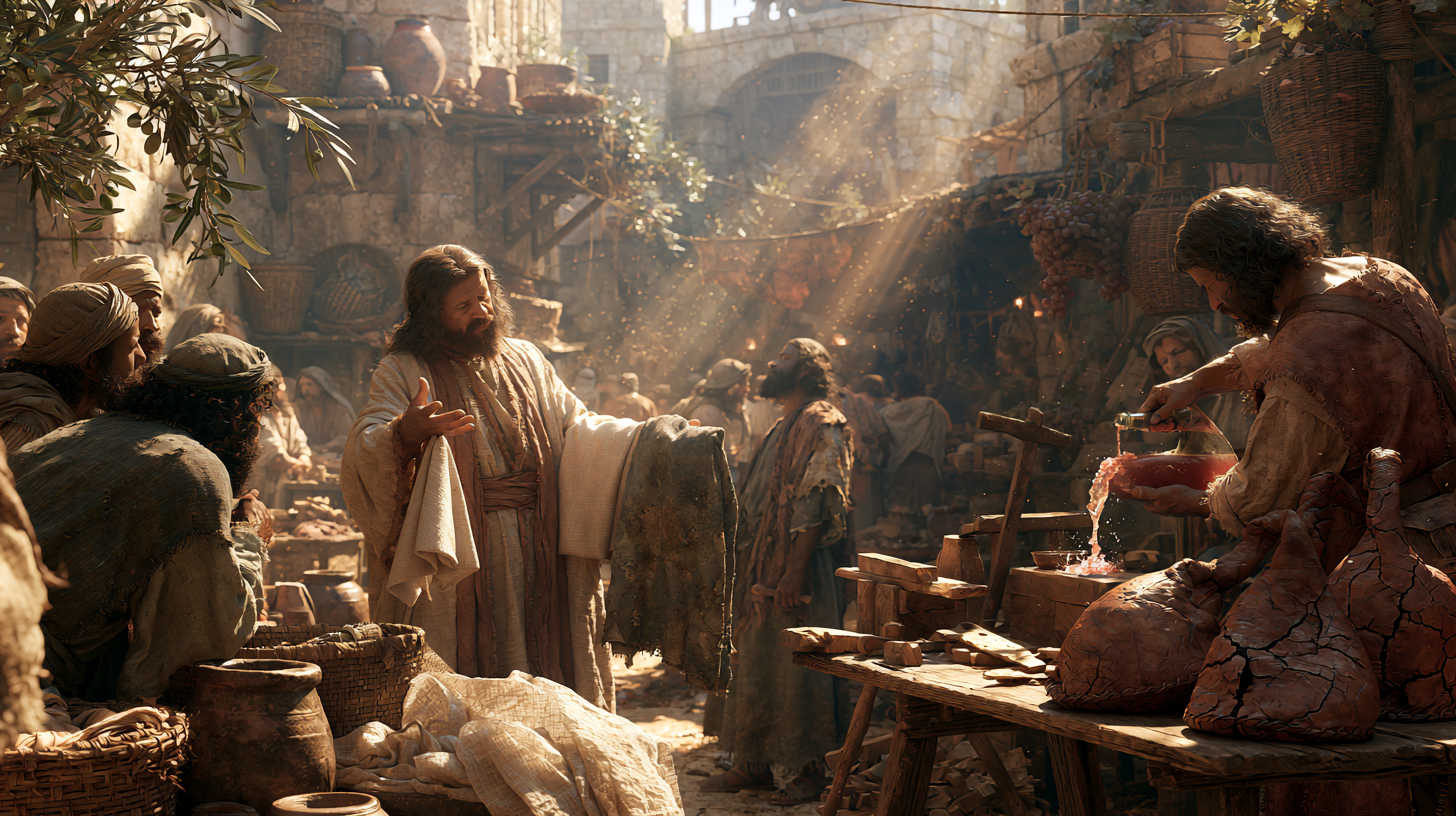
Parable of the New Cloth and New Wineskins: Verse, Meaning & Lesson
The twin parables of the New Cloth and New Wineskins appear in all three synoptic Gospels — Matthew 9:16-17, Mark 2:21-22, and Luke 5:36-39. Using two everyday images familiar to any first-century listener, Jesus makes a single, sharp point: his message cannot simply be patched onto old religious systems without destroying both.
This guide walks through the full text of the parable across all three Gospels, the specific question that prompted it, its two major interpretations, and the practical lessons it offers about grace, tradition, and change. A summary table and FAQ section are included for quick reference.
The Verse: Matthew 9:16-17, Mark 2:21-22, and Luke 5:36-39
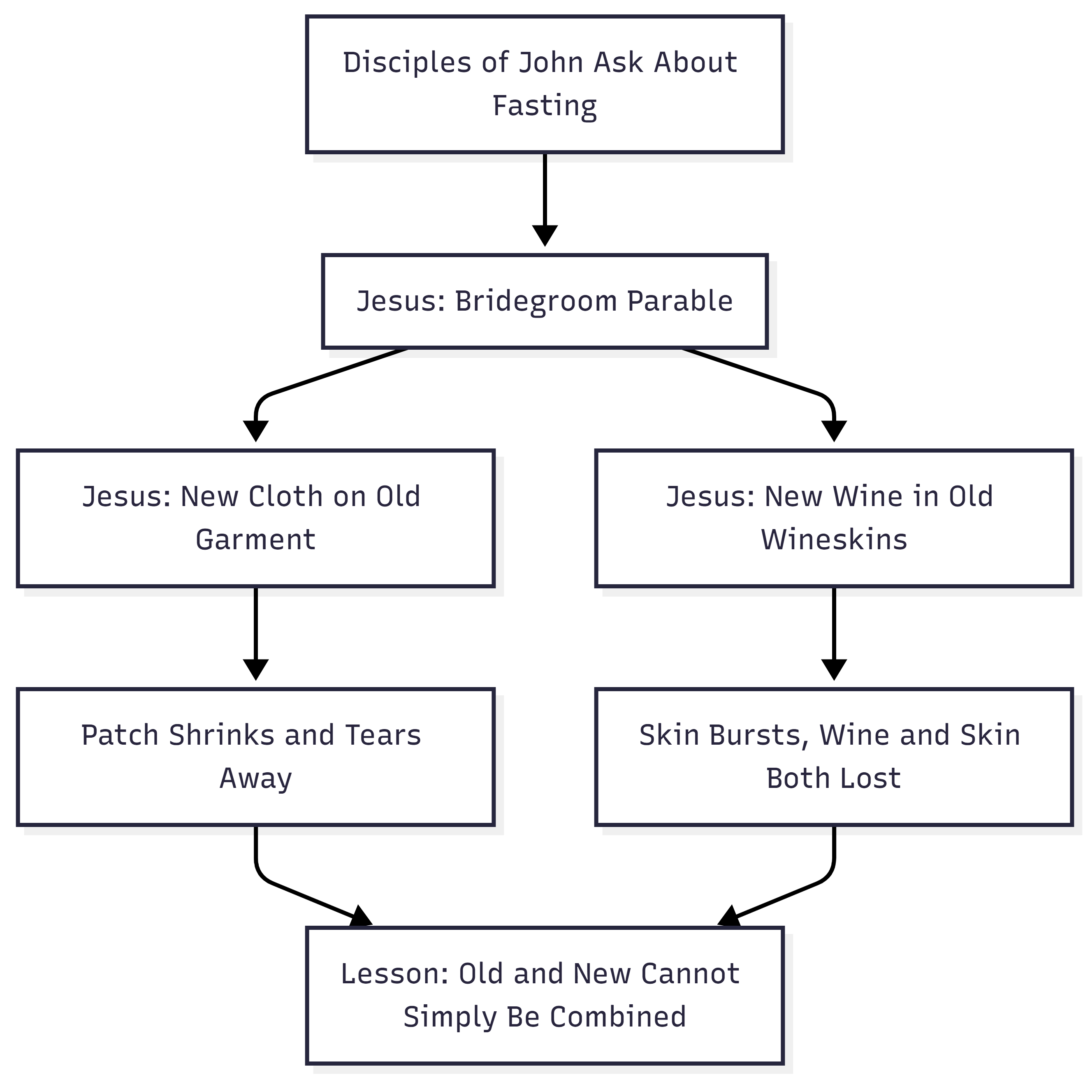
Matthew’s account reads: “No one sews a patch of unshrunk cloth on an old garment, for the patch will pull away from the garment, making the tear worse. Neither do people pour new wine into old wineskins. If they do, the skins will burst; the wine will run out and the wineskins will be ruined. No, they pour new wine into new wineskins, and both are preserved.”
Mark’s version is nearly identical, adding the detail that the patch specifically shrinks before tearing away. Luke’s account includes an additional line not found in the other two Gospels: “No one after drinking old wine immediately desires new, for he says, ‘The old is better.'” This extra sentence adds a layer of commentary on human resistance to change that is missing from Matthew and Mark’s parallel accounts.
The Question That Prompted the Parable
This teaching does not stand alone. In all three Gospels, it follows a direct question from the disciples of John the Baptist: “Why do we and the Pharisees fast often, but your disciples do not fast?” (Matthew 9:14). Jesus first answers with a short parable of his own — comparing himself to a bridegroom whose wedding guests would not mourn while he is present, only after he is “taken away” — before moving into the cloth and wineskin illustrations.
Under Mosaic Law, only one day of required fasting existed annually, the Day of Atonement (Leviticus 16:29, 31). The frequent fasting practiced by John’s disciples and the Pharisees was not commanded by the law itself but was one of the many “traditions of the elders” (Mark 7:3) layered on top of it.
The Pharisees had adopted a custom of fasting twice weekly, and it appears John’s disciples had adopted a similar pattern. Jesus’s disciples, by contrast, were known for eating with tax collectors and sinners rather than observing this additional ritual (Matthew 9:11).
Historical Background on Wineskins and Cloth
Understanding the parable requires knowing how wineskins functioned in the ancient world. Wineskins were made from tanned animal hide — typically goat or sheep skin — sewn closed at the points where legs and tail had been removed.
When freshly pressed grape juice (must) was placed in a new wineskin, the skin’s elasticity allowed it to stretch as fermentation produced gas and expanded the liquid’s volume. An old wineskin, having already been stretched to its limit during a previous use, lost this elasticity. Filling it with new, still-fermenting wine would cause it to burst under the pressure, ruining both the skin and the wine it held.
The cloth illustration works on a similar principle. Unshrunk (unwashed) fabric naturally shrinks the first time it is washed. If a patch of new, unshrunk cloth is sewn onto an older garment, the patch will shrink after washing, pulling away from the surrounding fabric and tearing the hole even wider than before repair.
Both images share the same underlying lesson: attempting to combine something new with something old, without adapting the container or garment itself, destroys both rather than preserving either.
Two Interpretations of the Parable
Because this parable is explicitly tied to a question about fasting, scholars have proposed two related but distinct interpretations.
The Primary Interpretation: Old Covenant vs. New Covenant
Most commentators read this parable as illustrating the incompatibility between the Old Covenant, characterized by the Mosaic Law and its accumulated traditions, and the New Covenant of grace through faith in Christ.
In this reading, the new cloth and new wine represent the gospel message Jesus brings, while the old garment and old wineskins represent the legalistic, works-based religious system of the Pharisees.
Under this interpretation, Jesus is not suggesting his teaching should be treated as a minor addition or improvement to existing Jewish religious practice. Instead, he is establishing something categorically new — a covenant that cannot be grafted onto a system built around earning righteousness through strict adherence to rules. Attempting the combination tears both apart: it corrupts the purity of grace while also failing to satisfy the demands of the law.
The Secondary Interpretation: Fasting and Feasting as Incompatible Postures
A smaller number of scholars note that the passage immediately preceding this parable deals specifically with fasting and feasting, not explicitly with the Old and New Covenants as theological systems.
Under this reading, Jesus’s point is narrower: fasting (a posture of mourning) and feasting (a posture of celebration) are simply contradictory behaviors that cannot be performed simultaneously. While Jesus, the bridegroom, remains present, celebration is appropriate; fasting will become appropriate only once he departs.
Both interpretations agree on the underlying principle of incompatibility — old and new, or fasting and feasting, cannot be mixed without one destroying the other. They differ mainly in how broadly that principle is applied: to an entire covenantal system, or more narrowly to a specific question about religious practice.
Comparing the Two Interpretations
| Element | Covenant Interpretation | Fasting/Feasting Interpretation |
|---|---|---|
| Scope | Old Covenant (Law) vs. New Covenant (Grace) | Fasting vs. feasting as contradictory postures |
| New cloth/wine represents | The gospel of grace through Christ | Joyful celebration during the bridegroom’s presence |
| Old garment/wineskins represent | Legalistic Jewish tradition | Mourning and fasting appropriate after the bridegroom departs |
| Support in immediate context | Broader theological reading of Jesus’s mission | Directly tied to the fasting question in verses 14-15 |
| Level of scholarly agreement | Majority view | Minority but textually grounded view |
Key Lessons from the Parable
| Lesson | Description | Supporting Verse |
|---|---|---|
| Grace and legalism cannot be combined | Attempting to earn salvation through law while also accepting grace creates internal conflict | Ephesians 2:8-9 |
| Genuine faith requires real change | Conversion is not a minor patch on an unchanged life, but a full transformation | 2 Corinthians 5:17 |
| Old traditions are not inherently worthless | The old wineskins are not condemned as evil, simply as unsuitable containers for something new | Luke 5:39 |
| Resistance to change is natural | The preference for “the old” over “the new” describes an understandable, common human tendency | Luke 5:39 |
| Jesus’s message required a new structure | The gospel could not be absorbed into existing religious frameworks without distortion | Matthew 9:17 |
Practical Application Today
This parable speaks directly to the tension between honoring tradition and embracing necessary change, both in personal faith and in religious community life.
- Examine whether faith is a genuine transformation or a surface addition. The parable warns against treating Christian faith as a minor patch applied to an otherwise unchanged life, rather than a complete renewal of perspective and priorities.
- Distinguish between core biblical truth and accumulated human tradition. Much of what Jesus challenged in this passage was not the Mosaic Law itself but additional customs layered on top of it. This distinction remains relevant when evaluating which practices reflect genuine biblical conviction versus inherited habit.
- Expect resistance to new understanding, including within yourself. Luke’s added detail — “the old is better” — acknowledges that comfort with familiar patterns is a natural human response, not evidence that the new teaching is wrong.
- Avoid trying to combine incompatible approaches to righteousness. Attempting to blend earning favor with God through personal effort and receiving it freely through grace creates the same kind of internal rupture the parable describes.
- Recognize that change, when genuine, requires new structures, not patchwork fixes. Whether in personal habits or communal practice, meaningful change sometimes requires starting fresh rather than modifying an existing system that was not built to accommodate it.
Frequently Asked Questions
The parable illustrates that Jesus’s message of grace cannot simply be added onto existing legalistic religious systems without destroying both; it requires a genuinely new framework rather than a patch on the old one.
The question about why Jesus’s disciples did not fast like John’s disciples or the Pharisees prompted Jesus to explain that his presence changed what was appropriate — celebration while the “bridegroom” was present, mourning only after his departure — using the cloth and wineskin images to reinforce the theme of incompatibility between old and new.
No. The parable does not describe the old wineskins or old garment as evil or without value; it simply illustrates that they are unsuited to contain something new. Many interpreters note that old wine is still best kept in old wineskins — the point is about compatibility, not condemnation of what came before.
This additional detail, found only in Luke 5:39, acknowledges the natural human tendency to resist new teaching in favor of the familiar, adding a layer of realistic commentary about why the Pharisees and John’s disciples may have struggled to accept Jesus’s approach.
Most interpreters identify the old wineskins as the rigid, rule-based religious traditions of first-century Judaism, and the new wine as the gospel of grace, which required a new structure — the New Covenant — rather than being absorbed into the old system.
It challenges believers to examine whether their faith reflects genuine transformation or merely an addition to an otherwise unchanged life, and cautions against blending self-effort and grace as two competing means of achieving righteousness.
Final Thoughts
The Parable of the New Cloth and New Wineskins uses two simple, physical illustrations to make a theological point with lasting significance: some things genuinely cannot be combined without one destroying the other.
Jesus’s message of grace was never meant to function as a minor repair to an existing religious system built on law and merit. It required — and still requires — a fundamentally new response, one that welcomes real transformation rather than settling for a patch that ultimately tears everything apart.
Please share this Parable of the New Cloth and New Wineskins: Verse, Meaning & Lesson with your friends and do a comment below about your feedback.
We will meet you on next article.
Until you can read, Parable of the Net: Verse, Meaning & Lesson