20 Bible Verses For When You Need Peace
Peace, in the biblical sense, is rarely just the absence of conflict. The Hebrew concept of shalom describes something fuller — wholeness, well-being, and harmony that holds steady even when circumstances are difficult. That distinction matters, because most people looking for peace aren’t hoping for problems to vanish; they’re hoping for a way to stay steady while problems remain.
These twenty verses, grouped by theme, cover three dimensions of biblical peace: the inner calm that counters anxiety, the peace available specifically during hardship, and the peace called for in relationships with other people.
What Biblical Peace Actually Means
Shalom carries a broader meaning than the English word “peace” usually implies. It points to completeness and right relationship — with God, with others, and within oneself — rather than simply a lack of noise or trouble.
Scripture treats this kind of peace as something given, not manufactured through willpower or ideal circumstances. That’s an important distinction for anyone who has tried to “just relax” during a hard season and found it doesn’t work: biblical peace isn’t a mood to talk yourself into, but something Scripture frames as coming from outside yourself, through God’s presence and promises.
Verses for Inner Peace and Anxiety
1. Philippians 4:6-7
This is likely the most cited peace verse in the Bible, instructing believers to bring anxiety to God through prayer, with thanksgiving, rather than carry it alone. The peace that follows is described as surpassing ordinary understanding — not a peace that makes logical sense given the circumstances, but one that holds regardless.
2. Isaiah 26:3
This verse ties peace directly to focus: perfect peace is promised to those whose minds stay fixed on God, because they trust him. It suggests peace isn’t unrelated to where attention rests — a wandering, worry-fixated mind and a steady, God-fixed mind produce very different internal states.
3. John 14:27
Jesus distinguishes the peace he gives from the peace the world offers, paired with a direct instruction not to let the heart be troubled or afraid. This peace isn’t contingent on external circumstances improving, which is precisely what makes it different from ordinary reassurance.
4. Romans 8:6
Paul contrasts a mind set on the flesh, which leads to death, with a mind set on the Spirit, which leads to life and peace — framing peace as connected to where attention and priorities are directed, not just external events.
5. 1 Peter 5:7
A short, direct instruction: cast every anxiety onto God, because he cares. This verse reframes anxiety as something to actively hand over rather than manage or suppress internally.
Verses for Peace During Hardship
6. John 16:33
Jesus tells his followers that tribulation in this world is certain, not a sign something has gone wrong — but pairs that honesty with peace and the assurance that he has already overcome the world. This verse doesn’t promise the absence of trouble; it promises peace within it.
7. Psalm 4:8
This verse expresses confidence in peaceful rest, specifically because God alone provides safety. It’s often cited by people struggling with anxiety-driven sleeplessness, since it directly links peace to trust rather than to circumstances being resolved.
8. Romans 15:13
Structured as a prayer, this verse asks that the God of hope would fill believers with joy and peace through trust, so that hope would overflow by the Holy Spirit’s power — linking peace directly to hope and trust rather than favorable conditions.
9. Isaiah 54:10
Using the imagery of mountains and hills being removed, this verse promises that God’s steadfast love and covenant of peace will remain even if everything else that seems permanent gives way — a peace anchored in something more stable than circumstances.
10. Matthew 11:28-30
Jesus invites the weary and burdened to come to him for rest, describing his yoke as easy and his burden as light. This passage frames peace as something found through partnership with Jesus rather than through eliminating every source of labor or difficulty.
Verses for Peace With Others
11. Romans 12:18
Paul instructs believers to live peaceably with everyone, “so far as it depends on you” — an important qualifier acknowledging that peace in relationships isn’t always fully within one person’s control, but the effort still matters.
12. Matthew 5:9
Part of the Beatitudes, this verse calls peacemakers blessed, identifying them as children of God — framing the active pursuit of peace between people as a mark of spiritual maturity, not passive conflict avoidance.
13. Colossians 3:15
This verse instructs letting the peace of Christ rule in the heart, specifically within the context of community life, paired with a call to gratitude. Peace here isn’t just personal — it’s meant to govern how a group of people function together.
14. Hebrews 12:14
This verse calls believers to actively strive for peace with everyone, paired with pursuing holiness — treating peace as something requiring ongoing effort rather than a passive default state.
15. James 3:18
This verse describes a “harvest of righteousness” as something sown in peace by those who work to make peace — connecting the practice of peacemaking directly to a positive, lasting outcome.
Verses on God as the Source of Peace
16. Numbers 6:24-26
Known as the Priestly Blessing, this passage asks for God’s protection, grace, and peace, concluding with the specific request that God would lift up his countenance and grant peace — one of the oldest and most enduring peace blessings in Scripture.
17. Isaiah 9:6
This prophetic verse names the coming Messiah “Prince of Peace” among other titles, establishing peace as a defining characteristic of Jesus’s identity rather than simply something he offers.
18. 2 Thessalonians 3:16
Paul prays that “the Lord of peace” would give peace “at all times in every way” — a phrase emphasizing that this peace isn’t limited to certain favorable seasons, but is available continuously.
19. Galatians 5:22-23
Peace is listed among the fruit of the Spirit, alongside love, joy, patience, and others — framing peace not as a technique to achieve, but as something that grows naturally as a byproduct of a Spirit-led life.
20. Romans 5:1
This verse describes peace with God specifically as a direct result of justification through faith — distinguishing this foundational peace with God from the ongoing, moment-to-moment “peace of God” described in other verses.
Verses by Theme: Quick Reference
| Verse | Theme | Core Promise |
|---|---|---|
| Philippians 4:6-7 | Anxiety | Prayer exchanges anxiety for peace beyond understanding |
| Isaiah 26:3 | Anxiety | Peace tied to a mind fixed on God |
| John 14:27 | Anxiety | A peace unlike the world’s, free of fear |
| Romans 8:6 | Anxiety | Mind set on the Spirit produces peace |
| 1 Peter 5:7 | Anxiety | Anxiety handed over, not carried alone |
| John 16:33 | Hardship | Peace amid guaranteed tribulation |
| Psalm 4:8 | Hardship | Peaceful rest through trust in God’s safety |
| Romans 15:13 | Hardship | Peace linked to hope and trust |
| Isaiah 54:10 | Hardship | A covenant of peace that outlasts everything else |
| Matthew 11:28-30 | Hardship | Rest found through partnership with Jesus |
| Romans 12:18 | Relationships | Effort toward peace with everyone |
| Matthew 5:9 | Relationships | Peacemakers called blessed |
| Colossians 3:15 | Relationships | Christ’s peace governing community life |
| Hebrews 12:14 | Relationships | Peace as something actively pursued |
| James 3:18 | Relationships | Peacemaking produces lasting good |
| Numbers 6:24-26 | Source | An ancient blessing of peace from God |
| Isaiah 9:6 | Source | Jesus identified as Prince of Peace |
| 2 Thessalonians 3:16 | Source | Peace available continuously, not seasonally |
| Galatians 5:22-23 | Source | Peace as fruit of a Spirit-led life |
| Romans 5:1 | Source | Peace with God through faith |
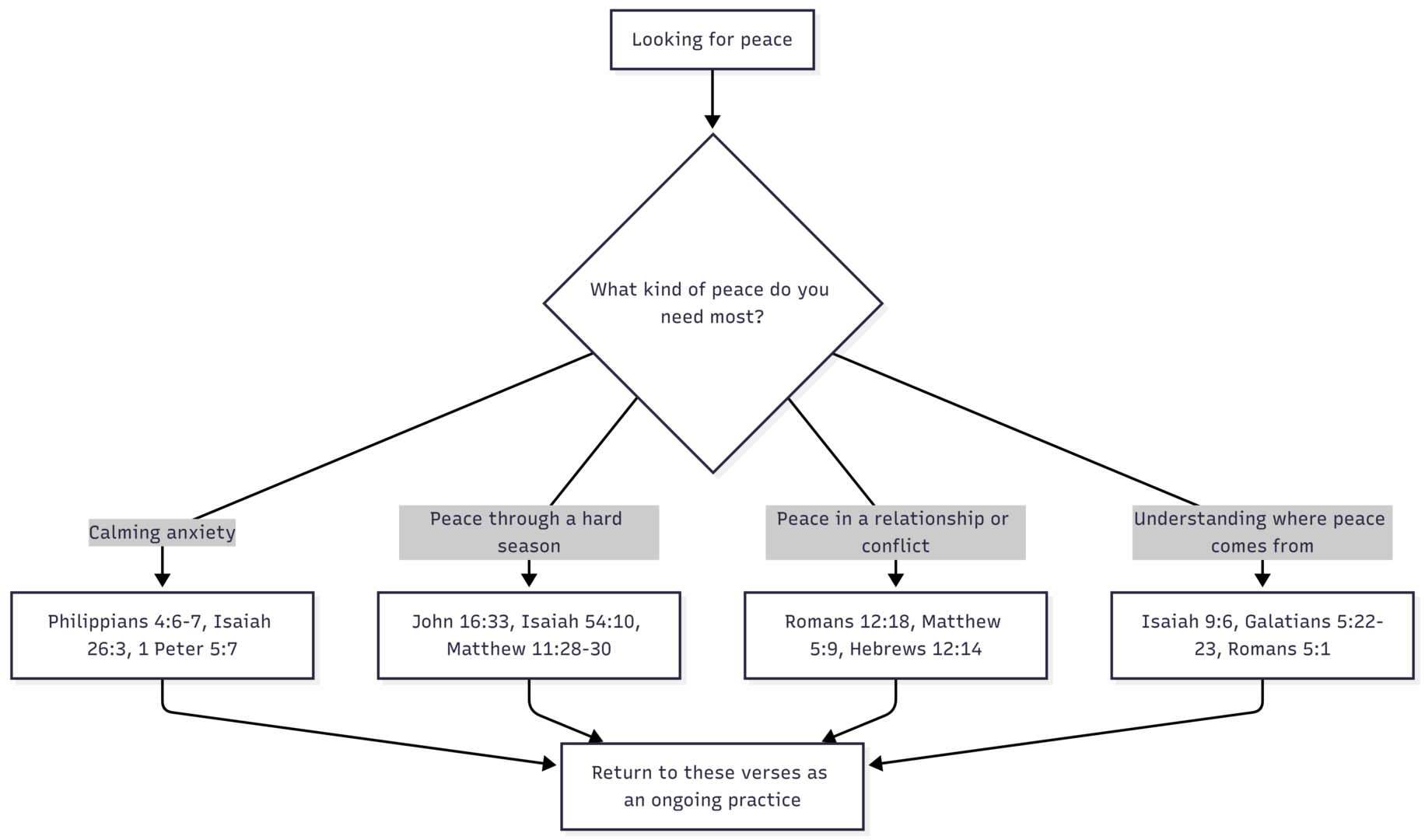
Finding the Right Verse for Your Situation
Practical Ways to Apply These Verses
- Pray Philippians 4:6-7 by name, listing the specific worry rather than praying generally — the instruction is to make requests known, not just to feel calm.
- Use Isaiah 26:3 as a redirect during a spiral of worry, deliberately shifting focus back to God rather than trying to force the anxious thought away directly.
- Apply Romans 12:18’s qualifier honestly in a strained relationship — recognizing that peace isn’t always fully achievable single-handedly, while still doing the part that is within your control.
- Return to Isaiah 54:10 during instability, especially when something that felt permanent — a job, a relationship, a health status — is shifting, as a reminder that God’s covenant of peace isn’t tied to those circumstances.
- Treat Galatians 5:22-23 as a diagnostic, not just a list — if peace feels absent, it can be a prompt to examine where attention and time are actually being spent.
Frequently Asked Questions
Philippians 4:6-7 is the most frequently cited peace verse, largely because it offers a specific, practical instruction — bringing anxiety to God through prayer — alongside the promise of a peace that surpasses understanding.
No. Verses like John 16:33 explicitly acknowledge that tribulation is guaranteed in this life. The peace offered is meant to be experienced within hardship, not as a replacement for it.
Peace with God, described in Romans 5:1, refers to reconciliation through faith — a settled, foundational relationship. The peace of God, described in passages like Philippians 4:7, refers to an ongoing, moment-to-moment sense of calm and stability available through trust in him.
Verses like Romans 12:18, Matthew 5:9, and Hebrews 12:14 frame peace as something to actively pursue in relationships with others, not just as a private internal state — treating peacemaking as a spiritual practice in its own right.
Scripture generally frames peace as something received rather than self-generated — tied to trust, prayer, and focus on God rather than willpower alone, which is why verses like Isaiah 26:3 emphasize where the mind is fixed rather than simply trying harder to feel calm.
Isaiah 54:10 speaks directly to instability, promising that God’s covenant of peace remains even if things that seem permanent — mountains and hills, in the verse’s imagery — are removed.
Peace in Scripture isn’t presented as a feeling to chase down or a set of circumstances to arrange perfectly — it’s presented as something available in the middle of anxiety, hardship, and even relational conflict, rooted in trust rather than in things going right. These twenty verses, read individually or returned to repeatedly, offer a starting point for exactly that kind of steady, durable peace.
Please share this Tips to Help You Choose Bulb Brightness and Shade with your friends and do a comment below about your feedback.
We will meet you on next article.
Until you can read, 20 Bible Verses About Having Faith in Hard Times