
Proverbs 3:5-6 — Trust in the LORD With All Your Heart
Few passages in Scripture are quoted, tattooed, and framed on walls as often as Proverbs 3:5-6. Its instruction is simple to state and genuinely difficult to practice: trust God completely, don’t rely solely on your own reasoning, acknowledge him in every decision, and he will direct your path.
The verse’s popularity sometimes works against it — familiar words get recited without being fully considered. This guide breaks the passage down phrase by phrase, places it in its full context within Proverbs 3, and looks at what actually applying it looks like in everyday decisions.
The Passage in Context
Proverbs 3:5-6 sits within a longer section (Proverbs 3:1-35) that a father addresses to his son, framed as wisdom teaching passed from one generation to the next. The chapter opens by urging the son not to forget the father’s instruction, promising that holding onto it brings a long, peaceful, and prosperous life.
It goes on to describe wisdom as more valuable than silver, gold, or rubies, and warns against relying on one’s own judgment instead of fearing the Lord. Verses 5 and 6 sit at the emotional center of this teaching — the clearest, most concentrated statement of the whole chapter’s argument: real security doesn’t come from self-reliance, but from trusting God completely.
Phrase-by-Phrase Breakdown
“Trust in the Lord with all your heart”
In Hebrew thought, the “heart” represents far more than emotion — it’s the center of a person’s will, thinking, and decision-making. This isn’t a call to feel warmly toward God; it’s an instruction to place total confidence in him at the core of how decisions actually get made. The phrase “with all your heart” rules out partial trust — trusting God with the parts of life that feel manageable while keeping tight control over the parts that feel uncertain or risky.
“And lean not on your own understanding”
This doesn’t instruct abandoning reason or common sense — Proverbs elsewhere praises wisdom and discernment repeatedly. Instead, it warns against treating personal understanding as the final authority, especially when it conflicts with what God has revealed.
Human understanding is limited by definition: it can’t see the future, can’t account for every variable, and is shaped by incomplete information and personal bias. Leaning on it exclusively means building decisions on an unstable foundation.
“In all your ways submit to him” (or “acknowledge him”)
Different translations render this phrase slightly differently — some use “acknowledge,” others “submit” or “in all your ways know him.”
The underlying idea combines both senses: actively recognizing God’s presence and authority across every area of life, not just the explicitly religious ones. This includes ordinary decisions — career choices, relationships, finances, daily plans — not only moments of crisis or major life transitions.
“And he will make your paths straight”
This is the promise attached to the preceding instructions. “Straight paths” doesn’t necessarily mean an easy or trouble-free life — elsewhere Scripture is clear that hardship is part of a life of faith. Instead, it suggests direction and clarity: a path that isn’t wandering aimlessly, even if it isn’t free of obstacles. The promise is guidance, not the absence of difficulty.
Why This Verse Resonates So Widely
Part of what makes Proverbs 3:5-6 so frequently returned to is how directly it names a universal struggle: the tension between wanting control and needing to trust something bigger than personal understanding.
Anxiety about the future, comparison to others’ progress, uncertainty about major decisions — all of these map directly onto the exact problem this verse addresses. It doesn’t offer a vague sense of comfort; it offers a specific reframe: the discomfort of not knowing everything isn’t a problem to solve through more control, but an invitation to trust.
Common Misapplications to Avoid
- Treating it as a formula for passivity. The verse doesn’t instruct doing nothing and waiting for God to act. Acknowledging God “in all your ways” implies active engagement with decisions, prayer, and wise counsel — not disengagement.
- Assuming “straight paths” means an easy life. The promise is about direction and guidance, not the absence of hardship or difficulty along the way.
- Reciting it without application. Because the verse is so familiar, it’s easy to quote without actually examining where personal understanding is currently being trusted over God — the verse’s real challenge is specific, not general.
- Ignoring the surrounding context. Read in isolation, the verse can feel abstract. Read within Proverbs 3 as a whole, it’s clearly connected to concrete instructions about generosity, integrity, and humility — trust isn’t just an internal feeling, it shows up in how a person actually treats others and handles resources.
How the Verse Connects to the Rest of Proverbs 3
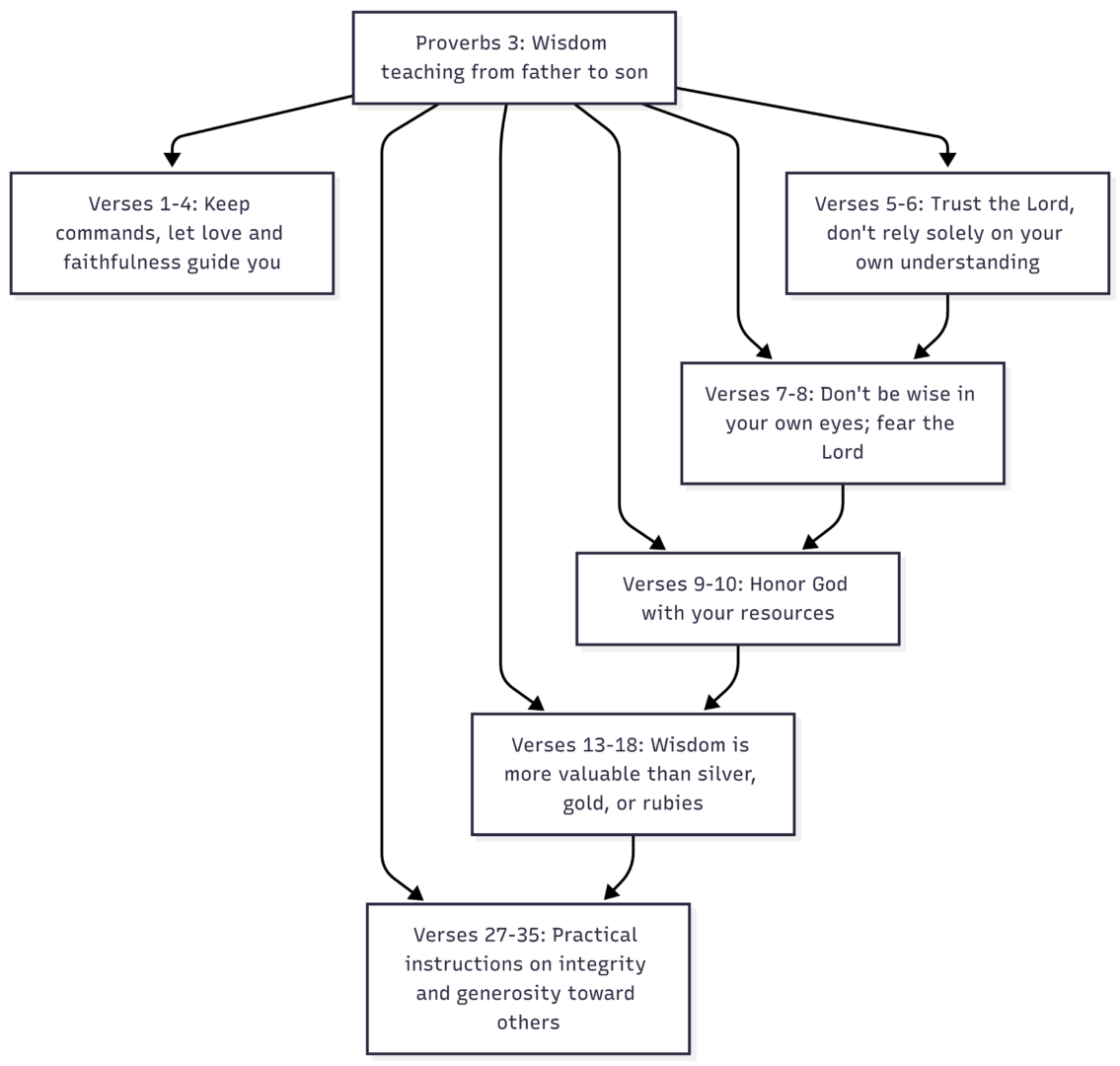
The passage builds a coherent argument: trust isn’t an isolated feeling, it’s connected to humility (not being wise in your own eyes), practical generosity (honoring God with resources), and integrity in relationships with others. Proverbs 3:5-6 is the hinge the rest of the chapter turns on.
Applying Proverbs 3:5-6 in Practice
| Life Area | What “Leaning on Own Understanding” Looks Like | What Trusting God Looks Like |
|---|---|---|
| Career decisions | Choosing solely based on salary or prestige | Weighing calling, integrity, and wisdom alongside practical factors |
| Comparison to others | Measuring worth against others’ visible progress | Trusting a personal path even when it looks different from peers’ |
| Financial choices | Controlling every dollar out of fear of scarcity | Practicing generosity as an act of trust, as verses 9-10 describe |
| Uncertain seasons | Trying to control every variable and outcome | Making wise decisions, then releasing the outcome |
| Relationships | Reacting from personal judgment or suspicion | Extending trust and integrity, as verses 27-30 instruct |
A Practical Framework for “All Your Ways”
One helpful way to apply this verse is to audit which specific areas of life are currently being navigated purely by personal reasoning, without any real acknowledgment of God’s guidance. A few starting questions:
- Is there a decision right now being made purely on logic or fear, without any space for prayer or reflection?
- Is comparison to someone else’s timeline or circumstances driving anxiety about a personal path?
- Are resources — time, money, energy — being controlled out of fear rather than offered with trust?
- Is there a relationship being handled with suspicion or self-protection rather than the integrity Proverbs 3 describes later in the chapter?
Each of these questions turns an abstract command into something specific enough to actually act on.
Why “Understanding” Isn’t the Enemy
It’s worth being clear that this verse isn’t anti-intellectual or opposed to careful thinking. Proverbs as a whole is a book devoted to the pursuit of wisdom, discernment, and good judgment.
The distinction the verse draws is between understanding used as a tool in submission to God, versus understanding treated as the ultimate, unquestionable authority. A wise decision-making process still involves research, planning, and sound judgment — the verse simply insists those tools stay subordinate to trust in God rather than replacing it.
Comparing How Different Translations Render the Verse
| Translation | Key Word Choice in Verse 6 | Emphasis |
|---|---|---|
| New International Version | “submit to him” | Active posture of yielding control |
| New King James Version | “acknowledge Him” | Recognition of God’s presence and authority |
| English Standard Version | “acknowledge him” | Recognition, similar to NKJV |
| New Living Translation | “seek his will” | Intentional pursuit of God’s direction |
| Christian Standard Bible | “know him” | Relational familiarity as the basis for guidance |
None of these renderings contradict each other — they highlight different facets of the same underlying Hebrew concept, which combines recognition, relationship, and submission. Reading several translations side by side often gives a fuller sense of the verse’s meaning than relying on just one.
Why This Verse Is So Often Chosen for Tattoos, Weddings, and Milestones
Proverbs 3:5-6 shows up constantly at weddings, on graduation cards, and as a personal “life verse” for major transitions — and not by accident. It directly addresses the exact uncertainty that accompanies big life changes: a wedding introduces a shared, unknown future; a graduation opens a path with no guaranteed outcome; any major transition strips away the illusion of control.
Choosing this verse to mark such a moment is essentially a public declaration of the same posture the verse itself describes — trusting God’s direction over the temptation to manage every outcome personally. That’s also part of why the verse can become worn thin through overuse: its familiarity as a milestone quote can start to outpace genuine reflection on what it’s actually asking.
Frequently Asked Questions
It means not treating personal reasoning as the final word, especially when it conflicts with what God has revealed or when it’s driven by fear rather than wisdom. It doesn’t mean abandoning careful thought altogether.
Not necessarily. The promise of “straight paths” refers to guidance and direction rather than the absence of hardship. Other parts of Scripture make clear that following God doesn’t exempt anyone from difficulty.
The underlying Hebrew concept combines active recognition of God’s presence with a posture of submission to his authority, which is why different translations emphasize slightly different English words to capture the same idea.
The verse directly addresses the discomfort of not being able to control or predict outcomes, offering trust in God’s guidance as the alternative to trying to manage every variable through personal understanding alone.
No — the phrase “in all your ways” specifically includes ordinary, everyday decisions, not just major life turning points. The instruction applies as much to daily choices as to significant ones.
Identifying a specific current decision or worry, naming where personal understanding or control is currently driving that situation, and deliberately choosing to bring it to God in prayer rather than managing it entirely through willpower or logic alone.
Proverbs 3:5-6 is short enough to memorize in a single reading, but its real challenge isn’t memorization — it’s application. Trusting God “with all your heart” means examining exactly where personal understanding is currently doing the driving, and choosing, decision by decision, to hand that control over instead.
Please share this Tips to Help You Choose Bulb Brightness and Shade with your friends and do a comment below about your feedback.
We will meet you on next article.
Until you can read, 20 Bible Verses For When You Need Peace