15 Bible Verses to Encourage You
A quick search for encouragement online tends to turn up the same recycled affirmations — “you’ve got this,” “just believe in yourself.” There’s nothing wrong with a kind word, but Scripture offers something deeper than a pep talk.
Biblical encouragement isn’t about feeling good in the moment; it’s about receiving actual courage, grounded in the character and promises of God, to keep going through genuine hardship.
That distinction matters most exactly when life is hardest — during grief, uncertainty, exhaustion, or fear. These fifteen verses, grouped by theme, offer that kind of grounded encouragement rather than a hollow motivational quote.
Each one comes from a different book of the Bible, spanning both the Old and New Testaments, which shows just how consistently Scripture returns to these same themes of peace, strength, and hope across very different circumstances and centuries.
What Makes Biblical Encouragement Different
The word “encourage” literally means to instill courage, not simply to comfort or compliment. Scripture consistently frames encouragement as something that flows from truth — from being reminded of who God is and what He has promised — rather than from empty positivity.
That’s why the same handful of biblical passages get returned to again and again across generations: they don’t just make people feel better temporarily, they anchor people to something durable enough to hold up under real pressure.
Verses for Peace and Rest
1. Philippians 4:6-7
Paul instructs believers not to be consumed by anxiety, but instead to bring every concern to God through prayer, with thankfulness. The promise that follows is striking: a peace that doesn’t depend on circumstances being resolved, described as surpassing ordinary understanding, guarding both heart and mind. This verse doesn’t ask worry to simply disappear — it redirects it into something more productive: honest, thankful prayer.
2. Matthew 11:28-30
Jesus offers rest specifically to those who are weary and burdened, describing his way as gentle rather than harsh. The imagery of a “yoke” — a tool for shared labor — suggests partnership rather than abandonment: the invitation isn’t to stop working or struggling, but to stop carrying the full weight alone.
3. John 16:33
Jesus tells his followers plainly that hardship in this world is guaranteed, not a sign that something has gone wrong. But he follows that honesty with a promise of peace and the assurance that he has already overcome the very trouble being faced. This verse is often reached for precisely because it doesn’t pretend suffering is avoidable — it offers something sturdier than false optimism.
4. Psalm 46:1
Described as “a very present help in trouble,” this verse frames God not as a distant source of comfort but as immediately available support in the exact moment of crisis, not just after it has passed.
5. John 14:27
Jesus distinguishes the peace he offers from the peace the world typically provides — a peace not dependent on the absence of trouble, paired with a direct instruction not to let the heart be troubled or afraid.
Verses for Strength and Courage
6. Joshua 1:9
This is one of the most frequently cited encouragement verses in Scripture, and for good reason: it’s a direct command to be strong and courageous, paired immediately with the reason why — God’s presence goes wherever the person goes. It’s not encouragement based on ability or circumstance, but on presence.
7. Isaiah 40:31
This verse promises renewed strength to those who wait on God, using the image of eagles mounting up on wings, running without growing weary, and walking without fainting. It captures a kind of endurance that isn’t dependent on personal willpower alone.
8. Isaiah 40:29
A companion verse to the one above, this promises strength specifically to the weak and power to those who feel they have none left — directly addressing the exhaustion that so often accompanies genuine hardship.
9. 2 Timothy 1:7
Paul reminds Timothy that fear isn’t the spirit God gives believers; instead, the text points to power, love, and a sound mind. This verse is often used to counter anxiety or timidity specifically, reframing fear as something to actively resist rather than simply endure.
10. Deuteronomy 31:6, 8
Moses instructs the Israelites to be strong and bold, without fear or dread, because God goes ahead of them and will not fail or abandon them. The repetition of this promise — not being forsaken — appears throughout Scripture because it directly answers one of the deepest fears people carry: being left alone in hardship.
Verses for Hope
11. Jeremiah 29:11
Perhaps one of the most widely quoted hope verses in the Bible, this passage assures that God’s plans are for welfare rather than harm, aimed at giving a future and a hope. Read in its full context — addressed to Israelites in exile — it’s a promise that hardship isn’t the final chapter, even when the present moment feels like it.
12. Romans 15:13
This verse is structured as a prayer, asking that the God of hope would fill believers with joy and peace as they trust him, so that hope would overflow through the Holy Spirit’s power. It links hope directly to trust, suggesting that hope grows in proportion to how much someone leans on God rather than their own circumstances.
13. Lamentations 3:22-24
Written in the middle of a book largely about grief and loss, this passage insists that God’s mercies are new every morning and his faithfulness is great — a striking declaration of hope precisely because of, not despite, the surrounding context of sorrow.
14. Romans 8:28
This verse promises that all things work together for good for those who love God, a claim that isn’t about every individual event being good in isolation, but about a larger pattern of purpose running through even painful circumstances.
15. Revelation 21:4
Looking toward the ultimate future rather than the present moment, this verse promises an end to tears, death, mourning, crying, and pain entirely — offering hope not just for the current hardship, but for the eventual and total resolution of hardship itself.
Verses by Theme: Quick Reference
| Verse | Theme | Core Promise |
|---|---|---|
| Philippians 4:6-7 | Peace | Prayer exchanges anxiety for peace beyond understanding |
| Matthew 11:28-30 | Rest | Jesus offers to share the burden, not remove all effort |
| John 16:33 | Peace | Peace amid guaranteed hardship, not instead of it |
| Psalm 46:1 | Peace | God as immediate help in the moment of trouble |
| John 14:27 | Peace | A peace unlike the world’s, free of fear |
| Joshua 1:9 | Courage | Strength grounded in God’s presence |
| Isaiah 40:31 | Strength | Renewed endurance for those who wait on God |
| Isaiah 40:29 | Strength | Power given specifically to the weak |
| 2 Timothy 1:7 | Courage | Power, love, and sound mind instead of fear |
| Deuteronomy 31:6, 8 | Courage | God’s presence removes reason for abandonment fear |
| Jeremiah 29:11 | Hope | God’s plans aim at welfare and a future |
| Romans 15:13 | Hope | Hope grows through trust in God |
| Lamentations 3:22-24 | Hope | Mercy renewed daily, even amid grief |
| Romans 8:28 | Hope | Purpose woven through hardship |
| Revelation 21:4 | Hope | Ultimate future free of pain and mourning |
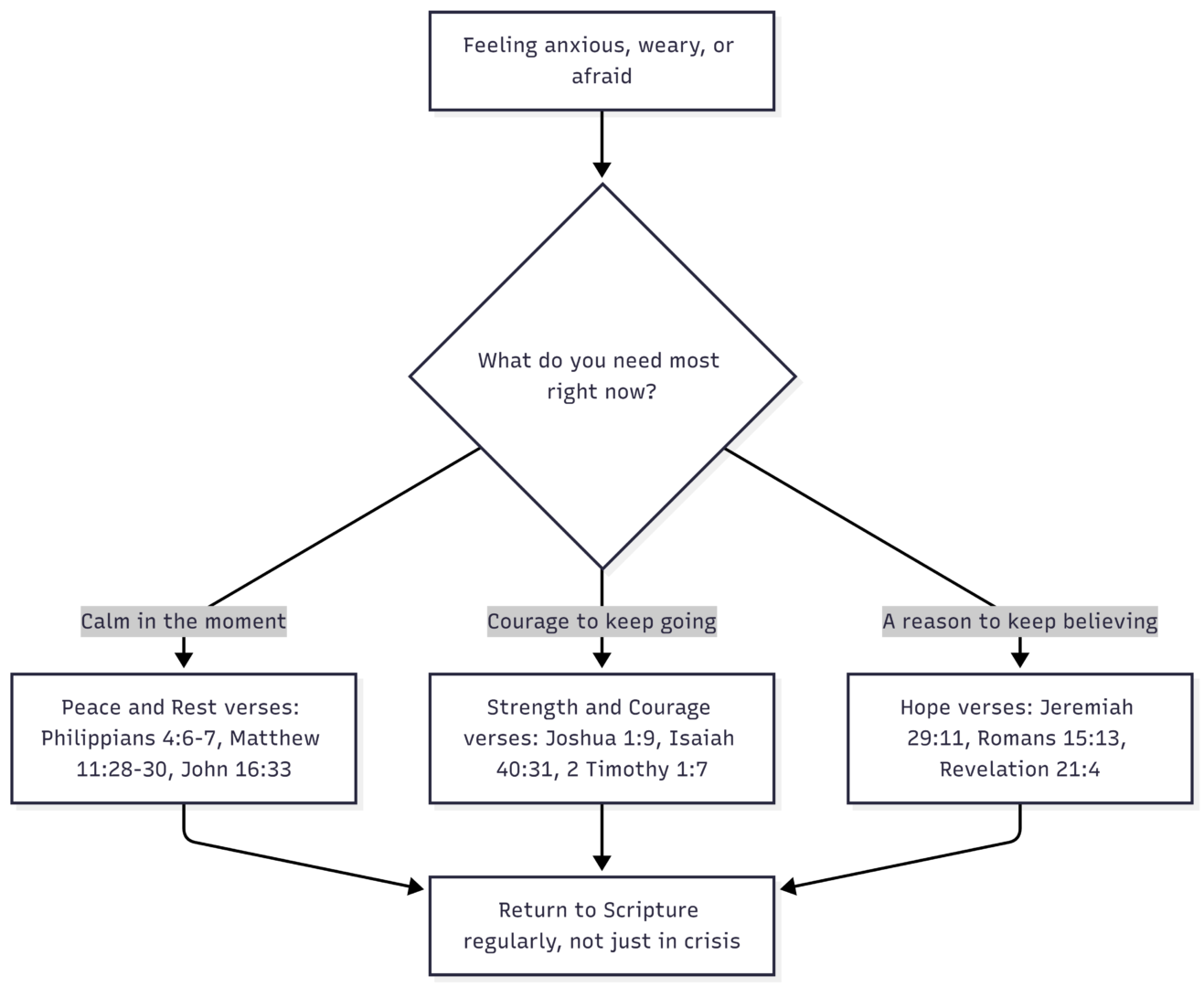
How These Verses Connect
Using These Verses in Daily Life
During acute anxiety: Philippians 4:6-7 and Matthew 11:28-30 work well as immediate prayers — naming the specific worry aloud rather than letting it stay vague and formless.
When facing a hard decision or new challenge: Joshua 1:9 and Isaiah 40:31 are often used before a difficult undertaking — a job change, a diagnosis, a move — as a reminder that courage doesn’t have to come from personal confidence alone.
During prolonged grief or hardship: Lamentations 3:22-24 and Romans 8:28 are frequently returned to specifically because they were written in or address contexts of real loss, not abstract difficulty.
When supporting a friend going through a hard season: Many of these verses work well shared directly — as a text message, a card, or a spoken prayer — since encouragement is explicitly framed in Scripture as something believers are meant to actively give one another, not just receive privately.
Frequently Asked Questions
Jeremiah 29:11 and Joshua 1:9 are among the most frequently quoted encouragement verses, the former for its promise of hope and the latter for its direct command to be strong and courageous because of God’s presence.
Biblical encouragement is rooted in specific promises about God’s character and presence, rather than generic affirmations about self-worth or ability. It’s meant to instill actual courage grounded in something durable, not just temporary good feeling.
Philippians 4:6-7 directly addresses anxiety, instructing believers to bring it to God through prayer rather than carry it alone, paired with a promised peace that follows.
Scripture explicitly frames encouragement as something believers are meant to give one another, not just receive individually — sharing a verse with someone going through hardship is a direct application of that instruction.
Matching the verse to the specific need tends to work best — peace-themed verses for acute anxiety, strength-themed verses before a difficult undertaking, and hope-themed verses during prolonged grief or uncertainty.
Not directly. Several, including John 16:33, explicitly acknowledge that hardship is guaranteed in this life. The encouragement offered is for enduring and finding peace through hardship, with Revelation 21:4 pointing toward an ultimate, future resolution rather than an immediate one.
Whether facing a specific hardship today or simply looking for a place to return to when life feels heavy, these fifteen verses offer something more durable than a passing motivational phrase — a foundation built on presence, promise, and hope that holds up under real weight.
Please share this Tips to Help You Choose Bulb Brightness and Shade with your friends and do a comment below about your feedback.
We will meet you on next article.
Until you can read, How Many Verses Are There in the Bible?