Revelation 1 – Introduction; A Vision of Jesus
Revelation 1
Introduction & A Vision of Jesus
The unveiling begins — John encounters the glorified Christ on Patmos and receives a commission for the ages
Revelation 1 is one of the most dramatic opening chapters in all of Scripture. Written by the Apostle John while exiled on the rocky island of Patmos, it announces the purpose of the entire book — to unveil Jesus Christ — and immediately delivers on that promise with a staggering vision of the risen, glorified Lord standing among seven golden lampstands. It is not a book about tribulation. It is not primarily a book about the Antichrist. It is the Revelation of Jesus Christ, and everything else in its twenty-two chapters exists to serve that central disclosure.
The chapter divides cleanly into four movements: a prologue identifying the book’s divine origin and its unique blessing (vv. 1–3), a greeting to the seven churches in Asia that introduces the Trinity in full (vv. 4–8), the circumstances of John’s exile and his encounter with a trumpet-like voice (vv. 9–11), and the vision itself — an overwhelming portrait of Christ in heavenly glory that reduces the aged apostle to the ground (vv. 12–20). This commentary walks through each movement with careful attention to the text, its symbols, and its enduring significance for the church.
The Prologue: What This Book Is and Why It Was Written
The very first word of the book — “apokalypsis” in the original Greek — is the source of our word “apocalypse,” but its meaning is far more precise than popular culture suggests. It simply means an unveiling, a disclosure of something previously hidden. This book does not hide reality; it reveals it. It does not obscure the future; it shows it to God’s servants so they may be prepared and strengthened for whatever comes.
The chain of transmission described in verses 1–2 is deliberately layered: God gave the revelation to Jesus, who sent it through His angel to His servant John, who then bore witness to all he saw. This chain establishes the book’s divine authority at every link. By the time the words reach the reader, they have passed through God Himself, the exalted Son, an angelic messenger, and an apostolic eyewitness. No other book in the New Testament describes its own origin so explicitly.
Revelation 1:3 pronounces a specific blessing on those who read, hear, and obey its words — one of only seven beatitudes in the entire book (Rev 1:3; 14:13; 16:15; 19:9; 20:6; 22:7; 22:14). This blessing is not reserved for scholars or prophecy specialists. It is available to every reader who engages the text with an obedient heart.
The phrase “the time is near” (v. 3) deserves careful attention. It does not mean that all events in Revelation were to be fulfilled within the first generation. The Greek word translated “shortly” (en tachei) carries the sense of rapidly or suddenly — once the sequence of events begins, it will unfold with speed. History since the first century has run parallel to the brink of consummation, never far from the edge. The urgent tone is pastoral, not a timetable error.
The Greeting: Grace from the Trinity and Three Titles of Christ
John’s greeting in verses 4–5 is one of the most compact Trinitarian statements in the New Testament. Grace and peace flow from three sources: “Him who is and was and is to come” (God the Father, whose name echoes the Hebrew Yahweh of Exodus 3:14), “the seven spirits before His throne” (the Holy Spirit in His sevenfold fullness, drawn from Isaiah 11:2’s description of seven spiritual characteristics), and Jesus Christ, identified by three titles that summarize His entire work.
| Title of Christ | Meaning | OT/NT Background |
|---|---|---|
| Faithful Witness | Jesus testified perfectly to the Father, even unto death. The Greek “martys” means witness and martyr. | John 18:37; Psalm 89:37 |
| Firstborn from the Dead | Pre-eminent among all who are or will be resurrected. Not merely the first chronologically but the supreme one. | Col 1:18; Rom 8:29 |
| Ruler of Kings | Jesus already reigns. Before the book is over, every earthly king will bow to Him. | Psalm 2:6; Rev 19:16 |
Verse 6 adds a stunning identity statement: Jesus has made believers “a kingdom of priests.” This was God’s original intention for Israel at Sinai (Exodus 19:6), but it was never fully realized under the old covenant. Under the new covenant, every believer is both royalty — with authority and standing — and priest — with direct access to the Father and the calling to intercede for others. This is not a role earned; it is one conferred by Christ’s love and the washing of His blood.
Verse 7, the book’s first prophetic declaration, borrows from two Old Testament passages: Daniel 7:13 (“coming with clouds”) and Zechariah 12:10 (“even those who pierced Him”). The return of Jesus will not be a private event. It will be visible to every eye — including the eyes of those who rejected Him. The mourning of all the tribes of the earth is not an expression of sorrow at being caught; it is the deep grief of recognition: this is the one we dismissed.
“I am the Alpha and the Omega,” says the Lord God, “who is and who was and who is to come — the Almighty.”
Alpha and Omega — the first and last letters of the Greek alphabet — make the same declaration as the Hebrew “Aleph and Tav.” Jesus is not somewhere in history; He is the frame within which all history happens. Nothing falls outside His range, from the first atom of creation to the final trumpet of eternity. The word “Almighty” translates the Greek pantokrater — “the one who has His hand on everything.” It appears nine of its ten New Testament occurrences in the Book of Revelation, underscoring the book’s central theological claim: God is sovereign over all of it.
John on Patmos: Context, Exile, and the Lord’s Day
Verse 9 is one of the most humanly tender moments in the entire book. Before describing his magnificent vision, John identifies himself simply as “your brother and partner in the tribulation.” He is not writing from a position of comfort or authority. He is a prisoner, exiled to a small, rocky island approximately 35 miles off the coast of Asia Minor. Archaeological evidence confirms that Patmos had first-century marble quarries; exiles were typically forced laborers. Yet it is precisely in this place of stripping and deprivation that heaven opens.
Patmos is roughly 10 miles long and 6 miles wide — rocky, desolate, with little farmland. The Roman historian Eusebius records that John was exiled there under Emperor Domitian (AD 81–96) and later returned to Ephesus under Nerva. A grotto on the island, still maintained by monks today, is traditionally identified as the place where John received his visions.
John describes being “in the Spirit on the Lord’s Day” — a phrase that indicates more than ordinary spiritual attentiveness. It describes a state of heightened, prophetic reception in which the Holy Spirit carried John beyond normal perception. The “Lord’s Day” refers to Sunday, the day early Christians gathered to celebrate the resurrection (Acts 20:7; 1 Corinthians 16:2). The irony is intentional: the Roman Empire had its own “Emperor’s Day” to honor Caesar. The church had its Lord’s Day to honor a different King entirely.
The voice John hears is described as “like a trumpet” — sharp, arresting, commanding attention. He is told to write what he sees and send it to seven specific churches. The selection of seven is not arbitrary. In Scripture, seven consistently signals completeness. These seven churches — arranged in a roughly circular postal route through the Roman province of Asia — represent the universal church in all its conditions, not merely seven local congregations in the first century.
The Seven Churches and Their Archaeological Contexts
Each of the seven cities addressed in Revelation had a distinct historical and cultural character that shaped Jesus’s message to its church. The table below draws on what archaeology and ancient history reveal about these communities.
| Church | Location / Significance | Archaeological Note | Jesus’s Key Message (Preview) |
|---|---|---|---|
| Ephesus | Major port city; center of Artemis worship | Theater seats 25,000 — scene of Paul vs. silversmiths (Acts 19) | You have left your first love (Rev 2:4) |
| Smyrna | Wealthy; loyal to Rome; Jewish community hostile to Christians | Polycarp martyred here within decades of Revelation’s writing | Be faithful unto death (Rev 2:10) |
| Pergamum | Provincial capital; site of massive Zeus altar; imperial cult | Hilltop acropolis resembles a throne — likely “where Satan’s throne is” (Rev 2:13) | Hold fast; resist compromise (Rev 2:13) |
| Thyatira | Trade guild city; economic pressure to participate in idol feasts | Evidence of guild temples where members were required to worship | Toleration of false teaching (Rev 2:20) |
| Sardis | Once unconquerable citadel; fell twice to surprise attacks | City walls believed impregnable, yet captured due to watchlessness | Wake up — you are dead (Rev 3:2) |
| Philadelphia | Located on a fault line; frequent earthquakes destroyed buildings | Repeated earthquake damage made stability precious to residents | I will make you a pillar (Rev 3:12) |
| Laodicea | Wealthy banking and textile city; tepid aqueduct water supply | Water pipes show heavy mineral deposits from lukewarm water source | You are lukewarm (Rev 3:16) |
The Vision of the Son of Man: Every Detail Is a Sermon
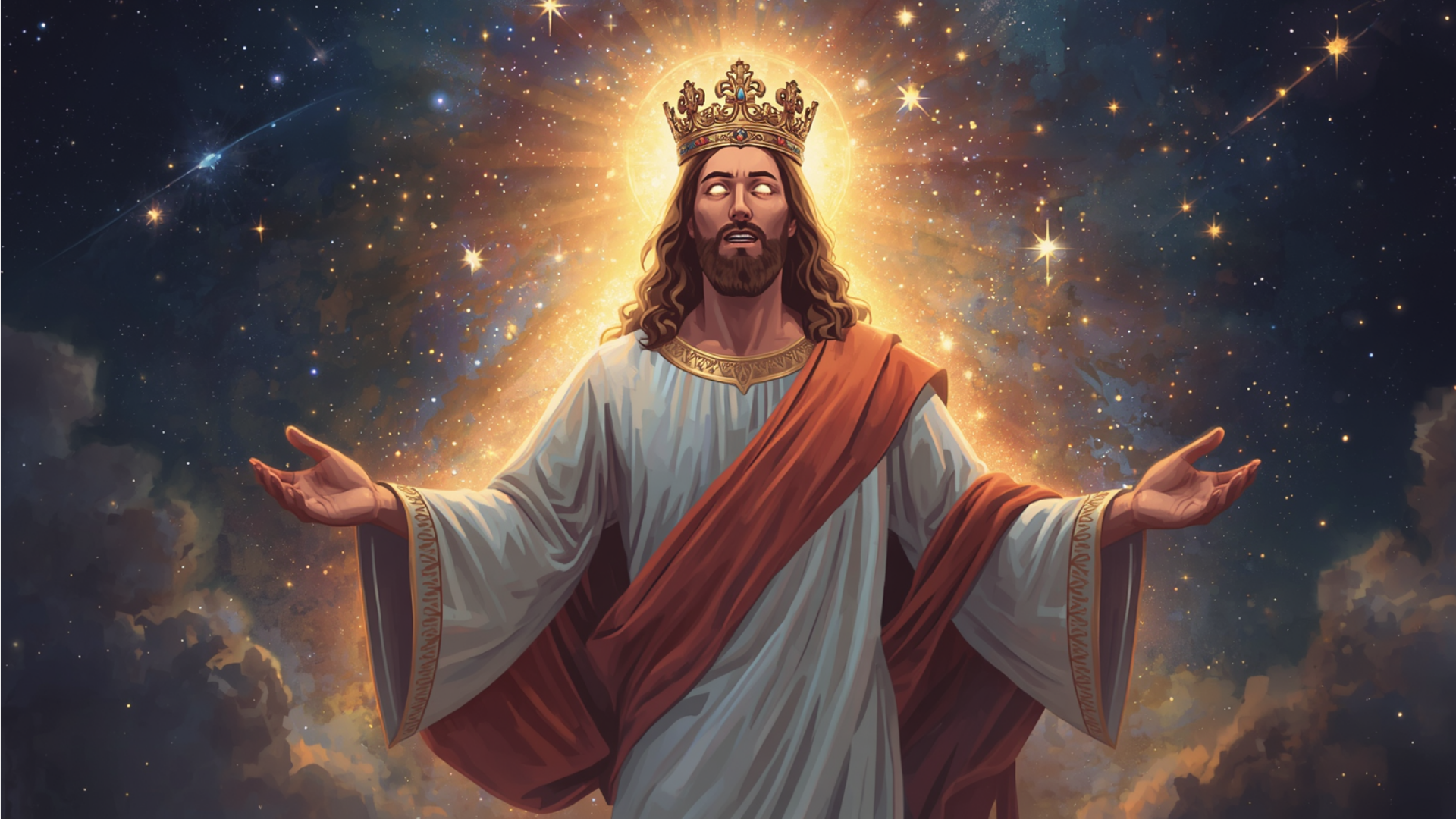
When John turns to see the voice (vv. 12–16), what he describes is not merely a picturesque apparition. Every feature of the glorified Christ is loaded with theological meaning drawn from the entire arc of Scripture, particularly the Old Testament. This is the only extended physical description of Jesus found anywhere in the Bible — not Jesus in the manger, not Jesus on the road to Emmaus, but Jesus as He actually is: reigning, judging, sovereign, and alive forevermore.
| Feature Seen | What It Represents | Scripture Background |
|---|---|---|
| Robe to the feet + golden sash | High priestly authority and dignity | Exodus 28:4; 29:5 |
| White hair — like wool, like snow | Timeless wisdom, purity, eternal nature | Daniel 7:9; Isaiah 1:18 |
| Eyes like a flame of fire | Penetrating omniscience; holy judgment | Hebrews 4:13; 2 Peter 3:7 |
| Feet like burnished bronze | Steadfast strength; refined through suffering; judgment | Ezekiel 1:7; Exodus 27:1–6 |
| Voice like many waters | Majestic, overwhelming authority | Psalm 29:3–4; Ezekiel 43:2 |
| Seven stars in right hand | Authority over the messengers of the seven churches | Rev 1:20; Job 38:7 |
| Sharp double-edged sword from mouth | The power of His spoken word — judging and saving | Hebrews 4:12; Ephesians 6:17; Isaiah 49:2 |
| Face like the sun at full strength | The unveiled glory of God — impossible to look upon directly | Matthew 17:2; Exodus 34:29–35 |
The sword coming from Christ’s mouth is not a literal blade between His teeth — it represents His word as the ultimate weapon and authority. The Greek word used here is rhomphaia, a large, heavy sword of destruction, distinct from the smaller machaira (the tactical blade of Hebrews 4:12). Both truths apply: His word both pierces the heart for salvation and destroys the wicked in judgment. “There is no handling this weapon without cutting yourself, for it has no back to it, it is all edge.” — Spurgeon
Christ’s Comfort and Commission: “Do Not Be Afraid”
John’s response to the vision is instinctive and entirely understandable: he falls at Christ’s feet as though dead (v. 17). This is the same John who once reclined next to Jesus at the Last Supper (John 13:23), who ran to the tomb on resurrection morning. Three years of daily life with Jesus had not prepared him for this. The vision is not Jesus as He appeared among fishermen in Galilee. It is Jesus as He is: the eternal, glorified King of all creation.
What Jesus does next is one of the most moving gestures in the New Testament. He lays His right hand on the prostrate apostle. Then He speaks three identity statements, each one a reason not to fear.
A title belonging to Yahweh in Isaiah 41:4; 44:6; 48:12. Jesus here claims the divine name of the God of Israel. All of history is held within His authority — nothing precedes Him, nothing outlasts Him.
The resurrection is not merely a past event; it is a permanent state. Jesus does not live again temporarily. His victory over death is final, irreversible, and everlasting. Death has no more dominion over Him.
The devil is not the lord of death. Jesus holds the keys — He determines who enters and who exits. For the believer, this means that no circumstance of death, illness, or suffering can operate outside His sovereign permission and purpose.
The commission in verses 19–20 gives the entire Book of Revelation its structural outline. John is to write three categories of things: what he has seen (Chapter 1), what is (Chapters 2–3, the letters to the seven churches), and what will take place after this (Chapters 4–22, the unfolding of end-time events). This three-part structure resolves the confusion many readers bring to Revelation. It is not a random collection of visions; it is an organized narrative moving from the present reality of Christ’s glory through the current condition of the church and into the future consummation of all things.
- Seven Stars The angels (messengers) of the seven churches. Whether these are heavenly angelic guardians or the human leaders (pastors) of each congregation, their location is what matters: they are in Christ’s right hand — the place of strength, authority, and protection.
- Seven Lampstands The seven churches themselves. Unlike the single menorah of the tabernacle (Exodus 25:31–37), these are seven separate stands — representing the multiplication of God’s light-bearing community among the nations. The church does not generate light; it displays the light of Christ.
How Should Revelation Be Interpreted? Four Major Views
Revelation has generated more interpretive diversity than perhaps any other book of the Bible. Understanding the four main approaches helps the reader engage the text honestly rather than assuming one lens is obviously correct. Each view contains genuine insights, and each faces genuine challenges.
| View | Core Claim | Strength | Limitation |
|---|---|---|---|
| Preterist | Revelation described events of John’s own time in symbolic code for persecuted believers | Takes historical context seriously; explains urgency language | Struggles to account for the clearly future scope of chapters 19–22 |
| Historicist | Revelation maps church history from the apostolic era to the present | Explains the Reformers’ reading of Revelation as addressing the papacy | Interpretations vary widely; difficult to verify historically |
| Idealist / Poetic | Revelation is symbolic literature conveying timeless spiritual truths, not historical events | Honors the symbolic language; applies across all eras | Risks removing all predictive content that the text explicitly claims |
| Futurist | From chapter 4 onward, Revelation describes end-time events preceding Christ’s return | Best accounts for the book’s explicit claim to predictive prophecy (1:1, 1:3) | Requires care to distinguish near-term and far-future passages |
The futurist view best honors the text’s own self-description. Revelation 1:1 explicitly states that it shows “what must soon take place” — the language of predictive prophecy. Revelation 1:3 declares that “the time is near” — not that the time has passed. A book that calls itself prophecy and promises blessing for those who keep its words is claiming predictive content. None of this prevents the other three views from contributing genuine insights, but the futurist framework best respects the book’s own claims about what it is doing.
Old Testament Foundations of Revelation 1
Revelation does not emerge from a cultural vacuum. It is the most thoroughly Old Testament book in the New Testament — containing over 500 allusions and 278 of its 404 verses making some reference to Old Testament texts. Chapter 1 alone draws from at least eight major Old Testament passages, demonstrating that this is not a strange, disconnected vision but the culmination of the entire biblical narrative.
| Revelation 1 Image | Old Testament Source | Connection |
|---|---|---|
| “Him who is and was and is to come” | Exodus 3:14; 6:3 | The divine name Yahweh — the eternal I AM |
| Coming with clouds | Daniel 7:13–14 | The Son of Man receiving dominion and glory |
| Those who pierced Him will mourn | Zechariah 12:10 | Israel’s eschatological mourning and restoration |
| White hair — Ancient of Days | Daniel 7:9 | The eternal judge on His throne |
| Seven spirits (fullness of the Spirit) | Isaiah 11:2 | Seven aspects of the Spirit resting on the Messiah |
| Kingdom of priests | Exodus 19:6 | God’s original design for His covenant community |
| Golden lampstand | Exodus 25:31–37; Zechariah 4 | The light of God’s presence among His people |
| Alpha and Omega | Isaiah 44:6; 48:12 | God declares He is the first and the last |
Frequently Asked Questions About Revelation 1
Why Revelation 1 Matters for Every Reader Today
Revelation 1 is not an introduction to a frightening book — it is an introduction to a magnificent Person. Everything John sees in his vision is calculated to answer the question the church in every age has needed to answer: who is Jesus, really? Not the historical figure of the first century, though He is that. Not the gentle shepherd of popular imagination, though He is that too. But Jesus as He is right now — seated, reigning, walking among His churches, holding their leaders in His hand, alive forevermore with the keys of death and the grave.
This vision has carried persecuted believers across twenty centuries. John received it in exile. The seven churches to whom it was sent lived under Roman pressure and the constant threat of economic exclusion or martyrdom. For them, as for believers in hostile environments today, the central message of this chapter was not a prophecy chart. It was a person: the risen, glorified, sovereign Christ who walks among His lampstands and has never once let go of them.
The blessing promised in verse 3 remains in effect. It belongs to every reader who does not merely consume Revelation’s imagery as apocalyptic entertainment, but who receives its unveiling of Jesus — and lives accordingly.
“Therefore write down the things you have seen, the things that are, and the things that will happen after this.”
Please share this Revelation 1 – Introduction; A Vision of Jesus with your friends and do a comment below about your feedback.
We will meet you on next article.
Until you can read, Birth of Jesus HD Images 4K HD Wallpaper