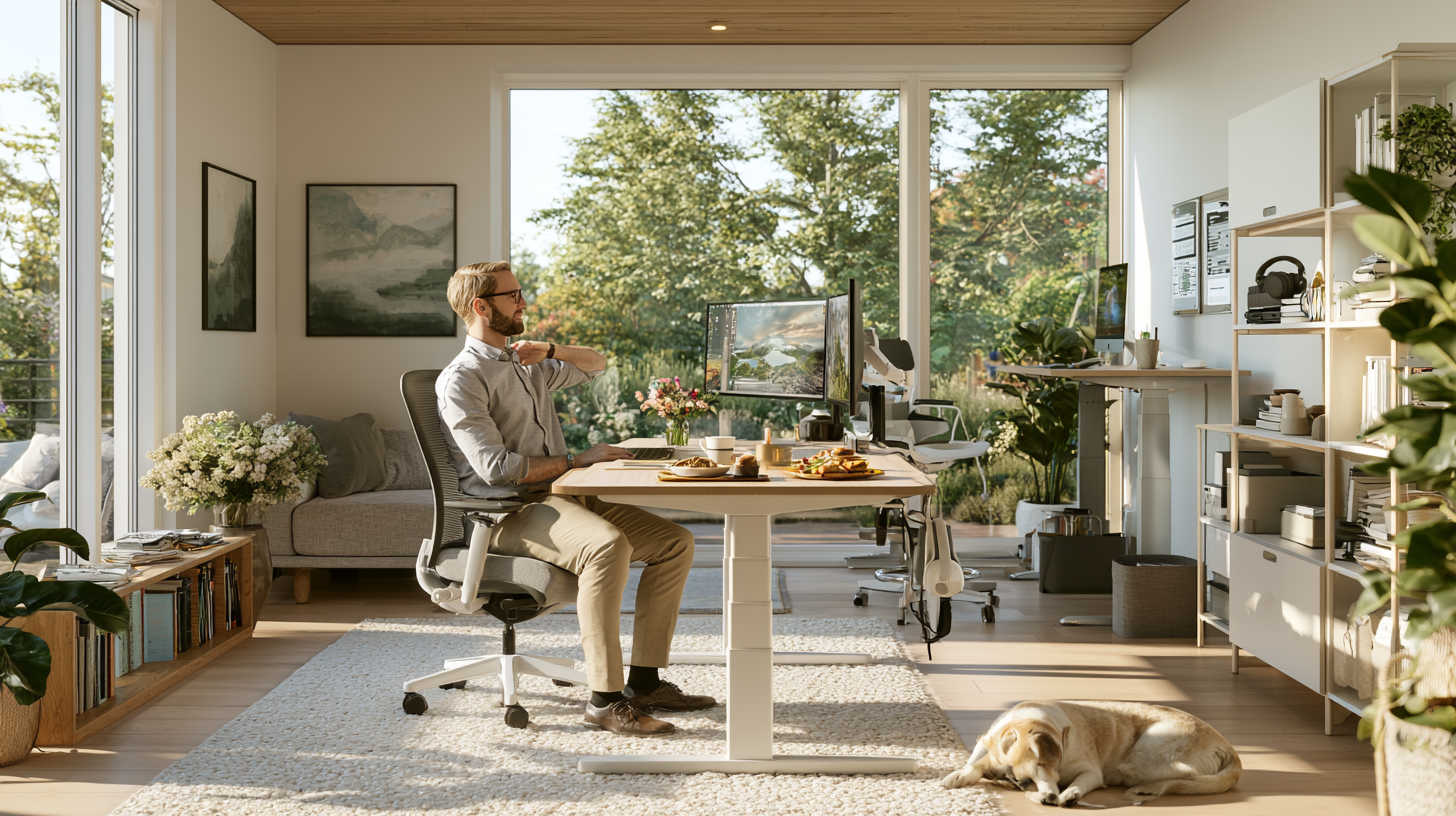
9 things you can do to make working from home more joyful
Most work-from-home advice focuses entirely on productivity: stay focused, avoid distractions, don’t slack off. Almost none of it addresses whether the experience actually feels good. But a remote workday doesn’t have to be a joyless stretch between meetings — small, intentional changes to environment and routine can make working from home genuinely enjoyable, not just tolerable.
These nine strategies are grounded in workplace research and real remote-work experience, covering everything from sensory environment to break structure to the psychology of transitions.
1. Build a “Get to Work” Ritual
One of the hardest parts of remote work is knowing when the workday has actually started. Without a commute or a physical office to walk into, the brain doesn’t get a clear signal that it’s time to shift into focus mode.
A ritual solves this. Playing the same song every time you sit down to work conditions the brain to associate that specific trigger with focus — a simple form of behavioral conditioning. Putting on real, comfortable clothes rather than staying in sleepwear creates a similar effect, marking a clear boundary between “off” and “on.” At the end of the day, physically closing the laptop and putting work materials away gives the same psychological closure a commute used to provide.
2. Upgrade Your Sensory Environment
Traditional offices tend to be sensory wastelands: neutral colors, synthetic carpet, humming HVAC systems, and fluorescent lighting. Research comparing “lean” workspaces to “enriched” ones — spaces with art, plants, and more sensory variety — found workers in enriched environments were roughly 15% more productive. When employees also had control over how their space was arranged, productivity gains reached roughly 32%.
Working from home gives you exactly that control. A few practical upgrades:
- Add low-maintenance plants like a Pothos or Snake Plant. Beyond aesthetics, greenery has been shown to help restore concentration and reduce stress.
- Invest in ergonomics. A supportive chair and a desk at the right height prevent the back and shoulder strain that builds up over months of poor posture.
- Use lighting deliberately. Position a desk near natural light where possible, and add a warm, dimmable lamp for afternoons when daylight fades.
- Engage touch and smell, senses that get almost no attention during a typical screen-heavy workday — a textured seat cover, a scented candle, or a diffuser can make a workspace feel noticeably less clinical.
3. Get Real Sunlight Exposure
Daylight exposure directly affects sleep quality, stress levels, and mood by regulating the hormones and neurotransmitters tied to the body’s internal clock. Workers with more daylight exposure report meaningfully better sleep — in some studies, close to 45 additional minutes per night — along with lower stress and higher daytime activity levels.
Since office lighting is usually limited to overhead fluorescents, working from home is actually an opportunity to do better. Position a desk near a window when possible, and if natural light is limited, use brighter artificial lighting during the day to help keep the body’s circadian rhythm on track. A short walk outside before starting work replicates some of the morning light exposure a commute used to provide — light exposure has its strongest effect on circadian rhythm earlier in the day.
4. Make Breaks Meaningful, Not Just Screen Swaps
Checking a phone or opening a streaming app during a break isn’t really rest — the eyes stay fixed on a screen and the body stays seated. A genuine break involves stepping away from the screen entirely: stretching, going outside, or moving around for even five to ten minutes every 50 to 60 minutes of work.
Turning a break into a small ritual — brewing a proper cup of coffee, cutting up fresh fruit into a small plate, or preparing a snack that feels like a treat rather than fuel — adds a sense of being cared for during the day, something that’s easy to lose when work and rest blend together at home.
5. Reclaim Your Old Commute Time
The average commute ranges from roughly 30 minutes to two hours round trip. Even at the low end, that adds up to two and a half hours reclaimed per week once remote work removes it entirely.
The key is being deliberate about how that time gets used, rather than letting it silently absorb into extra work hours. Blocking it out on a calendar — for a walk, a hobby, unstructured downtime, or simply extra sleep — helps ensure the time actually gets enjoyed rather than lost to open-ended screen time or work creep.
6. Add Playfulness to Your Workspace
Offices are typically designed around the assumption that play and work are opposites. But psychologically, the more accurate opposite of play isn’t work — it’s disengagement and low mood. Small playful elements in a home workspace can meaningfully shift the emotional tone of a workday:
- A desk toy like a Rubik’s cube or small puzzle to occupy hands during a mental break
- Standing desk converters or an exercise ball chair to change posture and energy
- Lighthearted decor — even something as small as googly eyes on a stapler
There’s also research suggesting that “cute” or playful visual elements can improve focus, likely because they introduce a small amount of positive stimulation into an otherwise repetitive environment.
7. Move Your Body Throughout the Day
Office workdays include incidental movement most people don’t think about — walking to a train, between meetings, or to get coffee. Remote work removes almost all of that, and it’s common for people to unknowingly drop under 1,000 steps a day once everything they need is within a couple of rooms.
Working from home offers the flexibility to fix this deliberately: setting a timer for a short stretch or workout between tasks, testing different working postures throughout the day instead of sitting in one position for hours, or taking a walk at the end of the workday instead of immediately closing the laptop and moving to the couch. Alternating between sitting, standing, and even floor-based positions can also reduce the fatigue that comes from staying in one posture too long.
8. Create a Physical End-of-Day Boundary
One of the most common complaints about remote work isn’t the work itself — it’s not knowing when the workday has ended. Without a commute or a clear “leaving the building” moment, laptops and paperwork tend to sit out indefinitely, making full mental disengagement difficult.
A simple fix: designate a specific place — a basket, a closet, a drawer — where work materials get physically put away at the end of each day. This doesn’t require a dedicated home office. The act of physically closing off access to work items creates the same sense of separation an office used to provide automatically, and it materially reduces the tendency to glance back at a laptop “just for a minute” during the evening.
9. Protect Time and Energy Like a Finite Resource
Work naturally expands to fill the time available for it — a well-documented tendency sometimes called Parkinson’s Law. Without external structure forcing a stop time, a task that should take 30 minutes can quietly consume an entire day.
Setting a firm, self-imposed end time and working backward from it tends to increase both focus and satisfaction, since deadlines create useful urgency rather than open-ended drift. Structuring the day around clear start and stop points — rather than letting work bleed into evenings — is one of the most reliable ways to protect the extra time remote work is supposed to provide in the first place.
Quick Reference: Strategy Impact and Effort
| Strategy | Effort to Implement | Primary Benefit |
|---|---|---|
| Get-to-work ritual (music, clothing cue) | Low | Faster transition into focus mode |
| Sensory environment upgrade (plants, ergonomics, lighting) | Low–Medium | Higher measured productivity, reduced stress |
| Sunlight exposure | Low | Better sleep, lower stress, improved mood |
| Meaningful screen-free breaks | Low | Reduced fatigue, renewed focus |
| Reclaiming commute time | Low | More rest or leisure time, less work creep |
| Playful workspace elements | Low | Improved mood and sustained focus |
| Deliberate movement throughout the day | Low | Reduced physical strain, more energy |
| Physical end-of-day boundary | Low | Cleaner mental separation from work |
| Firm stop times | Low | Reduced overwork, higher daily satisfaction |
Research Snapshot: Environment and Productivity
| Workspace Type | Relative Productivity |
|---|---|
| “Lean” workspace (minimal decor, no personalization) | Baseline |
| “Enriched” workspace (plants, art, sensory variety) | Roughly 15% higher |
| Enriched workspace with employee control over layout | Roughly 32% higher |
The Joy-Building Cycle
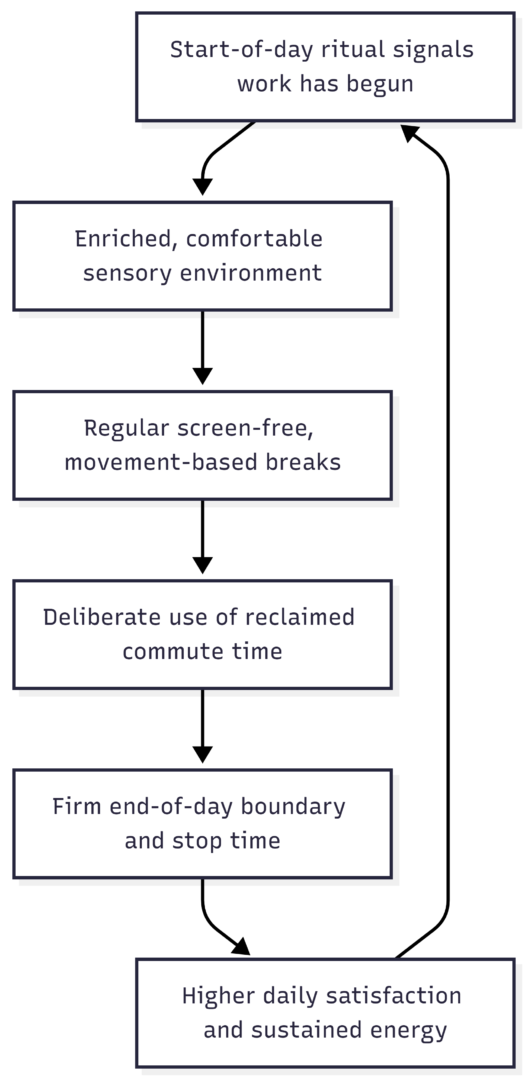
Each stage reinforces the next: a strong start makes breaks easier to take without guilt, breaks preserve energy for a firm stop time, and a clear stop time protects the next day’s start. Skipping any one stage tends to erode the others over time.
Making These Habits Stick
New routines fail most often not because the ideas are wrong, but because there’s no friction preventing the old default behavior. A few practical supports help:
- Keep work devices in a bag or drawer that gets physically closed at day’s end
- Put a phone in another room or on airplane mode during focus blocks to reduce pull-back distractions
- Schedule at least one non-work-related, informal conversation with a colleague each week to offset isolation
- Plan something specific for the end of each workday — a walk, a meal, a hobby — so there’s a reason to actually stop
Frequently Asked Questions
Creating a clear start-of-day ritual tends to have the highest impact relative to effort, since it fixes the most common complaint about remote work: not knowing when the workday has actually begun.
Research comparing enriched workspaces to plain ones found measurable productivity differences, with enriched, personalized spaces outperforming minimal ones by a significant margin, not just improving subjective comfort.
Setting a firm stop time and creating a physical boundary — putting laptops and work materials away in a specific spot — are the two most effective tools for preventing work from expanding into personal time.
It’s easy for reclaimed commute time to quietly become extra work hours unless it’s deliberately scheduled for something else, whether that’s rest, exercise, or a hobby.
Yes. Screen-free breaks that involve movement and a change of scenery reduce eye strain and physical fatigue more effectively than switching to a different screen, which keeps the same strain patterns active.
Partially. Playful workspace elements and better breaks improve daily mood, but isolation specifically benefits most from scheduling regular informal social contact, whether that’s a coworker chat, a coworking space visit, or time with friends during reclaimed commute hours.
Working from home doesn’t have to be a trade-off between comfort and productivity, or between flexibility and joy. Small, deliberate changes to ritual, environment, and boundaries can turn a remote workday from something merely endured into something genuinely enjoyable — and often more productive as a natural side effect.
Please share this 9 things you can do to make working from home more joyful with your friends and do a comment below about your feedback.
We will meet you on next article.
Until you can read, Why Working From Home is Making You Lazy