Parable of the Workers In the Vineyard: Verse, Meaning & Lesson
The Parable of the Workers in the Vineyard, found only in Matthew 20:1-16, describes a landowner who pays every worker the same full day’s wage, regardless of whether they labored since dawn or joined an hour before sunset. It is one of Jesus’s more counterintuitive teachings, directly challenging the assumption that spiritual reward should be proportional to effort or time served.
This guide walks through the full text of the parable, the context that prompted Jesus to tell it, its meaning, and the practical lessons it offers about grace, comparison, and envy. A summary table and FAQ section are included for quick reference.
The Verse: Matthew 20:1-16
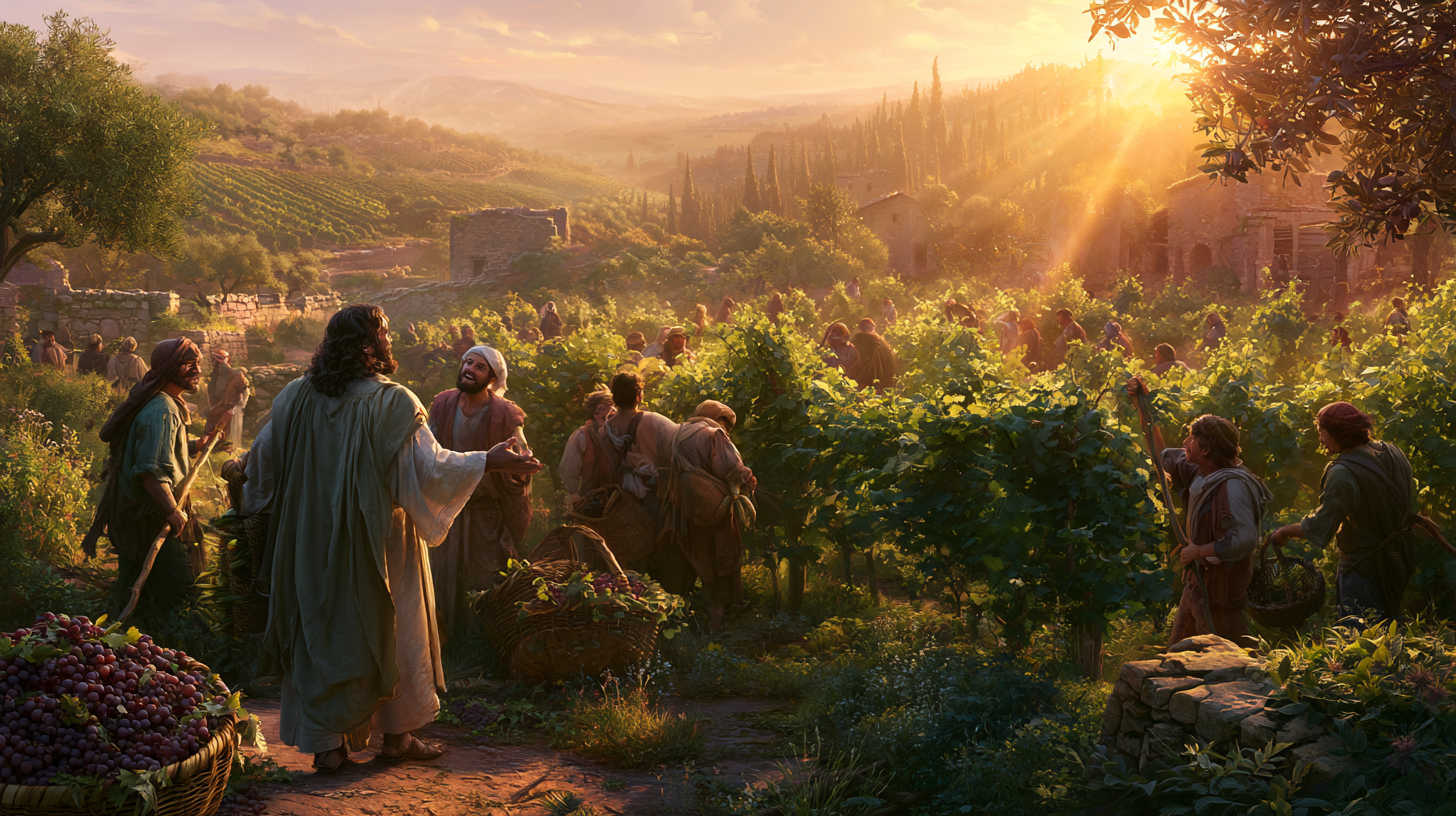
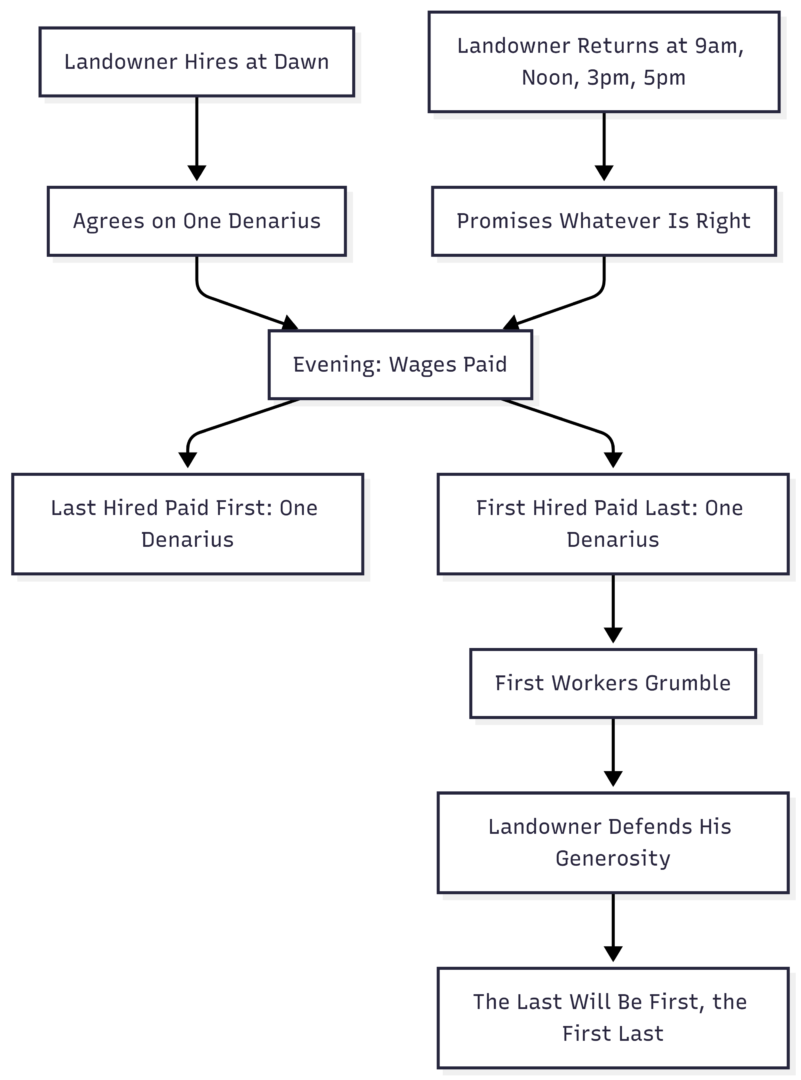
A landowner goes to the marketplace at dawn to hire day laborers for his vineyard, agreeing to pay them the standard wage of one denarius for the day. He returns to the marketplace at the third hour (roughly 9 a.m.), the sixth and ninth hours (noon and 3 p.m.), and again at the eleventh hour (about 5 p.m., an hour before quitting time), hiring more workers each time. To those hired later in the day, he does not name a specific wage, only promising to pay “whatever is right.”
When evening comes, the landowner instructs his foreman to pay the workers, beginning with those hired last. Each receives a full denarius, including those who worked only one hour. When the workers hired at dawn see this, they expect to receive more, but they too are paid exactly one denarius — the amount they had originally agreed to. They grumble against the landowner, complaining that those who worked only an hour have been made equal to those who bore “the burden of the day and the scorching heat.”
The landowner responds directly to one of them: “Friend, I am doing you no wrong. Didn’t you agree with me for a denarius? Take what is yours and go. I want to give this last worker the same as I gave you. Don’t I have the right to do what I want with my own money? Or are you envious because I am generous?” Jesus concludes the parable with the statement: “So the last will be first, and the first will be last.”
The Context: Why Jesus Told This Parable
This parable does not appear in isolation. It directly follows Peter’s question in Matthew 19:27: “We have left everything to follow you! What then will there be for us?” Peter, along with the other disciples, had given up livelihoods and family stability to follow Jesus, and he wanted assurance that this sacrifice would be recognized.
Jesus responds first with a promise of reward for those who have left everything for his sake, then immediately follows with the statement that closes chapter 19 and reappears at the end of this parable: “Many who are first will be last, and many who are last will be first” (Matthew 19:30). The parable of the vineyard workers is Jesus’s extended illustration of that statement, addressing the disciples’ underlying concern about reward, ranking, and fairness within the kingdom of heaven.
Historical Background on Vineyard Labor
Farming and maintaining vineyards in first-century Israel required intensive physical labor, particularly during harvest season, when timing mattered enormously. A landowner needed enough workers to bring in the crop before weather or over-ripening spoiled it, which explains why this landowner returns to the marketplace multiple times throughout the day rather than hiring his full workforce at dawn.
Hiring day laborers by the hour, rather than for a full day or half-day, was unusual for the period. This detail signals urgency: the landowner needed hands in the field immediately, even for a single remaining hour before sunset. The wage of one denarius represented a standard day’s pay at the time, roughly equivalent to a Roman soldier’s daily wage, making it a fair and generous offer to the workers hired at dawn.
The Meaning of the Parable
The Landowner Represents God
The landowner’s decision to pay every worker the same wage is not an act of injustice but an act of mercy extended according to his own generosity, not obligated by anyone’s calculation of what they deserve.
This mirrors God’s own description of himself in Exodus 33:19, later quoted in Romans 9:15: “I will have mercy on whom I have mercy.” Salvation, like the wage, is not distributed by strict proportional accounting.
The Denarius Represents Eternal Life
The wage paid to every worker, regardless of hours logged, represents the gift of eternal life extended equally to every believer. This is the parable’s most direct challenge to a merit-based view of salvation: the reward is identical whether a person has served faithfully for decades or turned to faith in their final moments, much like the repentant thief crucified alongside Jesus, who was promised paradise that same day (Luke 23:43).
The Workers Represent Believers Who Come to Faith at Different Times
The four hiring times throughout the day illustrate that people come to genuine faith at vastly different points in life — some as children, some in old age, some only in a final moment of crisis. The parable insists that timing does not create a hierarchy of reward among those who are genuinely redeemed.
The Grumbling Workers Represent Envy at God’s Generosity
The complaint from the workers hired at dawn is not that they were treated unfairly according to their contract; the landowner explicitly points out that they received exactly what was agreed. Their complaint is that someone else received the same benefit for less effort. This response is described directly as envy, using the Hebrew idiom of an “evil eye,” a term for jealousy and resentment at another’s good fortune.
Key Lessons from the Parable
| Lesson | Description | Supporting Verse |
|---|---|---|
| Grace is not earned by merit | Salvation is a gift determined by God’s generosity, not a wage proportional to effort | Matthew 20:14-15 |
| All believers receive the same ultimate reward | Eternal life is not distributed on a sliding scale based on years of service | Matthew 20:9-10 |
| Envy distorts perception of fairness | The dawn workers were not cheated; their resentment came from comparison, not injustice | Matthew 20:11-12, 15 |
| God’s generosity is his prerogative | The landowner explicitly claims the right to do as he wishes with what belongs to him | Matthew 20:15 |
| Human expectations of fairness differ from divine grace | “The last will be first, and the first last” reverses ordinary assumptions about reward | Matthew 20:16 |
Comparing Human Fairness and Divine Grace
| Human Expectation | What the Parable Teaches |
|---|---|
| Reward should be proportional to hours worked | Reward is proportional to God’s generosity, not human effort |
| Longer service should yield greater benefit | Salvation is the same complete gift for all believers |
| Comparing outcomes with others is natural | Comparison produces envy and misses the point of grace |
| Fairness means everyone gets exactly what they individually earn | Fairness, in God’s economy, means the landowner honors every agreement while remaining free to be generous beyond it |
| Those who serve longest deserve the most recognition | The order of hiring does not determine the order or size of reward |
Practical Application Today
This parable directly confronts a temptation common to long-term believers and newer believers alike: measuring one’s own standing against someone else’s.
- Resist comparing your walk of faith to others’. The dawn workers’ complaint arose entirely from watching what someone else received, not from any injustice done to them personally. Comparison, more than circumstance, produced their resentment.
- Recognize that timing of faith does not create spiritual rank. Someone who comes to faith late in life, or even in a final moment, is not a second-class recipient of grace. The parable directly rules out this kind of hierarchy.
- Rejoice at others’ blessings rather than resenting them. The landowner’s question — “are you envious because I am generous?” — reframes another person’s good fortune as something to celebrate rather than something that diminishes your own reward.
- Remember that grace, by definition, cannot be earned. Any framework where reward is calculated strictly by effort undermines the very meaning of grace as an unearned gift.
- Focus on faithfulness rather than status. The parable does not discourage long, dedicated service; it discourages using that service as leverage for comparative reward or recognition.
Frequently Asked Questions
The parable teaches that God’s grace and the gift of eternal life are distributed according to his generosity, not according to a strict accounting of effort or time served, and that all genuine believers receive the same ultimate reward.
They were not treated unfairly according to their agreement; they received exactly the wage they had accepted. Their frustration arose from comparing their pay to what later-hired workers received, which the parable identifies directly as envy.
This phrase reverses ordinary human expectations about reward and status, illustrating that in God’s kingdom, timing of service does not determine ranking or benefit — all who are redeemed share equally in the same eternal reward.
The parable specifically addresses the reward of eternal life, which it presents as equal for all believers regardless of when they come to faith. Other passages of Scripture describe differing rewards for service, but the ultimate gift of salvation itself is presented here as the same for everyone.
It follows directly from Peter’s question about what reward the disciples would receive for having given up everything to follow Jesus (Matthew 19:27), addressing underlying concerns about fairness, ranking, and reward within the kingdom of heaven.
The thief who repented in his final moments (Luke 23:39-43) is often cited as a real-life example of the parable’s teaching: someone who turned to faith at the very end of life received the same promise of paradise as those who served faithfully for a lifetime.
Final Thoughts
The Parable of the Workers in the Vineyard remains one of the sharpest correctives in Jesus’s teaching against a merit-based view of spiritual reward. It does not deny that some serve longer or harder than others; it insists that this difference does not translate into a greater share of God’s grace.
The landowner’s generosity, not the workers’ labor, determines the outcome — a reminder that measuring one’s own blessings against someone else’s is, in the end, a form of envy dressed up as fairness.
Please share this Parable of the Workers In the Vineyard: Verse, Meaning & Lesson with your friends and do a comment below about your feedback.
We will meet you on next article.
Until you can read, Parable of the Wise and Foolish Builders: Verse, Meaning & Lesson