
Parable of the Pharisee and the Tax Collector: Verse, Meaning & Lesson
Two men walk into the temple to pray. One is respected, disciplined, and morally admirable by every outward measure. The other is despised, corrupt, and avoided by decent society.
Yet Jesus says only one of them leaves justified before God — and it’s not the one anyone would expect. The Parable of the Pharisee and the Tax Collector, found in Luke 18:9-14, is one of the shortest parables Jesus told, but it delivers one of the sharpest reversals in the Gospels: outward righteousness can hide inward pride, and honest desperation can be the very posture that opens the door to grace.
This guide covers the full verse, what each character represents, the historical background that makes the story so shocking, and the lasting lesson on humility, pride, and how a person is made right with God.
Quick Overview
| Detail | Information |
|---|---|
| Scripture location | Luke 18:9-14 |
| Speaker | Jesus Christ |
| Audience | Those “confident of their own righteousness” who looked down on others |
| Main characters | A Pharisee, a tax collector |
| Core theme | Humility versus self-righteousness in approaching God |
| Literary type | Parable |
| Precedes | The Parable of the Persistent Widow (Luke 18:1-8) |
The Full Text of Luke 18:9-14
“To some who were confident of their own righteousness and looked down on everyone else, Jesus told this parable: ‘Two men went up to the temple to pray, one a Pharisee and the other a tax collector. The Pharisee stood by himself and prayed: “God, I thank you that I am not like other people—robbers, evildoers, adulterers—or even like this tax collector. I fast twice a week and give a tenth of all I get.”
But the tax collector stood at a distance. He would not even look up to heaven, but beat his breast and said, “God, have mercy on me, a sinner.”
I tell you that this man, rather than the other, went home justified before God. For all those who exalt themselves will be humbled, and those who humble themselves will be exalted.'”
A Simple Summary of the Story
- Two men go to the temple at the same time to pray: a Pharisee and a tax collector.
- The Pharisee stands prominently and thanks God that he is not like sinful people — specifically naming the tax collector — and lists his religious accomplishments: fasting twice a week and tithing on everything he earns.
- The tax collector stands far off, won’t even lift his eyes toward heaven, and beats his chest in grief, saying only, “God, have mercy on me, a sinner.”
- Jesus declares that the tax collector — not the Pharisee — went home justified before God.
- He closes with the principle: those who exalt themselves will be humbled, and those who humble themselves will be exalted.
Who’s Who in the Parable
| Character | Represents | Social Standing |
|---|---|---|
| The Pharisee | Self-righteousness and reliance on personal merit | Highly respected religious leader |
| The Tax Collector | Honest repentance and reliance on God’s mercy | Despised social outcast |
Why This Contrast Was So Shocking
To understand why this parable landed like a punch to the original audience, it helps to know exactly who these two figures were.
The Pharisees were the most respected religious group in first-century Judaism. The historian Josephus, writing in that era, described them as a group that appeared more devoted to religious law than anyone else and interpreted it with exceptional precision. Pharisees didn’t just follow the law’s minimum requirements — many went well beyond them. The law required fasting once a year, on the Day of Atonement; this Pharisee fasted twice a week. The law required tithing specific categories of income; many Pharisees tithed even small household herbs. By any visible standard, a Pharisee was the model citizen — the kind of person a community pointed to as an example.
Tax collectors, by contrast, were among the most hated figures in Jewish society. They were Jews hired by Rome to collect taxes from their own people, and the system allowed them to charge more than what was owed and pocket the difference. This made them wealthy through a method widely viewed as extortion, and it made them traitors in the eyes of their own community — collaborators profiting off the oppression of their neighbors. A tax collector entering a village was met with contempt, not welcome.
By pairing these two figures, Jesus set up a comparison His audience would have judged instantly and confidently: obviously the Pharisee is the righteous one. That’s exactly the assumption the parable exists to overturn.
Comparing the Two Prayers
| The Pharisee | The Tax Collector | |
|---|---|---|
| Posture | Stood prominently, likely near the front | Stood far off, at a distance |
| Eyes | Lifted toward heaven | Would not look up |
| Physical gesture | None mentioned; confident stance | Beat his chest in anguish |
| Content of prayer | A list of his own virtues and comparisons to others | A single plea for mercy |
| Focus of the prayer | Himself | God’s mercy |
| Outcome | Not justified | Justified |
Breaking Down the Pharisee’s Prayer
Look closely at what the Pharisee actually says: “God, I thank you that I am not like other people—robbers, evildoers, adulterers—or even like this tax collector. I fast twice a week and give a tenth of all I get.” On the surface, it opens with thanksgiving, which sounds appropriate. But the substance of the prayer never moves beyond the Pharisee himself. There’s no confession, no request, no acknowledgment of need. He isn’t communicating with God so much as narrating his own resume in God’s presence — and doing so by contrast, elevating himself specifically by naming who he is glad not to be.
This matters theologically. The Pharisee likely did believe his good qualities came from God’s help — he opens by thanking God, after all. His error wasn’t claiming to be self-made; it was trusting in his own righteousness, however he acquired it, as sufficient grounds for standing before God. The problem wasn’t gratitude. It was where his confidence was ultimately placed.
Breaking Down the Tax Collector’s Prayer
The tax collector’s prayer is nine words in most English translations: “God, have mercy on me, a sinner.” No comparisons, no résumé, no explanation of extenuating circumstances. In the original Greek, his plea for mercy carries the sense of asking God to be propitiated — not simply overlooking the offense, but addressing the debt it created. He isn’t asking for a lighter sentence; he’s asking for the full weight of what he’s done to be dealt with by God’s mercy rather than held against him.
His physical posture reinforces the words. Standing at a distance reflects both social reality (a tax collector wouldn’t have been welcomed among the respected worshippers) and the way he saw himself before a holy God. Not lifting his eyes and beating his chest were recognized ancient gestures of grief and repentance, not performance for onlookers — there was no one whose approval he stood to gain that day.
The Verdict and Its Reversal
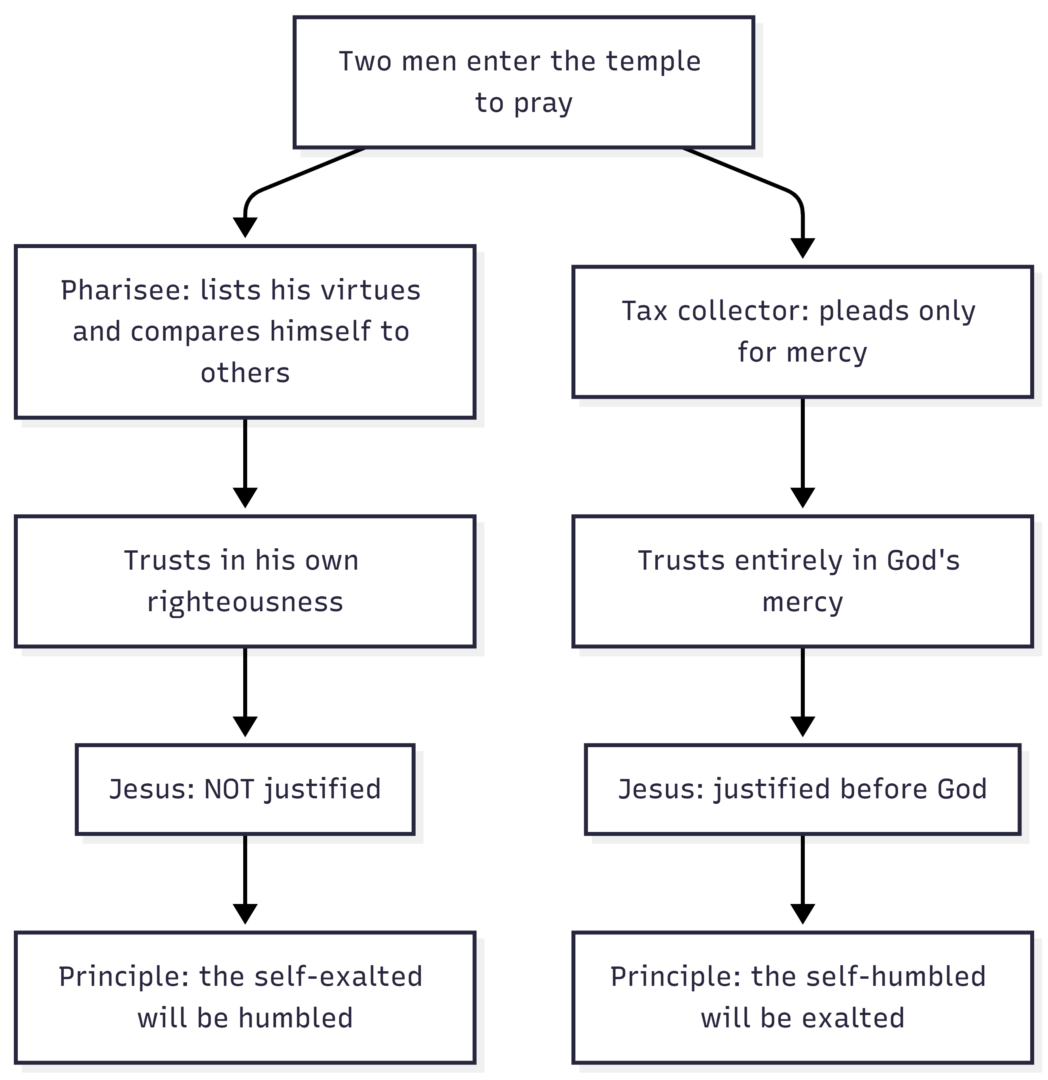
The reversal is the entire point. Jesus doesn’t merely say the tax collector was forgiven while the Pharisee was not condemned — He says the tax collector went home justified “rather than the other,” a direct comparison that would have stunned His listeners. Social respectability and religious performance are not what God evaluates. What matters is whether a person approaches God empty-handed, in honest need of mercy, or arrives with a ledger of accomplishments expecting credit.
The Core Lesson: Justification Is Not Earned
This parable is often treated as a simple lesson about humility versus pride, and that’s true as far as it goes. But the deeper theological point is about the basis of justification — how a person is made right with God in the first place.
The Pharisee’s error wasn’t that he did bad things; by every external measure, he didn’t. His error was believing that his own moral performance was the currency that purchased his standing before God. The tax collector, by contrast, had no moral performance to offer and knew it. His only appeal was to God’s mercy — and that appeal, empty-handed as it was, is what Jesus says was received.
This is the same principle articulated elsewhere in the New Testament: righteousness that qualifies someone before God is not self-generated but received. The tax collector’s prayer models the posture the rest of Scripture consistently commends — not confidence in one’s own goodness, but reliance on grace that isn’t earned.
Comparing Outward Reputation to Inward Reality
| Measure | The Pharisee | The Tax Collector |
|---|---|---|
| Public reputation | Respected, moral, devout | Despised, corrupt, avoided |
| Religious observance | Exceeds legal requirements | None mentioned |
| Heart posture before God | Confident, self-referential | Broken, others-referential (toward God) |
| Jesus’s verdict | Not justified | Justified |
This table captures the parable’s central irony: the categories society uses to judge someone’s standing — reputation, visible discipline, moral track record — are not the categories God uses. The parable doesn’t say the Pharisee’s discipline was worthless; it says that discipline became a liability the moment it replaced humility as the basis of his confidence before God.
Common Misreadings to Avoid
It’s worth clarifying what this parable is not saying, since it’s easy to draw the wrong conclusion from it.
- It is not condemning fasting, tithing, or moral living. These practices aren’t the problem; trusting in them as the grounds for acceptance with God is.
- It is not suggesting sin doesn’t matter, or that being a “bad person” is somehow safer than being disciplined. The tax collector isn’t commended for his corrupt career — he’s commended for his honest confession of it.
- It is not merely “don’t be arrogant.” The deeper issue is theological: who or what are you trusting to make you acceptable to God — your own record, or God’s mercy?
- It does not mean humility itself earns salvation. Even the posture of humility isn’t a new performance to master; it’s simply the honest recognition that there is nothing to offer, which is precisely what opens a person to receive grace freely given.
Applying the Parable Today
- Examine the basis of your confidence. When reflecting on your standing with God, notice whether your instinct is to list what you’ve done right or to ask for mercy. The parable suggests those are two very different postures, only one of which Jesus commends.
- Watch for comparison as a warning sign. The Pharisee’s prayer went wrong the moment it turned toward “not like other people.” Measuring your own standing by contrast with someone else’s failures is a reliable sign that self-righteousness has crept in.
- Let visible discipline stay a fruit, not a foundation. Practices like giving, fasting, or moral consistency are good — but this parable warns against letting them quietly become the thing you’re actually trusting in.
- Approach prayer honestly. The tax collector’s brief, unpolished prayer was received where the Pharisee’s practiced, articulate one was not. Honesty about need matters more than eloquence or achievement.
Frequently Asked Questions
No, there’s no indication he was dishonest about fasting twice a week or tithing everything he earned. The problem wasn’t false claims — it was trusting those true accomplishments as the basis for his standing before God.
Tax collectors worked for Rome collecting taxes from their own people and were permitted to overcharge and keep the surplus, which made the role synonymous with extortion and betrayal of their own community.
To be justified means to be declared righteous or right standing before God. Jesus’s point is that this declaration came to the tax collector through humble reliance on mercy, not through the Pharisee’s moral record.
While the original audience was religious leaders, the underlying pattern — trusting in personal merit versus trusting in mercy — applies to any form of self-righteousness, religious or otherwise.
Final Thoughts
The Parable of the Pharisee and the Tax Collector strips away every external measure society uses to rank people and asks a single question instead: are you trusting in yourself, or are you asking for mercy? The most respected man in the room went home unjustified. The most despised man in the room went home right with God. That reversal is the whole point — grace is not given to those with the most impressive record, but to those honest enough to admit they have nothing to offer except their need.
Please share this Parable of the Pharisee and the Tax Collector: Verse, Meaning & Lesson with your friends and do a comment below about your feedback.
We will meet you on next article.
Until you can read, Parable of the Prodigal Son: Verse, Meaning & Lesson