
Does Working from Home Save Companies Money?
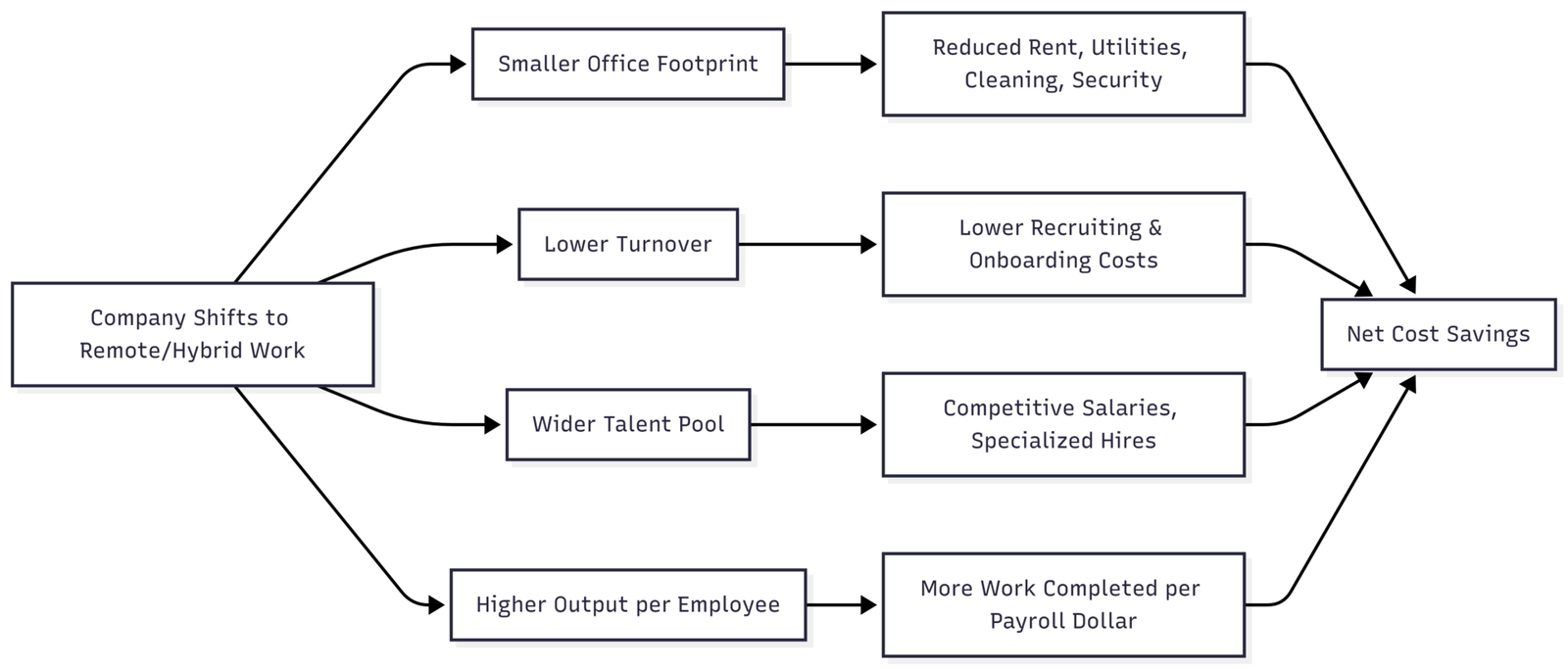
Yes — for most companies, remote work saves real money. The biggest gains come from smaller office footprints, lower utility and maintenance bills, reduced employee turnover, and measurable productivity increases.
Employees save too, mostly on commuting, food, and work wardrobes. But remote work isn’t free: it shifts spending toward technology, cybersecurity, and management overhead. Whether it’s a net win depends on how a company structures the transition.
This guide breaks down exactly where the savings come from, what they’re worth in dollar terms, and where the hidden costs offset them.
The Short Answer, In Numbers
| Savings Category | Who Benefits | Estimated Annual Value |
|---|---|---|
| Office rent, utilities, cleaning | Employer | $8,000–$11,000 per remote employee |
| Reduced turnover and recruiting costs | Employer | 20–50% lower hiring spend per role |
| Higher output per worker | Employer | Productivity gains of 5–15%, depending on role |
| Commuting (gas, transit, parking, wear on vehicle) | Employee | $2,000–$5,000 per year |
| Food, coffee, and work wardrobe | Employee | $1,000–$2,500 per year |
| Childcare flexibility | Employee | Varies widely; can exceed $3,000 per year |
These figures come from a mix of industry surveys (Owl Labs, Global Workplace Analytics, Gallup) and vary by industry, location, and role. Use them as directional benchmarks, not guarantees — a software company with expensive downtown office space will save far more than a manufacturer whose staff can’t work remotely at all.
Where Employer Savings Actually Come From
1. Real Estate Is the Biggest Line Item
Office space is usually one of the largest fixed costs a company carries, and it’s the first thing that shrinks when a workforce goes remote or hybrid. Some of the earliest and most cited examples of this came from large tech and industrial firms that reported tens of millions of dollars in annual real estate savings after shifting significant portions of their workforce to telecommuting arrangements, along with double-digit percentage reductions in non-labor overhead.
The math is straightforward: fewer people in the building means less square footage to lease, lower utility bills, reduced janitorial contracts, and in many cases, a smaller security budget. Companies that go fully remote can eliminate office leases entirely; hybrid companies typically downsize and redesign their space around shared desks (“hot-desking”) rather than assigning a permanent seat to every employee.
2. Productivity Gains Are Measurable, Not Just Anecdotal
One common objection to remote work is that “nobody can prove people are actually more productive.” The data increasingly disagrees. Research examining dozens of private-sector industries has linked increases in remote work adoption to measurable gains in total factor productivity, driven largely by reductions in non-labor costs like office space, equipment, and materials.
Separate workplace research covering more than a million employees found that companies supporting hybrid or remote arrangements posted productivity levels well above the norm for traditional office-based teams.
Why does this happen? A few consistent factors show up across the research:
- Fewer interruptions. Open-plan offices are notoriously bad for focus; remote workers can control their environment.
- No commute stress. Employees start the day without the cognitive drain of traffic or crowded transit.
- Flexible peak hours. People can schedule demanding work during their personal high-energy windows instead of a fixed 9-to-5.
3. Lower Turnover and Recruiting Costs
Replacing an employee is expensive — recruiting, onboarding, and lost productivity during the ramp-up period can cost a meaningful fraction of that employee’s annual salary. Flexible work arrangements are consistently ranked among the top factors employees weigh when deciding whether to stay at a job, which means companies offering remote or hybrid options tend to retain staff longer and spend less on backfilling roles.
Remote work also reduces absenteeism. Employees with flexible schedules can work around minor illness or personal obligations instead of taking a full sick day, and contagious illnesses spread less easily when a workforce isn’t sharing the same physical space.
4. Access to a Larger, Cheaper Talent Pool
When a company isn’t limited to hiring within commuting distance of an office, it can recruit specialized talent from anywhere — often at more competitive salary rates than a major metro area would demand. This also improves diversity, since geographic barriers no longer filter out qualified candidates from smaller cities, rural areas, or other countries.
How the Savings Flow Together
What Employees Save By Working From Home
Employer savings get most of the attention, but the case for remote work is just as strong on the employee side — and it’s one reason flexible arrangements are so effective at improving retention.
| Expense Category | What Gets Cut | Typical Impact |
|---|---|---|
| Commuting | Gas, transit fares, parking, vehicle wear | Largest single savings category for most workers |
| Food | Takeout lunches, daily coffee runs, vending machine snacks | Home-cooked meals replace higher-cost convenience food |
| Wardrobe | Business attire, dry cleaning, professional grooming | Casual home wardrobe needs far less upkeep |
| Childcare | Before/after-school care, emergency sitters | Flexible hours reduce reliance on paid care |
| Housing | Rent or mortgage in expensive metro areas | Some workers relocate to lower-cost regions entirely |
The commuting savings alone are significant once vehicle depreciation and maintenance are factored in, not just fuel or transit fares. Combine that with skipping daily takeout and a smaller work wardrobe, and many employees save the equivalent of a modest raise simply by not going into an office.
There’s a second-order effect too: remote work is loosening the link between salary and geography. An employee can increasingly earn a big-city salary while living somewhere with a dramatically lower cost of living — a trend that is also feeding renewed interest in smaller towns and rural areas that were previously losing population to major cities.
The Environmental and Resilience Angle
Remote work isn’t just a financial story — it has operational and sustainability benefits companies increasingly track as part of ESG goals. Research published on commuting emissions has found that remote workers can cut their personal greenhouse gas emissions substantially by eliminating the daily commute, which helps companies chip away at broader carbon-reduction targets without requiring a major capital investment.
There’s also a resilience argument: companies with established remote-work infrastructure adapt faster to disruptions — severe weather, transit strikes, or facility issues — because the workforce isn’t dependent on a single physical location to function.
Hybrid Work: The Middle Ground Most Companies Are Choosing
Full remote and full in-office are no longer the only two options most companies consider. A large share of employers now offer some form of hybrid arrangement, and employee preference data shows a strong tilt toward hybrid over either extreme — most workers in remote-eligible roles say they’d rather split time between home and office than commit fully to one or the other.
Hybrid arrangements let companies keep in-person time for training, culture-building, and high-bandwidth collaboration, while still capturing much of the cost savings of remote work. Employees working remotely even part of the week report meaningful daily savings compared to commuting every day, and companies get a smaller average office footprint without giving up face-to-face collaboration entirely.
The Hidden Costs That Offset the Savings
Remote work isn’t a free lunch. Before assuming it’s an automatic win, companies need to budget for the costs that come with it.
| Hidden Cost | Why It Matters |
|---|---|
| Technology and software | Video conferencing, project management tools, and secure remote-access software all cost money |
| Cybersecurity | VPNs, endpoint protection, and multifactor authentication are non-negotiable once employees connect from home networks |
| Management overhead | Remote teams need clearer documentation, more deliberate check-ins, and stronger asynchronous communication habits |
| Legal and compliance | Workplace safety obligations, multi-state tax exposure, and local zoning or HOA restrictions can all complicate remote arrangements |
| Career development friction | Remote employees sometimes worry about being overlooked for promotions without visible face time |
A few of these deserve extra attention:
Tax exposure. Some cities and states tax remote workers based on where the employer is located, not where the employee actually works, which can create dual tax obligations depending on the states involved. Companies with remote staff spread across multiple states should loop in a tax professional before assuming remote work is a clean cost-saver.
Legal liability. Workplace safety regulations generally still apply to home offices, which means employers can carry some liability for unsafe home working conditions. This is a smaller risk than in a traditional office, but it isn’t zero.
Not every role fits. Remote work depends on self-direction, a distraction-free space, and comfort with digital collaboration tools. Employees who thrive on in-person structure — or whose homes don’t allow for a dedicated workspace — may perform worse remotely, which undercuts the productivity case entirely for those individuals.
Frequently Asked Questions
Estimates commonly land in the $8,000–$11,000 range per year when accounting for reduced office space, utilities, and related overhead, though the figure varies heavily by industry, location, and how much office space the company can actually shed.
Multiple independent studies point the same direction: fewer distractions, no commute fatigue, and more flexible scheduling tend to produce measurable productivity gains, though results vary by role and how well the company manages remote teams.
Yes. Flexibility is consistently one of the top factors employees cite when deciding whether to stay in a job, and companies offering it tend to see lower turnover and lower recruiting costs as a result.
For many companies, hybrid captures most of the cost and productivity benefits of remote work while preserving in-person collaboration — which is why it’s become the most common arrangement rather than either extreme.
The Bottom Line
The evidence is fairly consistent: remote and hybrid work save companies money, mostly through smaller real estate footprints, lower turnover, and measurable productivity gains, while also saving employees thousands of dollars a year in commuting, food, and wardrobe costs.
The savings aren’t automatic, though — companies need to budget for new technology, cybersecurity, and management practices designed for distributed teams, and account for tax and legal complexity that comes with employees working across different locations.
For most businesses, the net result still favors remote or hybrid arrangements, but the size of the win depends heavily on how deliberately the transition is managed.
Please share this Does Working from Home Save Companies Money? your friends and do a comment below about your feedback.
We will meet you on next article.
Until you can read, Parable of the Growing Seed: Verse, Meaning & Lesson