All Jesus’ Parables: In Order With Bible Passages By Christ
Jesus Christ spoke approximately 46 recorded parables across the four Gospels, primarily in Matthew, Mark, and Luke. These stories used everyday objects, people, and scenarios to communicate profound spiritual truths about the Kingdom of God, prayer, forgiveness, judgment, and eternal life. Understanding these parables in order — by Gospel and ministry phase — gives readers the clearest picture of what Christ was teaching and why.
What Is a Parable?
A parable is a short, illustrative story designed to reveal a spiritual truth through a relatable earthly scenario. Jesus used this method so consistently that Mark’s Gospel records: “He did not say anything to them without using a parable” (Mark 4:34). Unlike allegories where every element has a one-to-one meaning, parables typically carry a single central lesson.
Complete List of All Jesus’ Parables
The table below lists every parable of Jesus with its corresponding Gospel references across Matthew, Mark, and Luke.
| Parable | Matthew | Mark | Luke |
|---|---|---|---|
| The Lamp on a Stand | 5:14–16 | 4:21–25 | 8:16–18 |
| The Speck and the Log | 7:1–5 | — | 6:39–42 |
| The Wise and Foolish Builders | 7:24–27 | — | 6:47–49 |
| New Cloth and New Wineskins | 9:16–17 | 2:21–22 | 5:36–39 |
| The Divided Kingdom | 12:24–30 | 3:22–30 | 11:15–23 |
| The Sower | 13:3–23 | 4:3–20 | 8:5–15 |
| The Weeds | 13:24–30 | — | — |
| The Mustard Seed | 13:31–32 | 4:30–32 | 13:18–19 |
| The Yeast / Leaven | 13:33 | — | 13:20–21 |
| The Hidden Treasure | 13:44 | — | — |
| The Pearl | 13:45–46 | — | — |
| The Net | 13:47–50 | — | — |
| The Householder | 13:52 | — | — |
| The Lost Sheep | 18:12–14 | — | 15:3–7 |
| The Unforgiving Servant | 18:23–35 | — | — |
| The Workers in the Vineyard | 20:1–16 | — | — |
| The Two Sons | 21:28–32 | — | — |
| The Tenants | 21:33–44 | 12:1–11 | 20:9–18 |
| The Wedding Banquet | 22:1–14 | — | — |
| The Fig Tree | 24:32–35 | 13:28–31 | 21:29–33 |
| The Faithful Servant | 24:45–51 | — | 12:42–48 |
| The Ten Virgins | 25:1–13 | — | — |
| The Talents | 25:14–30 | — | 19:12–27 |
| The Sheep and Goats | 25:31–46 | — | — |
| The Growing Seed | — | 4:26–29 | — |
| The Watchful Servants | — | 13:34–37 | 12:35–40 |
| The Two Debtors / Moneylender | — | — | 7:41–43 |
| The Good Samaritan | — | — | 10:30–37 |
| The Friend at Night | — | — | 11:5–13 |
| The Rich Fool | — | — | 12:16–21 |
| The Barren Fig Tree | — | — | 13:6–9 |
| The Wedding Feast (Place of Honor) | — | — | 14:7–14 |
| The Great Banquet | — | — | 14:16–24 |
| The Tower (Counting the Cost) | — | — | 14:28–33 |
| The Lost Coin | — | — | 15:8–10 |
| The Prodigal Son | — | — | 15:11–32 |
| The Unjust Steward | — | — | 16:1–13 |
| The Rich Man and Lazarus | — | — | 16:19–31 |
| The Master and Servant | — | — | 17:7–10 |
| The Persistent Widow | — | — | 18:1–8 |
| The Pharisee and the Tax Collector | — | — | 18:9–14 |
Parables Organized by Ministry Phase
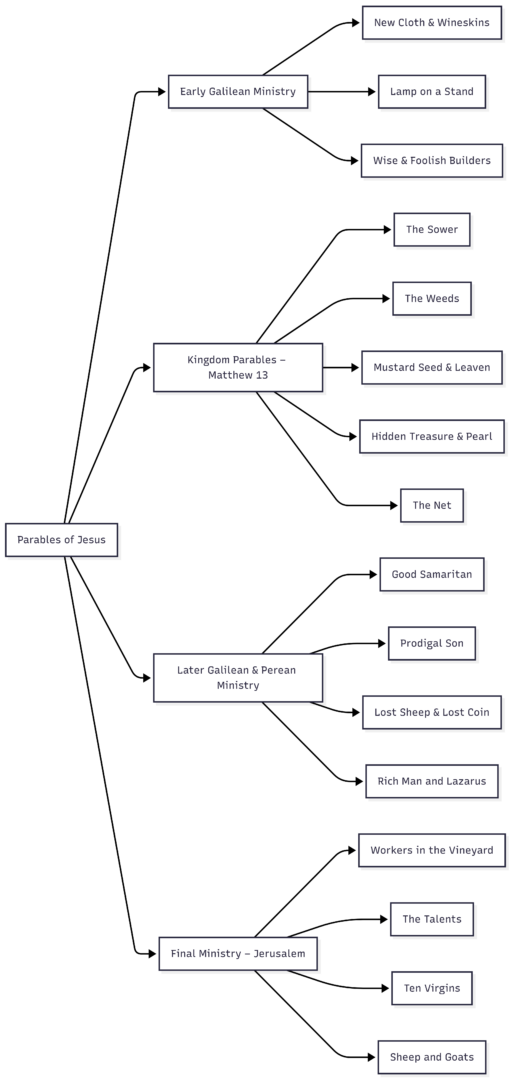
Parables in the Gospel of Matthew
Matthew wrote primarily for a Jewish audience seeking to understand Jesus as the Messiah. His Gospel contains the largest concentration of unique parables, many centered on the Kingdom of Heaven and the coming judgment.
1. New Cloth and New Wineskins
Passage: Matthew 9:16–17 | Mark 2:21–22 | Luke 5:36–38 Audience: John the Baptist’s disciples Key Verse: “No one sews a patch of unshrunk cloth on an old garment, for the patch will pull away from the garment, making the tear worse” (Matthew 9:16).
Jesus responds to a question about fasting by explaining that His ministry cannot simply be grafted onto existing Jewish religious traditions. Like unshrunk cloth sewn onto old fabric or new wine poured into brittle wineskins, the new covenant He was inaugurating required entirely new frameworks.
2. The Lamp on a Stand
Passage: Matthew 5:14–16 | Mark 4:21–22 | Luke 8:16 Audience: A great crowd (Sermon on the Mount) Key Verse: “Let your light shine before others, that they may see your good deeds and glorify your Father in heaven” (Matthew 5:16).
Jesus tells His followers they are the light of the world. Just as a lamp belongs on a stand — not hidden under a bowl — those who follow Christ are meant to be visible, their good works pointing others toward God.
3. The Wise and Foolish Builders
Passage: Matthew 7:24–27 | Luke 6:47–49 Audience: A great crowd (Sermon on the Mount) Key Verse: “Everyone who hears these words of mine and puts them into practice is like a wise man who built his house on the rock” (Matthew 7:24).
Obedience to Christ’s teaching is a foundation that withstands storms. Ignoring it is like building on sand — when life’s pressures come, everything collapses. To first-century Jews, this was radical: Jesus was placing His own words alongside the authority of the Torah.
4. The Sower
Passage: Matthew 13:3–23 | Mark 4:3–20 | Luke 8:5–15 Audience: A large crowd beside a lake Key Verse: “The seed falling on good soil refers to someone who hears the word and understands it. This is the one who produces a crop, yielding a hundred, sixty or thirty times what was sown” (Matthew 13:23).
Four types of soil represent four responses to the gospel. The path, rocky ground, and thorny soil each describe hearts that fail to sustain faith — through spiritual hardness, shallow commitment, or divided loyalties. Only the good soil produces lasting fruit. Jesus teaches that the condition of the heart determines how the gospel takes root.
5. The Weeds (Darnel)
Passage: Matthew 13:24–30, 36–43 Audience: A large crowd, with private explanation to the disciples Key Verses: “Let both grow together until the harvest. At that time I will tell the harvesters: First collect the weeds and tie them in bundles to be burned; then gather the wheat and bring it into my barn” (Matthew 13:29–30).
Darnel — a weed nearly indistinguishable from wheat in early growth — illustrates that the visible church will contain both genuine and false disciples until the final judgment. Jesus warns against premature human attempts to sort out who truly belongs to God’s kingdom. That determination belongs to God alone at the end of the age.
6. The Mustard Seed
Passage: Matthew 13:31–32 | Mark 4:30–32 | Luke 13:18–19 Key Verse: “Though it is the smallest of all seeds, yet when it grows, it is the largest of garden plants and becomes a tree” (Matthew 13:32).
The Kingdom of God would begin from the most unlikely and inauspicious origins — a group of fishermen and tax collectors following an itinerant rabbi from Galilee — yet grow to reshape human history and provide shelter for people from every nation.
7. The Leaven (Yeast)
Passage: Matthew 13:33 | Luke 13:20–21 Key Verse: “The kingdom of heaven is like yeast that a woman took and mixed into about sixty pounds of flour until it worked all through the dough” (Matthew 13:33).
Working alongside the Mustard Seed parable, the Leaven explains how the kingdom spreads — not through political force or conquest, but by quietly working its way through individuals, families, and cultures, transforming from within.
8. The Hidden Treasure and the Pearl
Passage: Matthew 13:44–46 Audience: The disciples Key Verse: “The kingdom of heaven is like treasure hidden in a field. When a man found it, he hid it again, and then in his joy went and sold all he had and bought that field” (Matthew 13:44–46).
These two brief parables share a single point: the Kingdom of God is worth everything. Both men — the one who stumbles on buried treasure and the merchant who seeks fine pearls — willingly sacrifice all they have to obtain it. No other allegiance compares.
9. The Net
Passage: Matthew 13:47–50 Key Verse: “When it was full, the fishermen pulled it up on the shore. Then they sat down and collected the good fish in baskets, but threw the bad away” (Matthew 13:48).
Similar to the Parable of the Weeds, this parable addresses final judgment. The gospel net draws in all kinds of people — the sincere and the superficial — but at the end of the age, a separation will occur. True disciples will be distinguished from those who were merely adjacent to the message.
10. The Lost Sheep (Matthew)
Passage: Matthew 18:12–14 Key Verse: “Your Father in heaven is not willing that any of these little ones should perish” (Matthew 18:14).
Spoken to the disciples after they asked who was greatest in the Kingdom, Jesus centers the conversation on the vulnerable — children, the overlooked, the marginalized. God’s care for even one wandering soul is so intense that He will leave the 99 to go after the one.
11. The Unforgiving Servant
Passage: Matthew 18:23–35 Context: Peter asks how many times we must forgive. Key Verse: “Shouldn’t you also have had mercy on your fellow servant, even as I had mercy on you?” (Matthew 18:33).
A king forgives a servant an astronomical, unpayable debt. That same servant then refuses to forgive a colleague a small sum — and is condemned for it. The point is direct: those who have received God’s extravagant forgiveness have no basis for withholding mercy from others.
12. The Workers in the Vineyard
Passage: Matthew 20:1–16 Key Verse: “So the last will be first, and the first will be last” (Matthew 20:16).
A landowner hires workers at different hours throughout the day but pays everyone the same wage. Those hired first protest the generosity shown to latecomers. The parable addresses Israel’s resentment at God extending covenant blessings to Gentiles — and corrects the assumption that longer service entitles greater reward in the Kingdom.
13. The Two Sons
Passage: Matthew 21:28–32 Key Verse: “The tax collectors and the prostitutes are entering into God’s Kingdom before you” (Matthew 21:31).
One son refuses to work in the vineyard but later goes. The other agrees but never follows through. Jesus contrasts the outward religious compliance of the Pharisees — who promised obedience but rejected God — with the sinners who had been disobedient but genuinely repented.
14. The Tenants
Passage: Matthew 21:33–44 | Mark 12:1–11 | Luke 20:9–18 Key Verse: “The kingdom of God will be taken away from you and given to a people who will produce its fruit” (Matthew 21:43).
Tenant farmers repeatedly abuse the landowner’s servants and ultimately kill his son. This is an unmistakable allegory: the landowner is God, the servants are the prophets, and the son is Jesus. The religious leaders understood they were the tenants in this story. The parable foreshadows both the crucifixion and the extension of God’s kingdom to all nations.
15. The Wedding Banquet
Passage: Matthew 22:1–14 Key Verse: “Those I invited did not deserve to come” (Matthew 22:8).
Invited guests repeatedly refuse to attend and even kill the king’s servants. The king fills the banquet with anyone he can find — but when a guest arrives without proper wedding attire, he is removed. The parable warns that even those newly welcomed into God’s kingdom must be clothed in the righteousness made available through Christ.
16. The Fig Tree
Passage: Matthew 24:32–35 | Mark 13:28–29 | Luke 21:29–31 Key Verse: “When you see all these things, you know that it is near, right at the door” (Matthew 24:33).
The fig tree’s budding leaves signal that summer is coming. Jesus instructs the disciples to read the signs of the times with the same attentiveness. The signs He describes in His Olivet Discourse should alert His followers that the end is approaching.
17. The Ten Virgins
Passage: Matthew 25:1–13 Key Verse: “Therefore keep watch, because you do not know the day or the hour” (Matthew 25:13).
Ten bridesmaids wait to escort a bridegroom in a wedding procession. Five bring extra oil for their lamps; five do not. When the bridegroom is delayed and finally arrives at midnight, the unprepared five run to buy oil and miss the feast entirely. The lesson is not simply about readiness but about the kind of sustained, internalized preparation that cannot be borrowed from others at the last moment.
18. The Talents
Passage: Matthew 25:14–30 | Luke 19:12–27 Key Verse: “For whoever has will be given more, and they will have an abundance. Whoever does not have, even what they have will be taken from them” (Matthew 25:29).
A master entrusts three servants with different sums before leaving on a journey. Two invest and multiply what they received; the third buries his out of fear. The master rewards the faithful stewards and condemns the one who hoarded. Every follower of Christ is accountable for how they use what has been entrusted to them — gifts, resources, and the grace they have received.
19. The Sheep and the Goats
Passage: Matthew 25:31–46 Key Verse: “Whatever you did for one of the least of these brothers and sisters of mine, you did for me” (Matthew 25:40).
At the final judgment, people are separated by how they treated the hungry, thirsty, stranger, naked, sick, and imprisoned. Jesus identifies so completely with the vulnerable that service to them is service to Him. Authentic saving faith is not passive — it produces active compassion for those in need.
Parables Unique to Mark
Mark’s Gospel is concise and action-oriented. While most of its parables overlap with Matthew, two are unique to Mark.
20. The Growing Seed
Passage: Mark 4:26–29 Key Verse: “All by itself the soil produces grain — first the stalk, then the head, then the full kernel in the head” (Mark 4:28).
The kingdom grows without human effort or engineering. A farmer sows seed, sleeps, rises — and the seed grows by its own power. This parable corrects any expectation that the Kingdom of God would be established through human force or political strategy.
21. The Watchful Servants
Passage: Mark 13:34–37 Key Verse: “What I say to you, I say to everyone: Watch!” (Mark 13:37).
A master leaves his household in the care of servants, each assigned specific duties. They are instructed to remain vigilant because they do not know when he will return. This parable parallels the Ten Virgins and emphasizes readiness in carrying out one’s responsibility.
Parables Unique to Luke
Luke contains more unique parables than any other Gospel — over 15 found only in his account. These stories tend to center on mercy, prayer, social reversal, and God’s relentless pursuit of the lost.
22. The Two Debtors (Moneylender)
Passage: Luke 7:41–43 Context: A sinful woman anoints Jesus at a Pharisee’s dinner. Key Verse: “Which of them will love him more?” (Luke 7:42).
A lender forgives two debts — one large, one small. The person forgiven more will love the lender more. Jesus uses this to explain why the sinful woman worships extravagantly: she understands how much she has been forgiven. The Pharisee, confident in his own righteousness, does not share that experience of grace.
23. The Good Samaritan
Passage: Luke 10:30–37 Audience: A teacher of the law Key Verses: “Which of these three do you think was a neighbour to the man who fell into the hands of robbers? … The one who had mercy on him … Go and do likewise” (Luke 10:36–37).
A man is beaten and left for dead. A priest and a Levite pass by without helping. A Samaritan — despised by Jews for centuries of ethnic and religious tension — stops, treats the man’s wounds, and pays for his care. Jesus answers the lawyer’s question (“Who is my neighbor?”) by showing that a true neighbor is defined not by shared ethnicity but by the willingness to show mercy. The application extends to all: anyone in need can be our neighbor.
24. The Friend at Night
Passage: Luke 11:5–8 Context: A disciple asks Jesus to teach them to pray. Key Verse: “Because of your shameless audacity he will surely get up and give you as much as you need” (Luke 11:8).
A man wakes his neighbor at midnight to borrow bread for a guest. Despite the inconvenience, the neighbor gets up and helps — because of the man’s persistent boldness. Jesus is not comparing God to a reluctant friend. He is contrasting: if even an inconvenienced man responds to bold persistence, how much more will a loving God respond to persistent prayer?
25. The Rich Fool
Passage: Luke 12:16–21 Context: A man asks Jesus to arbitrate an inheritance dispute. Key Verse: “You fool! This very night your life will be demanded from you. Then who will get what you have prepared for yourself?” (Luke 12:20).
A wealthy farmer accumulates such abundance that he tears down his barns to build bigger ones. His plan: store up enough goods, then relax and enjoy life. God calls him a fool — not because he was prudent, but because he completely ignored the reality of death and eternity. Wealth accumulated for personal comfort, with no regard for God, is worthless the moment life ends.
26. The Barren Fig Tree
Passage: Luke 13:6–9 Key Verse: “If it bears fruit next year, fine! If not, then cut it down” (Luke 13:9).
A vineyard owner wants a fruitless fig tree removed. The caretaker asks for one more year to fertilize and tend it. If it still bears no fruit, it will be cut down. Jesus calls people to repentance while the opportunity remains — because fruitlessness cannot continue indefinitely.
27. The Place of Honor (Wedding Feast)
Passage: Luke 14:7–11 Key Verse: “For all those who exalt themselves will be humbled, and those who humble themselves will be exalted” (Luke 14:11).
Jesus watches Pharisees jockeying for the best seats at a dinner party and addresses them directly. Choose the lowest seat — if the host moves you up, you are honored. Choose the highest seat — if the host removes you, you are humiliated. The deeper application: the Pharisees assumed prominent places in God’s kingdom. Jesus was warning them that a great reversal was coming.
28. The Great Banquet
Passage: Luke 14:16–24 Key Verse: “Not one of those who were invited will get a taste of my banquet” (Luke 14:24).
A man prepares a great feast, but every invited guest makes an excuse. In response, the host sends his servants into the streets to invite the poor, disabled, and outcasts. When there is still room, they go further — to roads and country lanes — compelling travelers to come in. Israel’s religious establishment was refusing God’s invitation; the kingdom would be filled with those they least expected.
29. The Lost Sheep, Lost Coin, and Prodigal Son
Passage: Luke 15:3–32 Context: The Pharisees grumble that Jesus associates with sinners.
These three parables form a triptych on God’s attitude toward the lost. In the first, a shepherd leaves 99 sheep to find one that wandered. In the second, a woman tears apart her house to find one lost coin. In the third — the most developed — a son demands his inheritance, squanders it, and returns in disgrace. The father sees him coming from a distance, runs to him, and throws a celebration.
The parable is often called the story of the Prodigal Son, but its real focus is the older brother — a figure for the Pharisees — who resents the grace shown to his returning sibling. The father’s response to the older son is also a word to the religious establishment: “All that I have is yours. But your brother was lost and is found.”
The progression from sheep to coin to son is intentional: value escalates with each story, and God’s joy at finding the lost intensifies accordingly.
30. The Unjust Steward
Passage: Luke 16:1–13 Key Verse: “Use worldly wealth to gain friends for yourselves, so that when it is gone, you will be welcomed into eternal dwellings” (Luke 16:9).
One of the most puzzling parables. A dishonest manager, about to be fired for mismanaging his employer’s finances, quickly reduces the debts of everyone who owes his master — securing favor for himself before his dismissal. Jesus does not commend his dishonesty, but commends his shrewdness. The point: worldly people often use their resources more strategically than believers do. Christians should use material wealth with similar purposefulness — but in service of eternal outcomes.
31. The Rich Man and Lazarus
Passage: Luke 16:19–31 Key Verse: “If they do not listen to Moses and the Prophets, they will not be convinced even if someone rises from the dead” (Luke 16:31).
A wealthy man who feasts daily ignores a sick beggar named Lazarus at his gate. After both die, their positions are reversed: Lazarus rests in Abraham’s side while the rich man suffers in torment. The rich man begs Abraham to send Lazarus to warn his brothers. Abraham refuses: they have the Law and the Prophets — if they won’t hear those, a resurrection won’t persuade them either. This final line is prophetically pointed toward Jesus’ own resurrection and the religious leaders who would still reject it.
32. The Persistent Widow
Passage: Luke 18:1–8 Context: Jesus teaches on persistent prayer. Key Verse: “Will not God bring about justice for his chosen ones, who cry out to him day and night?” (Luke 18:7).
A corrupt judge has no motivation to help anyone — but a widow keeps coming back until he relents simply to stop being pestered. Jesus again uses a contrast rather than a comparison: if even an unjust judge can be worn down, how much more will a just and loving God respond to the persistent prayers of His people?
33. The Pharisee and the Tax Collector
Passage: Luke 18:9–14 Context: Spoken to those confident in their own righteousness. Key Verse: “For all those who exalt themselves will be humbled, and those who humble themselves will be exalted” (Luke 18:14).
Two men pray in the temple. The Pharisee catalogs his virtues — fasting, tithing, moral superiority. The tax collector beats his chest and asks only for mercy. Jesus declares it is the tax collector who goes home justified. This parable directly confronts the assumption that religious performance earns standing before God. Approach to God must begin with honest acknowledgment of need, not confidence in personal achievement.
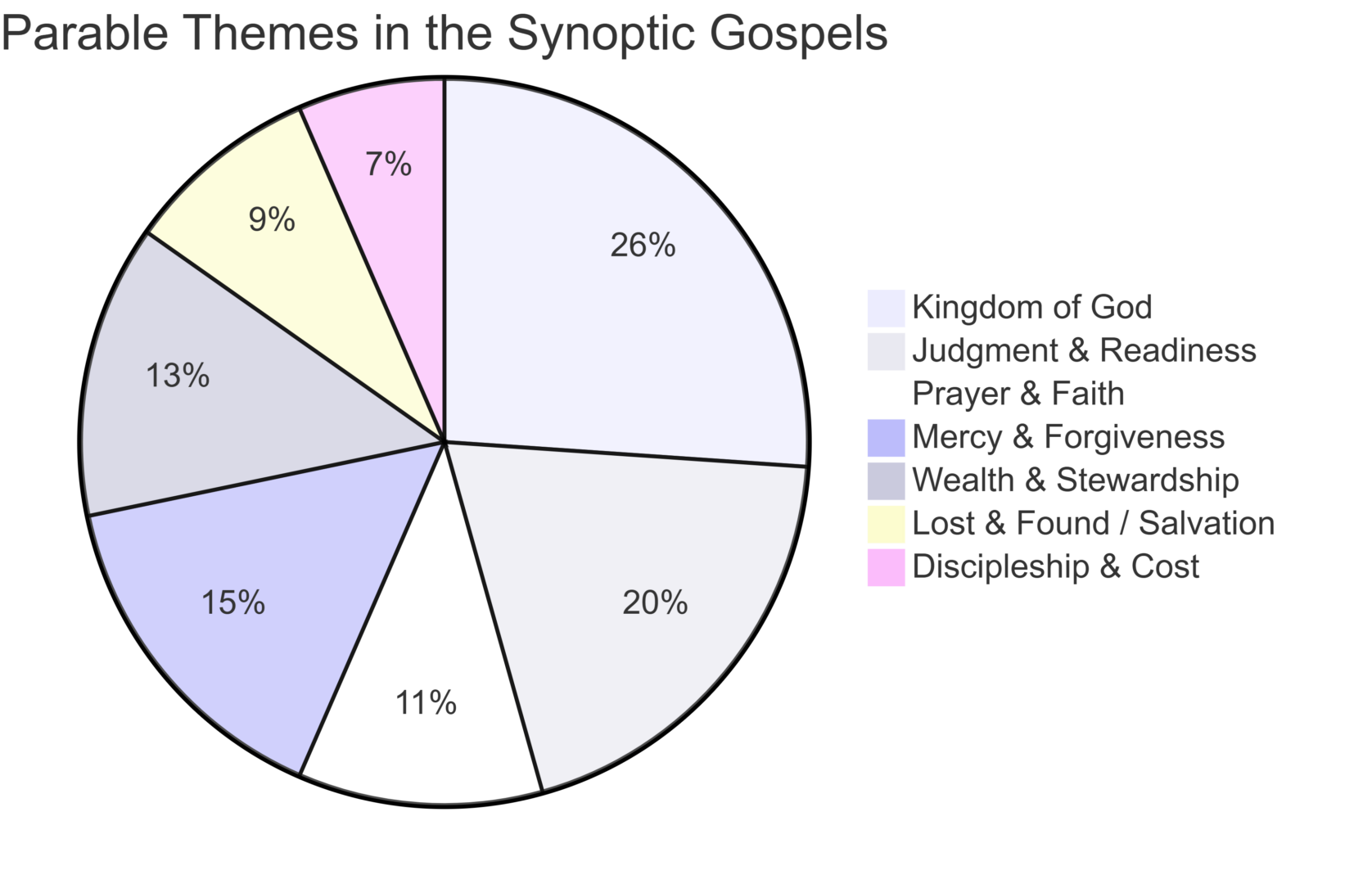
Thematic Overview of the Parables
Why Did Jesus Teach in Parables?
When the disciples asked why Jesus spoke to crowds in parables, He gave a specific reason: “Because the knowledge of the secrets of the kingdom of heaven has been given to you, but not to them” (Matthew 13:11). Parables simultaneously revealed truth to those genuinely seeking it and concealed it from those whose hearts were hardened. They acted as both an invitation and a test.
This method also made His teaching memorable and resistant to distortion. Stories travel across generations with their meaning intact in ways that abstract propositions often do not.
Key Takeaways
The parables of Jesus cover an extraordinary range of spiritual ground, but several consistent themes run throughout:
- The Kingdom of God grows from small, unlikely beginnings and operates by counterintuitive principles — the last become first, the humble are exalted, the lost are celebrated.
- Judgment is coming, and readiness is not passive — it requires active faithfulness and fruit-bearing.
- God relentlessly pursues the lost and rejoices when they return.
- Forgiveness and mercy cannot be compartmentalized — those who receive them must extend them.
- Wealth and resources are tools for eternal investment, not ends in themselves.
- Prayer should be persistent, humble, and grounded in an accurate understanding of who God is.
Together, these 40+ stories form the most coherent and compact body of moral and spiritual instruction ever given by a single teacher — and their clarity is inseparable from the simplicity of the form Jesus chose.
Please share this All Jesus’ Parables: In Order With Bible Passages By Christ with your friends and do a comment below about your feedback.
We will meet you on next article.
Until you can read, Sketch Arm Tattoo Designs 4K HD Download