Parables of Jesus (All 38 Parables with Verses & Meaning)
A parable is a short story drawn from everyday life that carries a deeper spiritual meaning. Jesus used this teaching method more than any other form of instruction. His parables drew on farming, fishing, weddings, household management, and legal disputes — the ordinary world his listeners inhabited — and turned those familiar scenes into windows on the Kingdom of God.
The 38 parables cataloged here are the standard traditional grouping drawn from the Synoptic Gospels (Matthew, Mark, and Luke). Each includes its scripture reference, a summary of the story, and its core meaning.
Why Jesus Taught in Parables
Jesus wasn’t the first Jewish teacher to use parables — the form existed in earlier Jewish wisdom literature. But he used them more extensively and more centrally than any predecessor. Where earlier teachers subordinated parables to Torah interpretation, Jesus made them his primary mode of communication.
When his disciples asked why he taught in parables, he gave a direct answer: the mysteries of the Kingdom are given to those who genuinely seek them, not to those who merely observe (Matthew 13:11–12). Parables simultaneously reveal and conceal — accessible enough for anyone to hear, but requiring genuine engagement to understand. A casual listener walks away with an interesting story. A serious listener walks away confronted.
Most of Jesus’ parables address three recurring concerns: the nature and arrival of the Kingdom of God, the right use of resources and relationships, and readiness for final judgment.
All 38 Parables: Overview Table
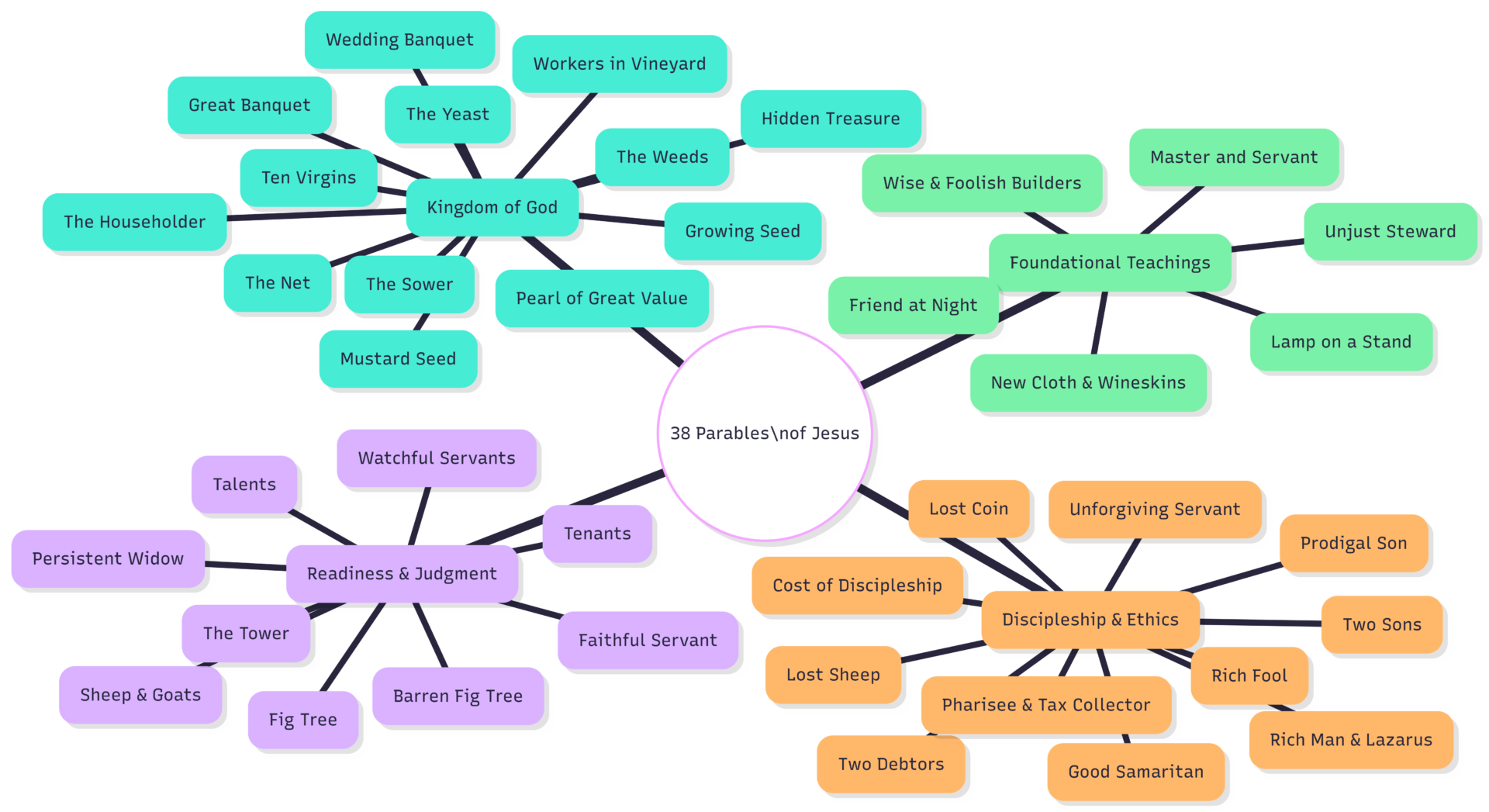
| # | Parable | Matthew | Mark | Luke | Core Meaning |
|---|---|---|---|---|---|
| 1 | New Cloth & New Wineskins | 9:16–17 | 2:21–22 | 5:36–39 | Jesus’ new teaching requires new forms |
| 2 | Lamp on a Stand | 5:14–16 | 4:21–25 | 8:16–18 | Believers should let their light be seen |
| 3 | Wise & Foolish Builders | 7:24–27 | — | 6:47–49 | Build life on Jesus’ teachings |
| 4 | Two Debtors | — | — | 7:41–43 | Greater forgiveness leads to greater love |
| 5 | Rich Fool | — | — | 12:16–21 | Life is not measured by possessions |
| 6 | Watchful Servants | — | 13:34–37 | 12:35–40 | Stay ready for the Lord’s return |
| 7 | Faithful Servant | 24:45–51 | — | 12:42–48 | Responsibility scales with what is given |
| 8 | Barren Fig Tree | — | — | 13:6–9 | Repent before judgment comes |
| 9 | The Sower | 13:3–23 | 4:3–20 | 8:5–15 | The heart determines how truth takes root |
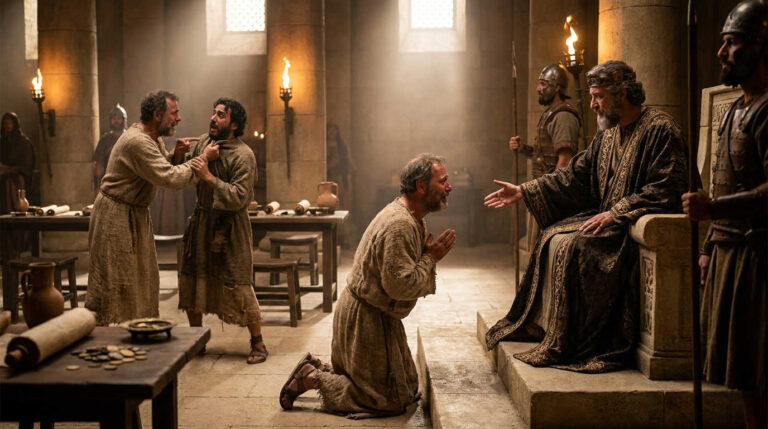
| 10 | The Weeds | 13:24–43 | — | — | Good and evil coexist until final judgment |
| 11 | Growing Seed | — | 4:26–29 | — | The Kingdom grows mysteriously |
| 12 | Mustard Seed | 13:31–32 | 4:30–32 | 13:18–19 | The Kingdom starts small and grows large |
| 13 | The Yeast | 13:33 | — | 13:20–21 | The Kingdom spreads pervasively |
| 14 | Hidden Treasure & Pearl | 13:44–46 | — | — | The Kingdom is worth everything |
| 15 | The Net | 13:47–50 | — | — | All are gathered; sorted at the end |
| 16 | The Householder | 13:52 | — | — | Bringing out old and new treasures |
| 17 | Lost Sheep | 18:12–14 | — | 15:3–7 | God rejoices over one repentant sinner |
| 18 | Master and Servant | — | — | 17:7–10 | No one earns God’s favor through duty |
| 19 | Unforgiving Servant | 18:23–35 | — | — | Forgive as you have been forgiven |
| 20 | Good Samaritan | — | — | 10:30–37 | Love your neighbor without limits |
| 21 | Friend at Night | — | — | 11:5–13 | Persist in prayer |
| 22 | Wedding Feast | — | — | 14:7–14 | Humility over self-promotion |
| 23 | Great Banquet | — | — | 14:16–24 | Many invited; excuses disqualify |
| 24 | The Tower | — | — | 14:28–33 | Count the cost of discipleship |
| 25 | Lost Coin | — | — | 15:8–10 | God values every individual |
| 26 | Prodigal Son | — | — | 15:11–32 | God welcomes repentant sinners home |
| 27 | Unjust Steward | — | — | 16:1–13 | Use worldly resources for eternal ends |
| 28 | Rich Man & Lazarus | — | — | 16:19–31 | Ignoring the suffering of others has consequences |
| 29 | Workers in the Vineyard | 20:1–16 | — | — | God’s generosity transcends human fairness |
| 30 | Persistent Widow | — | — | 18:1–8 | Persist in seeking justice; pray without ceasing |
| 31 | Pharisee & Tax Collector | — | — | 18:9–14 | Humility valued above self-righteousness |
| 32 | Two Sons | 21:28–32 | — | — | Action matters more than words |
| 33 | The Tenants | 21:33–44 | 12:1–11 | 20:9–18 | Judgment on those who reject God’s messengers |
| 34 | Wedding Banquet | 22:1–14 | — | — | Many called; few chosen |
| 35 | Fig Tree | 24:32–35 | 13:28–31 | 21:29–33 | Read the signs of the times |
| 36 | Ten Virgins | 25:1–13 | — | — | Prepare; the hour is unknown |
| 37 | The Talents | 25:14–30 | — | 19:12–27 | Use what God has given |
| 38 | Sheep & Goats | 25:31–46 | — | — | Judgment based on how we treated the vulnerable |
The Parables in Detail
Parables of the Kingdom of God
These parables describe what the Kingdom of Heaven is like — its unexpected origins, its hidden nature, its growth, and its mixed composition until the final separation.
1. New Cloth and New Wineskins (Matthew 9:16–17; Mark 2:21–22; Luke 5:36–39)
“No one puts new wine into old wineskins, or else the skins would burst, and the wine be spilled, and the skins ruined. No, they put new wine into fresh wineskins, and both are preserved.”
Jesus uses two images — patching old cloth with new fabric, and putting new wine into old containers — to make the same point: his message is not a patch on the existing religious system. It requires a new framework entirely. This parable appears near the beginning of Jesus’ ministry and frames everything that follows.
9. The Sower (Matthew 13:3–23; Mark 4:3–20; Luke 8:5–15)
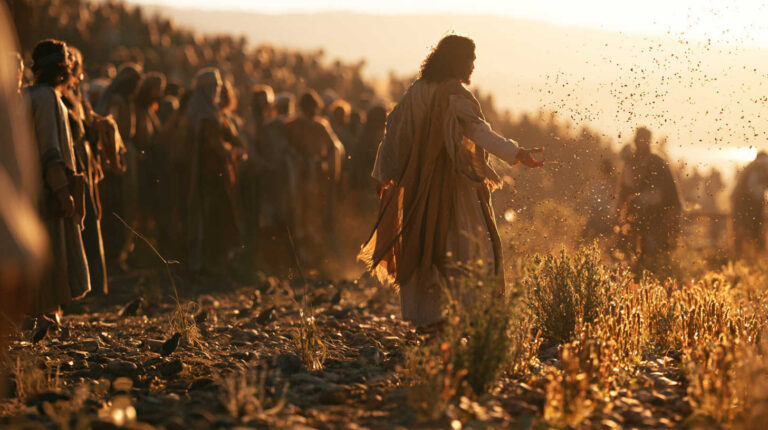
“Behold, a farmer went out to sow. As he sowed, some seeds fell by the roadside… others fell on rocky ground… others fell among thorns… others fell on good soil and yielded fruit: some one hundred times as much, some sixty, and some thirty.”
This is one of the few parables Jesus explained directly. The seed is God’s word. The four types of soil represent four kinds of hearers: those from whom the message is immediately taken (the roadside); those who receive it with joy but have no depth (rocky ground); those choked by the cares and distractions of life (thorns); and those who genuinely receive and bear fruit (good soil). The parable teaches that the outcome of hearing depends not on the seed but on the condition of the heart.
10. The Weeds (Matthew 13:24–30, 36–43)
“An enemy has done this. Do you want us to go and gather them up? But he said, ‘No, lest perhaps while you gather up the darnel weeds, you root up the wheat with them.'”
Jesus explains this parable too: the sower is the Son of Man, the field is the world, the good seed are those who belong to the Kingdom, the weeds are those who belong to the evil one. The point is not that good and evil are indistinguishable — it’s that premature judgment would destroy the good alongside the bad. The sorting belongs to God at the final harvest.
11. The Growing Seed (Mark 4:26–29)
“God’s Kingdom is as if a man should cast seed on the earth, and should sleep and rise night and day, and the seed should spring up and grow, though he doesn’t know how.”
Unique to Mark, this parable emphasizes the mysterious, self-generating nature of the Kingdom. The farmer does not understand the mechanism of growth — he simply plants and watches. The Kingdom advances by God’s power, not human effort.
12–13. Mustard Seed and Yeast (Matthew 13:31–33; Mark 4:30–32; Luke 13:18–21)
Two brief parables making the same point from different angles. A mustard seed — the smallest of seeds — becomes the largest of garden plants. Yeast hidden in three measures of flour leavens the entire batch. The Kingdom begins imperceptibly small and spreads through everything it touches. Both parables challenge the expectation of an obvious, dramatic arrival.
14. Hidden Treasure and Pearl of Great Value (Matthew 13:44–46)
Two paired parables about the supreme worth of the Kingdom. A man stumbles upon treasure hidden in a field and sells everything he owns to buy that field. A merchant searching for fine pearls finds one of incomparable value and sells all he has to acquire it. The Kingdom is not one priority among many — it is the one thing worth trading everything else to obtain.
15. The Net (Matthew 13:47–50)
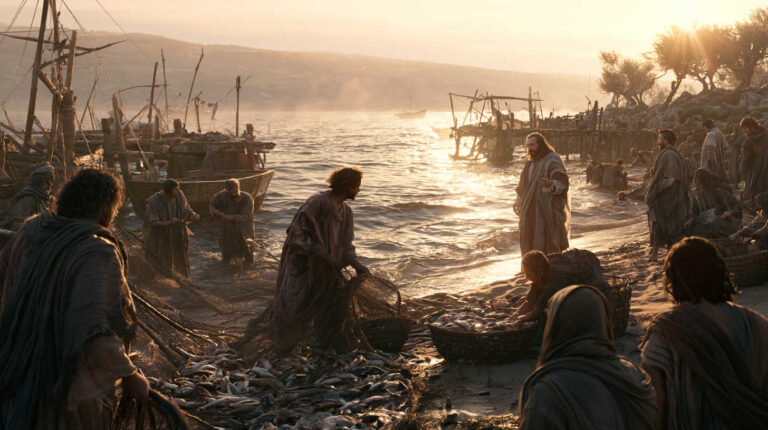
A dragnet catches fish of every kind. Only when it is full and drawn to shore are the good fish sorted from the bad. This mirrors the Weeds parable: the Kingdom gathers a mixed multitude now; the final sorting belongs to the end of the age.
Parables of Discipleship and Ethics
These parables address how followers of Jesus are to live — the nature of love, forgiveness, humility, and the proper use of wealth.
20. The Good Samaritan (Luke 10:30–37)
“A certain man was going down from Jerusalem to Jericho, and he fell among robbers… But a certain Samaritan, as he travelled, came where he was. When he saw him, he was moved with compassion.”
A man beaten and left for dead on the road to Jericho is passed by two religious figures — a priest and a Levite — who cross to the other side. A Samaritan (a member of an ethnic group despised by Jews) stops, provides medical care, transports the man to an inn, and pays for his ongoing care. Jesus asks which of the three was “neighbor” to the man. The parable redefines the question “Who is my neighbor?” — the relevant question is not who qualifies as your neighbor, but whether you act as one.
26. The Prodigal Son (Luke 15:11–32)
“But while he was still far off, his father saw him and was moved with compassion, and ran, fell on his neck, and kissed him.”
A younger son demands his inheritance early and squanders it abroad. Reduced to feeding pigs, he returns home rehearsing an apology. Before he can speak, his father runs to meet him, restores his status fully, and throws a celebration. The older son, who stayed and worked faithfully, is furious. The father’s reply — “Son, you are always with me, and all that is mine is yours” — is equally significant. Three characters, three responses: the father’s joy, the younger son’s repentance, the older son’s resentment. All three reveal something about the nature of grace.
19. The Unforgiving Servant (Matthew 18:23–35)
A servant forgiven an astronomical debt — ten thousand talents, a sum impossible to repay — immediately turns around and has a fellow servant imprisoned over a trivial amount. The king revokes the forgiveness. The lesson is explicit: the standard by which we forgive others is the standard we invoke for ourselves.
28. The Rich Man and Lazarus (Luke 16:19–31)
A wealthy man who feasted in luxury daily ignores a beggar named Lazarus at his gate. Both die. In the afterlife their positions are reversed. The rich man, in torment, asks Abraham to send Lazarus back to warn his brothers. Abraham’s reply is striking: “They have Moses and the prophets. Let them listen to them.” The parable warns that the evidence for how to live is already available — those who ignore the poor in this life have been warned.
38. The Sheep and the Goats (Matthew 25:31–46)
“Most certainly I tell you, because you did it to one of the least of these my brothers, you did it to me.”
At the final judgment, all nations are separated as a shepherd separates sheep from goats. The criterion is not doctrine or religious practice but treatment of the hungry, the thirsty, the stranger, the naked, the sick, and the imprisoned. Remarkably, neither group knew they were serving or failing Jesus in those encounters — both are surprised. The parable argues that how we treat the vulnerable reveals our actual orientation more clearly than any formal religious activity.
Parables of Readiness and Judgment
36. The Ten Virgins (Matthew 25:1–13)
Ten bridesmaids wait for the bridegroom. Five bring extra oil; five do not. The bridegroom is delayed. When he finally arrives at midnight, the five without extra oil have none left. While they go to buy more, the bridegroom arrives and the door is shut. “Most certainly I tell you, I don’t know you.” The parable emphasizes that readiness cannot be borrowed or transferred — it must be cultivated in advance.
37. The Talents (Matthew 25:14–30; Luke 19:12–27)
A master entrusts significant sums to three servants — five talents, two, and one — each according to their ability. The first two invest and double their amounts. The third buries his, returning only the original. The master commends the first two and condemns the third. The parable is not primarily about financial investment; it concerns the use of any gift, capacity, or responsibility entrusted to a person. The failure condemned is not the amount produced but the decision not to engage at all.
33. The Tenants (Matthew 21:33–44; Mark 12:1–11; Luke 20:9–18)
A landowner leases his vineyard to farmers and sends servants to collect fruit at harvest time. The farmers beat and kill the servants. Finally he sends his son — “they will respect my son.” The farmers kill him too, to seize the inheritance. Jesus then quotes Psalm 118: “The stone which the builders rejected was made the head of the corner.” The religious leaders understood immediately that the parable was directed at them — they were the tenants, the servants were the prophets, and the son was Jesus.
Key Themes Across the 38 Parables
| Theme | Representative Parables | Core Teaching |
|---|---|---|
| The Kingdom’s nature | Mustard Seed, Yeast, Growing Seed | Starts small; grows through hidden processes |
| The Kingdom’s value | Hidden Treasure, Pearl of Great Value | Worth surrendering everything to obtain |
| Final judgment | Weeds, Net, Sheep & Goats, Ten Virgins | Separation comes; readiness is required now |
| Forgiveness | Prodigal Son, Unforgiving Servant, Two Debtors | We receive and give forgiveness in the same measure |
| Prayer | Friend at Night, Persistent Widow | Persistence in prayer is expected and rewarded |
| Wealth and the poor | Rich Fool, Rich Man & Lazarus, Good Samaritan | Resources are for others, not for hoarding |
| Humility | Pharisee & Tax Collector, Wedding Feast | God honors the humble; self-exaltation reverses |
| Accountability | Talents, Faithful Servant, Workers in Vineyard | Stewardship will be evaluated; engagement is required |
The 38 parables of Jesus are not simply moral lessons or spiritual illustrations. They are challenges. Each one assumes that the listener will either recognize themselves in the story or resist doing so. That dynamic — recognition, resistance, and the call to respond — is what made Jesus’ teaching so powerful in his own time and what keeps these stories from settling into comfortable familiarity.
Please share this Parables of Jesus (All 38 Parables with Verses & Meaning) with your friends and do a comment below about your feedback.
We will meet you on next article.
Until you can read, Chronological Order Of New Testament