
Parable of the Persistent Widow: Verse, Meaning & Lesson
Prayer that seems to go unanswered is one of the most common struggles in the life of faith. The Parable of the Persistent Widow, told by Jesus in Luke 18:1-8, speaks directly to that struggle. It is a short story about a widow who refuses to stop asking a corrupt judge for justice — and it carries one of the clearest teachings in the Gospels on why believers should keep praying even when answers seem delayed.
This guide breaks down the full verse, the historical setting, what the parable actually means, and how to apply its lesson today.
Quick Overview
| Detail | Information |
|---|---|
| Scripture location | Luke 18:1-8 |
| Speaker | Jesus Christ |
| Audience | His disciples |
| Main characters | An unjust judge, a persistent widow |
| Core theme | Persistent, faithful prayer |
| Literary type | Parable (a short illustrative story) |
| Related parable | The Persistent Neighbor (Luke 11:5-10) |
What Is a Parable?
A parable is a short, everyday story used to illustrate a spiritual or moral truth. Jesus used ordinary settings — farms, weddings, households, courtrooms — so that His listeners could relate to the surface story while wrestling with a deeper meaning underneath it.
Parables were not simple illustrations; they required the listener to engage, reflect, and often reconsider their assumptions about God, themselves, or the world. That is exactly what happens in the story of the widow and the judge: it flips the listener’s expectations of who God is by contrasting Him with someone who is nothing like Him.
The Full Text of Luke 18:1-8
Then Jesus told his disciples a parable to show them that they should always pray and not give up. He said: “In a certain town there was a judge who neither feared God nor cared what people thought. And there was a widow in that town who kept coming to him with the plea, ‘Grant me justice against my adversary.’ For some time he refused. But finally he said to himself, ‘Even though I don’t fear God or care what people think, yet because this widow keeps bothering me, I will see that she gets justice, so that she won’t eventually come and attack me!'”
And the Lord said, “Listen to what the unjust judge says. And will not God bring about justice for his chosen ones, who cry out to him day and night? Will he keep putting them off? I tell you, he will see that they get justice, and quickly. However, when the Son of Man comes, will he find faith on the earth?”
A Simple Summary of the Story
- A judge in an unnamed town has no regard for God and no concern for people.
- A widow repeatedly comes before him, asking for justice against someone who has wronged her.
- The judge ignores her, again and again.
- The widow refuses to quit. She keeps coming back.
- Eventually the judge gives in — not out of compassion, but because her persistence is wearing him down.
- Jesus then draws the comparison: if even a corrupt judge eventually delivers justice, how much more will a loving, righteous God respond to those who cry out to Him?
Who’s Who in the Parable
Every character in a parable carries symbolic weight. Understanding what each figure represents is the key to unlocking the lesson.
| Character | Represents |
|---|---|
| The unjust judge | Indifference, corrupted power, and the injustice of a broken system |
| The widow | Vulnerability paired with unrelenting faith and persistence |
| God (implied) | The opposite of the judge — perfectly just, attentive, and willing to act |
It’s worth noting that the judge is not a stand-in for God. The parable works by contrast, not comparison. Jesus is not saying “God is reluctant like this judge.” He is saying, “If even this corrupt, uncaring man eventually acts justly, imagine how much more certainly a loving Father will act on behalf of those He loves.”
Historical Context: Why a Widow?
In first-century Jewish society, widows occupied one of the most vulnerable positions a person could hold. Without a husband, a woman often lost her main source of legal standing, financial support, and social protection.
Old Testament law repeatedly singles out widows for special care and protection (Deuteronomy 10:18; 24:17-21), precisely because they were so easily exploited or overlooked by those in power.
By making the central figure of this parable a widow instead of, say, a wealthy landowner, Jesus was deliberately choosing someone with no leverage, no money to offer as a bribe, and no social status to draw on. Her only tool was persistence. That detail matters: the parable isn’t about having the right connections or resources — it’s about refusing to stop asking, even from a position of powerlessness.
The judge, meanwhile, reflects a real problem of the era. Local judges under Roman-era administration were sometimes appointed more for political loyalty than integrity, and corruption among officials who exploited the poor was a well-known grievance. Jesus’s audience would have immediately recognized this judge as a believable, frustrating figure — not an exaggeration, but a type of person they had likely encountered.
What the Parable Means
Luke frames the purpose of the story before Jesus even tells it: “Then Jesus told his disciples a parable to show them that they should always pray and not give up” (Luke 18:1). Everything that follows serves that single point.
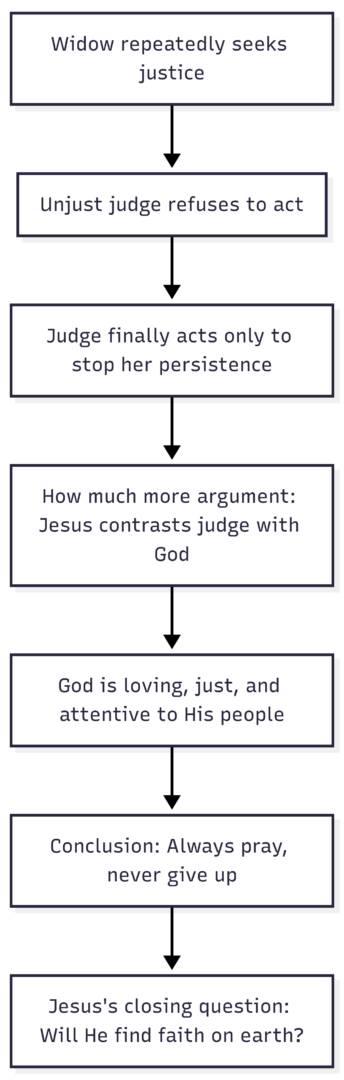
The parable makes its argument through what is sometimes called a “how much more” structure — a common rabbinic teaching technique where a lesser case is used to prove a greater one. If even an uncaring, corrupt judge can be moved to do the right thing, then a God who is inherently loving and just will certainly respond to the persistent prayers of His people. The comparison is not meant to make God look reluctant; it’s meant to remove any doubt that He will act.
There’s also a striking detail often lost in translation. The phrase describing the judge’s reason for finally helping the widow — that she was “wearing him out” — comes from a Greek term that more literally means to strike someone under the eye, like a blow in boxing.
Some scholars argue this suggests the widow’s persistence wasn’t quiet patience; it was closer to relentless, almost confrontational pressure. She was not passively waiting — she kept showing up and pressing her case until the system had no choice but to respond.
Judge vs. God: A Direct Contrast
| The Unjust Judge | God |
|---|---|
| Has no fear of God | Is holy and worthy of reverence |
| Has no regard for people | Deeply cares for His people |
| Acts only to remove annoyance | Acts out of love and justice |
| Delays out of indifference | Delays only for purposes tied to timing, not neglect |
| Responds reluctantly | Responds because He is faithful to His nature |
The Logic of the Parable
The following diagram shows how Jesus builds His argument from the lesser case (the judge) to the greater case (God), leading to His closing challenge about faith.
The Core Lessons of the Parable
1. Persistent prayer is not about manipulating God. The widow’s persistence works on the judge because he is corrupt and can be worn down. God is not worn down by prayer, nor does He need to be convinced or badgered into caring. Persistent prayer instead reflects ongoing trust — a relationship sustained over time, not a formula for forcing an outcome.
2. God’s justice is certain, even when it’s not immediate. The parable does not promise instant answers. It promises that God is just and that He will act. The gap between the widow’s first request and her final vindication mirrors the real experience of believers who pray for years about the same concern — a wayward family member, an unresolved illness, an unjust circumstance — without seeing quick resolution.
3. Faith is meant to endure delay without collapsing into despair. Jesus ends the parable with a piercing question: “When the Son of Man comes, will he find faith on the earth?” (Luke 18:8). This turns the story from a simple lesson on prayer into a challenge about endurance. The real test isn’t whether someone prays once with sincerity — it’s whether they keep believing God is just after months or years of waiting.
4. Powerlessness is not the same as helplessness. The widow had no money, no legal standing, and no advocate. What she had was the refusal to quit. The parable affirms that persistent, ordinary people — not just those with influence — have real access to justice through consistent action and prayer.
How This Parable Compares to the Persistent Neighbor
Luke includes a similar teaching earlier in his Gospel, the Parable of the Persistent Neighbor (Luke 11:5-10), in which a man wakes his friend at midnight to ask for bread and eventually receives it because of his boldness. Both parables use a “how much more” argument and both emphasize persistence, but they highlight slightly different angles.
| Persistent Neighbor (Luke 11) | Persistent Widow (Luke 18) | |
|---|---|---|
| Setting | A home at midnight | A courtroom |
| Requester | A friend needing bread | A widow needing justice |
| Person approached | A sleepy friend | A corrupt judge |
| Emphasis | Boldness in asking | Endurance and faithfulness over time |
| Underlying assurance | God is generous | God is just |
Together, the two parables build a fuller picture: God is both willing to give good things and committed to setting things right — and persistent prayer engages both realities.
Living Out the Lesson Today
Applying this parable isn’t about repeating the same prayer word-for-word until God relents. It’s about cultivating a posture of trust that doesn’t quit when circumstances stay unresolved. A few practical ways to live this out:
- Keep a prayer log. Writing down ongoing requests — and later, how they were answered — makes persistence tangible and builds a record of faithfulness over time.
- Pray in community, not isolation. The widow acted alone, but Jesus’s teaching elsewhere assumes believers pray together (Matthew 18:19-20). Sharing long-term prayer requests with others multiplies persistence.
- Separate the outcome from the relationship. Persistent prayer is sustained by trust in who God is, not by guaranteed results on a set timeline.
- Watch for God working through ordinary means. In the parable, God does not intervene directly — the widow’s own persistence is what moves the judge. Prayer and action are not opposites; persistent prayer often works alongside persistent effort.
Frequently Asked Questions
No. The parable works by contrast rather than comparison. Jesus uses the judge’s flaws to highlight, by contrast, how much more reliable and loving God is.
The widow represents anyone who feels powerless or overlooked but refuses to stop bringing their need before God. Historically, widows were among the most vulnerable people in ancient society, which makes her persistence even more striking.
The closing question — “will he find faith on the earth?” — shifts the focus from a single prayer to ongoing faithfulness. It challenges readers to consider whether they will still be trusting God by the time He returns, not just whether they prayed once.
No. The parable teaches that God’s justice is certain, not that it is instant. It calls believers to endurance rather than promising a specific timeline.
Final Thoughts
The Parable of the Persistent Widow is ultimately a story about character — both the character of the one praying and the character of the God being prayed to. The widow’s refusal to give up becomes a picture of what sustained faith looks like in a world where justice is often delayed.
And the contrast with the uncaring judge becomes a reminder that God’s reluctance is never the reason prayers go unanswered right away. The invitation of this parable is simple but demanding: keep asking, keep trusting, and don’t lose heart.
Please share this Parable of the Persistent Widow: Verse, Meaning & Lesson with your friends and do a comment below about your feedback.
We will meet you on next article.
Until you can read, Parable of the Pearl: Verse, Meaning & Lesson