Number of Chapters and Verses In Each Book of the Bible
The Bible is the best-selling and most translated book in human history, yet most readers have never seen its full structure laid out in one place. The standard Protestant Bible contains 66 books, 1,189 chapters, and 31,102 verses, split between 39 Old Testament books and 27 New Testament books. Below is a complete, easy-to-reference breakdown of every book’s chapter count, verse count, and average verses per chapter, based on the King James Version (KJV) and other widely used English translations.
Whether you’re planning a reading schedule, choosing a book to memorize, preparing a sermon series, or just curious about Bible trivia, this guide gives you the exact numbers along with the context behind them.
These figures hold steady across most modern English translations, including the King James Version (KJV), New International Version (NIV), English Standard Version (ESV), and New American Standard Bible (NASB), because chapter and verse divisions are treated as a shared reference system rather than something each translation committee redesigns from scratch.
Minor differences can appear between translations in how individual verses are worded, and occasionally a translation will combine or split a verse differently, but the overall chapter and verse framework used throughout Christian publishing, sermon citations, and study Bibles remains consistent. That consistency is what makes it possible to look up “John 3:16” in almost any English Bible and land on the same verse every time.
It’s also worth noting that this article covers the 66-book Protestant canon. Catholic Bibles include additional deuterocanonical books such as Tobit, Judith, Wisdom, Sirach, Baruch, and 1-2 Maccabees, while Eastern Orthodox Bibles include even more texts. Those additional books add extra chapters and verses beyond the totals listed here, so the numbers in this guide apply specifically to the Protestant Old and New Testament structure.
Quick Overview: Bible Structure at a Glance
| Division | Books | Chapters | Verses |
|---|---|---|---|
| Old Testament | 39 | 929 | 23,145 |
| New Testament | 27 | 260 | 7,957 |
| Total Bible | 66 | 1,189 | 31,102 |
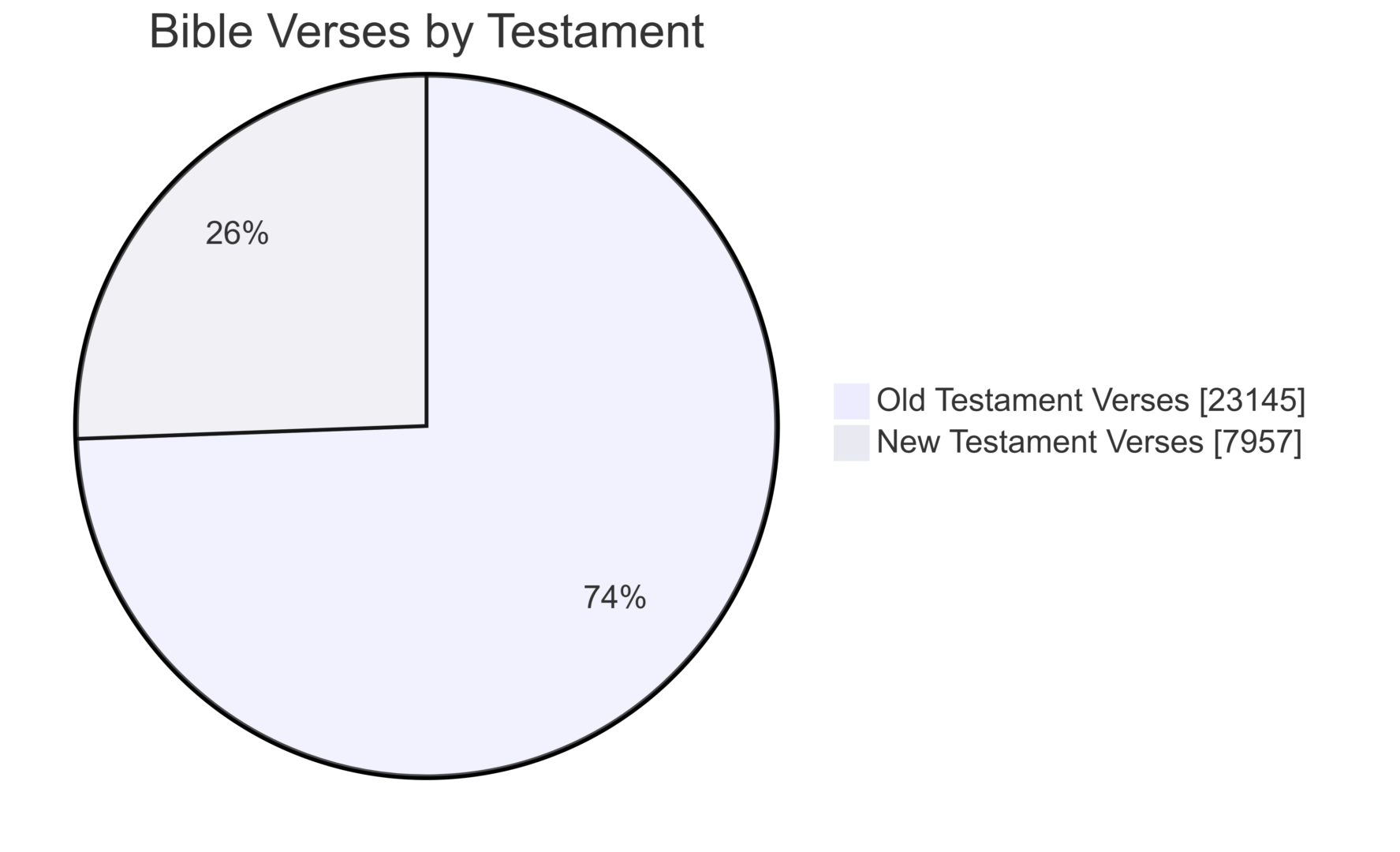
The Old Testament makes up roughly 78% of the Bible’s chapters and 74% of its verses, while the New Testament, though shorter, carries the foundational teachings of Christianity in a much more compact form.
Chapters and Verses in the Old Testament (39 Books)
The Old Testament spans everything from creation accounts and law codes to poetry, prophecy, and history. Genesis and Psalms are the longest books by verse count, while Obadiah is the shortest book in the entire Bible.
| Book | Chapters | Verses | Avg Verses/Chapter |
|---|---|---|---|
| Genesis | 50 | 1,533 | 31 |
| Exodus | 40 | 1,213 | 30 |
| Leviticus | 27 | 859 | 32 |
| Numbers | 36 | 1,288 | 36 |
| Deuteronomy | 34 | 959 | 28 |
| Joshua | 24 | 658 | 27 |
| Judges | 21 | 618 | 29 |
| Ruth | 4 | 85 | 21 |
| 1 Samuel | 31 | 810 | 26 |
| 2 Samuel | 24 | 695 | 29 |
| 1 Kings | 22 | 816 | 37 |
| 2 Kings | 25 | 719 | 29 |
| 1 Chronicles | 29 | 942 | 32 |
| 2 Chronicles | 36 | 822 | 23 |
| Ezra | 10 | 280 | 28 |
| Nehemiah | 13 | 406 | 31 |
| Esther | 10 | 167 | 17 |
| Job | 42 | 1,070 | 25 |
| Psalms | 150 | 2,461 | 16 |
| Proverbs | 31 | 915 | 29 |
| Ecclesiastes | 12 | 222 | 18 |
| Song of Solomon | 8 | 117 | 15 |
| Isaiah | 66 | 1,292 | 20 |
| Jeremiah | 52 | 1,364 | 26 |
| Lamentations | 5 | 154 | 31 |
| Ezekiel | 48 | 1,273 | 26 |
| Daniel | 12 | 357 | 30 |
| Hosea | 14 | 197 | 14 |
| Joel | 3 | 73 | 24 |
| Amos | 9 | 146 | 16 |
| Obadiah | 1 | 21 | 21 |
| Jonah | 4 | 48 | 12 |
| Micah | 7 | 105 | 15 |
| Nahum | 3 | 47 | 16 |
| Habakkuk | 3 | 56 | 19 |
| Zephaniah | 3 | 53 | 18 |
| Haggai | 2 | 38 | 19 |
| Zechariah | 14 | 211 | 15 |
| Malachi | 4 | 55 | 14 |
| Total | 929 | 23,145 | ~25 |
A note on Numbers: Some sites online list the book of Numbers as having 1,289 verses. This is incorrect. Across the KJV, NIV, and most standard translations, Numbers has 1,288 verses.
Chapters and Verses in the New Testament (27 Books)
The New Testament opens with the four Gospels, moves through the early church’s history in Acts, continues with the letters (epistles) written to churches and individuals, and closes with the prophetic book of Revelation.
| Book | Chapters | Verses | Avg Verses/Chapter |
|---|---|---|---|
| Matthew | 28 | 1,071 | 38 |
| Mark | 16 | 678 | 42 |
| Luke | 24 | 1,151 | 48 |
| John | 21 | 879 | 42 |
| Acts | 28 | 1,007 | 36 |
| Romans | 16 | 433 | 27 |
| 1 Corinthians | 16 | 437 | 27 |
| 2 Corinthians | 13 | 257 | 20 |
| Galatians | 6 | 149 | 25 |
| Ephesians | 6 | 155 | 26 |
| Philippians | 4 | 104 | 26 |
| Colossians | 4 | 95 | 24 |
| 1 Thessalonians | 5 | 89 | 18 |
| 2 Thessalonians | 3 | 47 | 16 |
| 1 Timothy | 6 | 113 | 19 |
| 2 Timothy | 4 | 83 | 21 |
| Titus | 3 | 46 | 15 |
| Philemon | 1 | 25 | 25 |
| Hebrews | 13 | 303 | 23 |
| James | 5 | 108 | 22 |
| 1 Peter | 5 | 105 | 21 |
| 2 Peter | 3 | 61 | 20 |
| 1 John | 5 | 105 | 21 |
| 2 John | 1 | 13 | 13 |
| 3 John | 1 | 14 | 14 |
| Jude | 1 | 25 | 25 |
| Revelation | 22 | 404 | 18 |
| Total | 260 | 7,957 | ~31 |
Interestingly, the New Testament has a higher average of verses per chapter than the Old Testament, largely because the Gospel writers packed dense narrative and teaching into fewer, longer chapters.
Longest and Shortest Books, Chapters, and Verses
Understanding the extremes helps put the rest of the Bible’s structure into perspective.
| Category | Book/Chapter | Detail |
|---|---|---|
| Longest book by chapters | Psalms | 150 chapters |
| Longest book by verses | Psalms | 2,461 verses |
| Shortest Old Testament book | Obadiah | 1 chapter, 21 verses |
| Shortest New Testament book | 3 John or 2 John | 1 chapter, 13-14 verses |
| Longest chapter in the Bible | Psalm 119 | 176 verses |
| Shortest chapter in the Bible | Psalm 117 | 2 verses |
| Books with only 1 chapter | Obadiah, Philemon, 2 John, 3 John, Jude | 5 books total |
How the Books Break Down by Length
If you’re building a Bible reading plan or trying to decide what to tackle first, it helps to think in terms of length categories rather than book names alone. The chart below groups every book by chapter count so you can quickly see which books are quick reads and which require more sustained commitment.
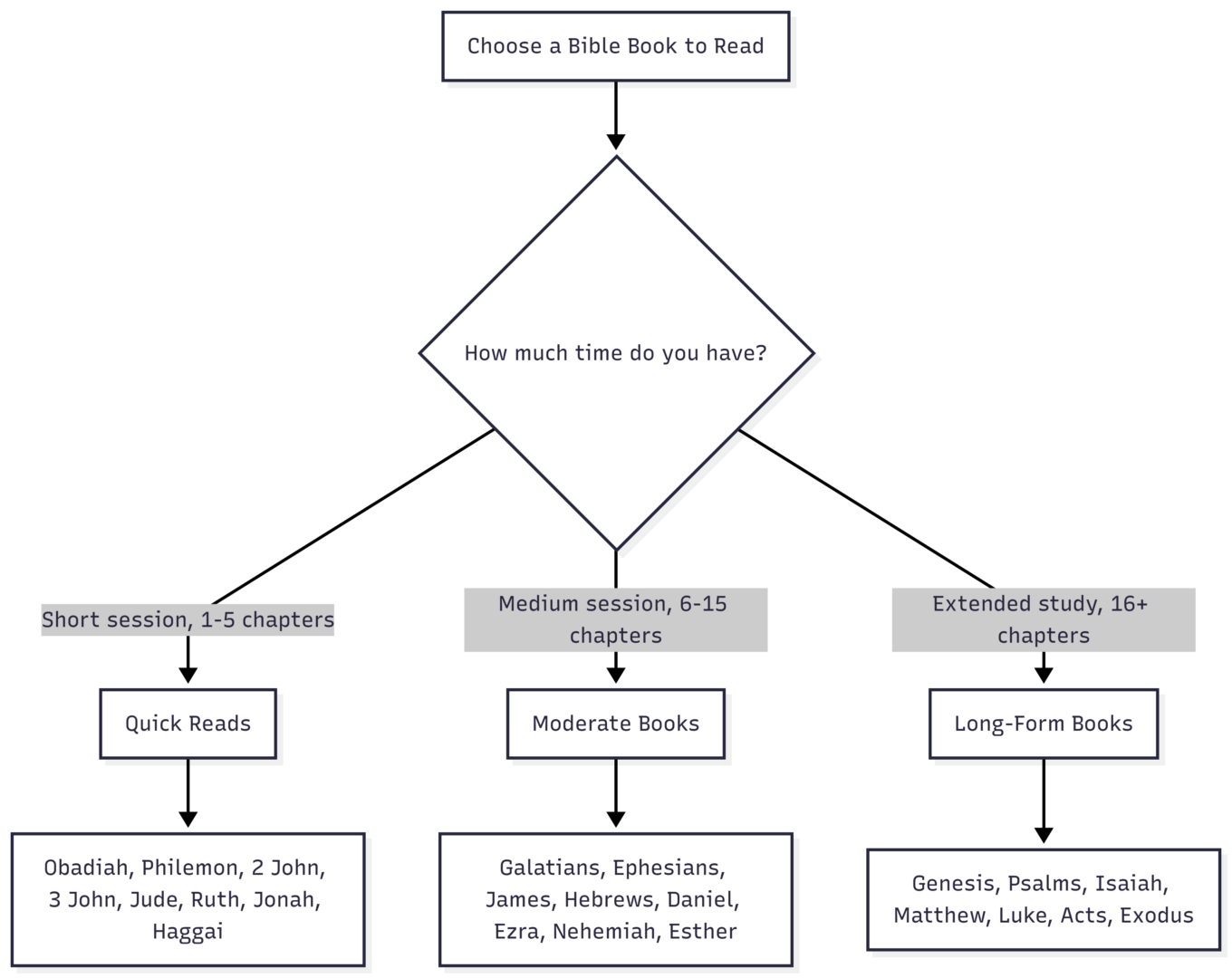
This kind of grouping is especially useful for Bible study groups, Sunday school curricula, or personal memorization goals, since it lets you match your available time to a realistically sized passage instead of guessing.
Why the Chapter and Verse Numbers Matter
The original biblical manuscripts were written as continuous text, without chapter breaks or verse markers. Chapter divisions were added in the 13th century, most commonly attributed to Archbishop Stephen Langton, while verse numbers were introduced in the 16th century by printer and scholar Robert Estienne. These additions were never part of the inspired text itself; they were later study aids designed to make it easier to locate, cite, and cross-reference specific passages.
That’s an important distinction for readers who want to understand context. A chapter break in the middle of a story doesn’t always mark a true narrative pause, and some verse divisions split sentences in ways that can obscure the original flow of thought. When studying a passage seriously, it’s worth reading a few verses before and after a chapter break to see the fuller context.
The Old Testament had already developed its own internal division system centuries earlier through the Masoretes, Jewish scribes who worked between roughly the 7th and 10th centuries to standardize the Hebrew text, add vowel markings, and mark paragraph and section breaks. Langton’s chapter divisions, created for the Latin Vulgate, were later adapted into Hebrew and Greek manuscripts and eventually carried over into English translations.
Estienne’s verse numbering system, printed in his 1551 Greek New Testament and later in a full 1555 Vulgate edition, is largely the same system still used in Bibles printed today. Because these systems were applied independently of the original authors’ intent, a handful of chapter and verse breaks fall in genuinely awkward places, which is one reason serious Bible study often involves reading full passages rather than isolated verses.
Bible Word Counts by Translation
While chapter and verse counts stay fixed, word counts shift depending on the translation because each translation team makes different choices about sentence structure, vocabulary, and how literally to render the original Hebrew, Aramaic, and Greek text.
| Translation | Approximate Word Count |
|---|---|
| King James Version (KJV) | 783,000 |
| New International Version (NIV) | 727,000 |
| English Standard Version (ESV) | 757,000 |
| New American Standard Bible (NASB) | 782,000 |
| New Living Translation (NLT) | 747,000 |
More literal, word-for-word translations like the KJV and NASB tend to run longer, while translations that favor readability and modern phrasing, like the NIV and NLT, often compress the same content into fewer words without changing the verse count.
Frequently Asked Questions
There are 929 chapters across the 39 books of the Old Testament.
There are 260 chapters across the 27 books of the New Testament.
The Bible contains 1,189 chapters across all 66 books combined.
There are 31,102 verses total: 23,145 in the Old Testament and 7,957 in the New Testament.
Psalm 119 is the longest chapter, with 176 verses dedicated to praising and reflecting on God’s law.
Psalm 117 is the shortest, containing only 2 verses, and it also happens to be the middle chapter of the entire Bible.
Word counts vary by translation, but the English Bible generally runs around 785,000 words, with the King James Version often cited near that figure.
Psalms has the most chapters of any book, with 150 total, followed by Isaiah with 66 and Jeremiah with 52.
Five books have a single chapter: Obadiah, Philemon, 2 John, 3 John, and Jude.
Yes. Despite some sources citing 1,289 verses, the correct and widely confirmed count across major translations is 1,288 verses in the book of Numbers.
Putting the Numbers to Use
Knowing the chapter and verse breakdown of each book is more than trivia. Pastors use it to plan sermon series that move through an entire book without over- or under-committing weeks to it. Bible study leaders use it to divide reading assignments evenly across a term. Individual readers use it to set realistic daily reading goals, since a chapter of Psalms (short) reads very differently from a chapter of Numbers (long and detailed).
A simple approach many readers use is to average roughly 3 chapters a day, which completes the entire Bible in just under 13 months, or about 3.5 chapters a day to finish within a calendar year. Since chapter lengths vary so widely, checking the verse count of the day’s assigned chapters ahead of time can help set accurate expectations for how long the reading will actually take.
Ultimately, chapters and verses are tools, not the message itself. They exist to help you find your place, mark your progress, and return to passages that matter to you, but the true value of Scripture is found in reading it in full context rather than isolated numbers.
Please share this Number of Chapters and Verses In Each Book of the Bible with your friends and do a comment below about your feedback.
We will meet you on next article.
Until you can read, Numbers Bible Trivia Quiz With Questions & Answers