Deuteronomy Bible Trivia Quiz with Questions & Answers
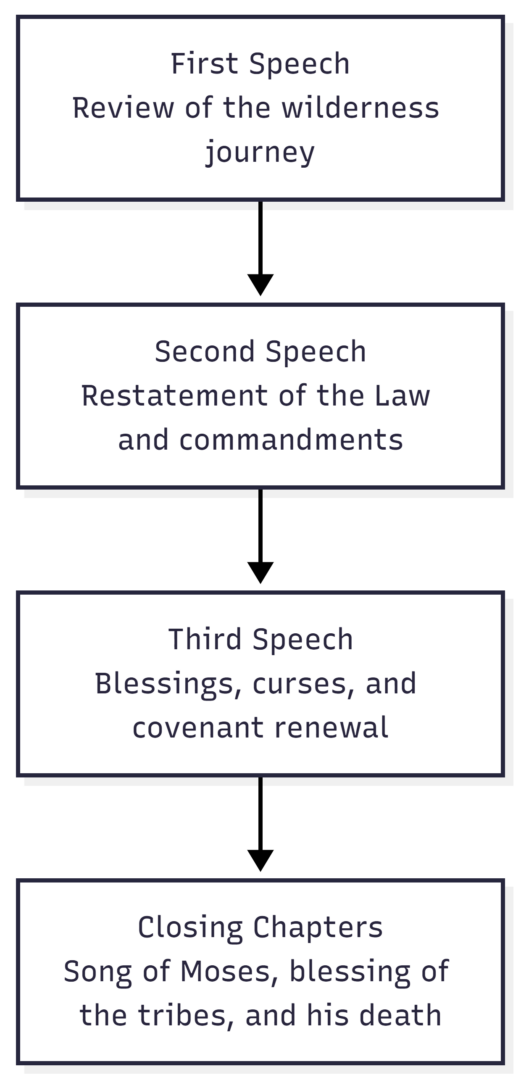
Deuteronomy closes out the Torah with a series of farewell speeches from Moses, delivered to a new generation of Israelites on the eve of entering the Promised Land. It restates the Law, recalls the journey through the wilderness, lays out blessings and curses tied to obedience, and ends with one of the most poignant scenes in the Old Testament: Moses viewing the land he would never enter, then dying within sight of it.
This trivia quiz works through the book’s setting, its laws, its memorable characters, and its closing chapters. Questions are organized into five themed rounds, each followed by an answer and a short explanation, so you can test your recall and pick up a few extra details along the way.
Quick Facts About the Book of Deuteronomy
| Category | Details |
|---|---|
| Position in the Bible | Fifth book of the Old Testament, the final book of the Torah/Pentateuch |
| Number of chapters | 34 |
| Setting | The plains of Moab, east of the Jordan River |
| Traditional author | Moses |
| Central theme | Covenant renewal and restatement of the Law before entering Canaan |
| Key passages | The Shema (6:4), the greatest commandment (6:5), blessings and curses (27–28) |
| Moses’ age at death | 120 years |
| Burial place | A valley in the land of Moab, with the exact location unknown |
How the Book Is Structured
Deuteronomy is organized around a series of speeches Moses delivers before his death, moving from a review of the past to instructions for the future and finally to his own farewell.
Round 1: Setting, Authorship, and Core Teachings
Question 1: Where did Moses deliver the speeches that make up the Book of Deuteronomy? On the plains of Moab, east of the Jordan River. The Israelites were camped there, preparing to cross into Canaan after decades in the wilderness.
Question 2: Who is traditionally credited as the author of Deuteronomy? Moses. The book presents itself as his words, recorded at the Lord’s direction, and this view of authorship has deep roots in both Jewish and Christian tradition.
Question 3: What well-known prayer begins with the declaration that the Lord is one God? The Shema. This short statement of faith is recited daily in Jewish tradition and is considered one of the most important passages in the entire book.
Question 4: According to Deuteronomy, what is the greatest commandment? To love the Lord with all your heart, soul, and strength. This command is later identified in the New Testament as the foundation on which all other commandments rest.
Question 5: What can Deuteronomy generally be described as, in terms of its content? A covenant document that combines a review of history, a restatement of religious law, and instruction for daily life. It is not primarily a book of prophecy, secular law, or military strategy.
Round 2: The Wilderness Journey and the Conquest
Question 6: Out of the entire generation that left Egypt, which two men were allowed to enter the Promised Land? Joshua and Caleb. They were the only two of the spies sent into Canaan who returned with a faithful, positive report about the land.
Question 7: Whose massive iron bed was kept on display as evidence of his unusual size? Og, king of Bashan. He is described as the last of a line of giants, and his bed measured roughly thirteen and a half feet long.
Question 8: What river marked the boundary between the territory east of Canaan and the Promised Land itself? The Jordan River. Crossing it was the final step before the Israelites began taking possession of the land.
Question 9: When laying siege to a city, which type of tree were the Israelites forbidden from cutting down for building materials? Fruit-bearing trees. Trees that didn’t produce edible fruit could be used for siege works, but those that did were protected.
Question 10: Where is Aaron said to have died and been buried? At a stop along the Israelites’ wilderness route, with his son taking over his priestly duties immediately afterward. His death is recalled in Deuteronomy as part of the larger review of the journey.
Round 3: Laws, Justice, and Caring for Others
Question 11: What was supposed to happen to debts between Israelites every seven years? They were to be forgiven, or canceled entirely. This regular release of debts was part of a broader pattern of periodic economic reset built into Israelite law.
Question 12: What was the stated purpose of the tithe — a tenth of the harvest given to the Lord? To teach the Israelites to trust in and revere God. Beyond its religious purpose, a portion of the tithe also supported groups with no land inheritance of their own, including Levites, foreigners, orphans, and widows.
Question 13: How many witnesses were required to convict someone of a crime? Two or three. A single witness was not considered sufficient grounds for conviction, a safeguard built into the legal system described in the book.
Question 14: What protection did the law provide for a newly married man? He was exempt from military service during his first year of marriage, allowing him to remain at home with his wife rather than going to war.
Question 15: How were the Israelites instructed to treat foreigners living among them? With love and fairness, with the text specifically reminding them that they themselves had once been foreigners in Egypt. This instruction ties the treatment of outsiders directly to Israel’s own history.
Round 4: Worship, Blessings, and Curses
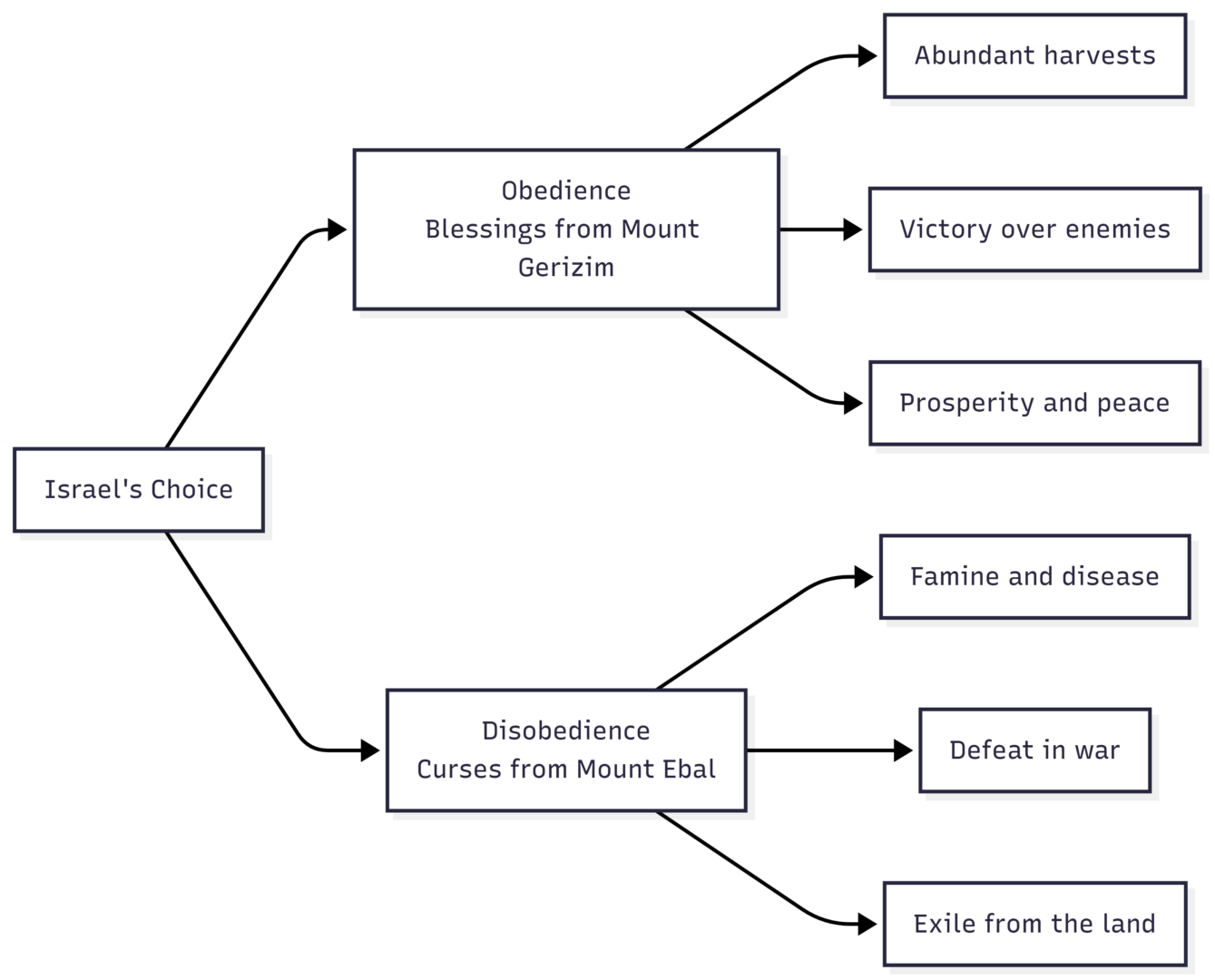
Question 16: From which two mountains were blessings and curses proclaimed to the Israelites? Blessings were proclaimed from Mount Gerizim, while curses were proclaimed from Mount Ebal. The two mountains stood opposite each other, creating a dramatic public setting for this part of the covenant ceremony.
Question 17: What were the three annual pilgrimage festivals the Israelites were commanded to observe? Passover (the Feast of Unleavened Bread), the Festival of Weeks, and the Festival of Tabernacles. Each of these festivals required Israelites to gather at a central location chosen by God.
Question 18: What category of practices, including consulting mediums and interpreting omens, did the law specifically forbid as detestable? Occult practices. The list includes things like divination, sorcery, casting spells, and consulting with the dead, all of which were considered incompatible with Israel’s worship of God.
Question 19: What kind of mixed clothing material did the law prohibit Israelites from wearing? A combination of wool and linen in the same garment. This was one of several regulations governing distinctions the Israelites were expected to maintain in daily life.
Question 20: According to the blessings and curses laid out for obedience and disobedience, what kinds of outcomes were tied to each path? Obedience was tied to outcomes like abundant harvests, victory over enemies, and general prosperity, while disobedience was tied to consequences such as famine, war, disease, and exile. These extended lists form one of the most detailed sections of the entire book.
Round 5: Moses’ Final Days
Question 21: From which mountain did Moses view the Promised Land before he died? Mount Nebo. He was allowed to see the land from a distance, even though he was not permitted to enter it himself.
Question 22: Why was Moses not allowed to enter the Promised Land? Because of an earlier act of disobedience in the wilderness, when he struck a rock in anger instead of following God’s specific instructions. This single incident had lasting consequences for the rest of his life.
Question 23: According to the closing chapters, who buried Moses? God himself is described as having buried Moses in a valley in the land of Moab, and the exact location of his grave remained unknown afterward.
Question 24: How old was Moses when he died, and how is his condition described at that time? 120 years old, and described as still having clear eyesight and full strength despite his age. This detail emphasizes that his death was not due to physical decline.
Question 25: What animal does Moses use as an image for God’s care of Israel in his closing song? An eagle. The image is used to describe a kind of protective, hovering care, fitting for a song that reflects on God’s faithfulness throughout Israel’s history.
Scoring Guide
This quiz contains 25 questions. Give yourself 4 points for each correct answer, for a maximum score of 100.
| Score Range | Result |
|---|---|
| 90–100 | Bible Scholar — you know Moses’ final speeches in detail |
| 70–89 | Well Versed — a strong grasp of the book’s laws and key events |
| 50–69 | Familiar Reader — solid general knowledge, with a few gaps |
| Below 50 | Time for a Re-Read — Deuteronomy rewards a closer look |
Obedience and Disobedience: The Blessings and Curses
One of the most distinctive features of Deuteronomy is how directly it ties Israel’s future to a single choice, dramatized through the blessings pronounced from one mountain and the curses pronounced from another.
Frequently Asked Questions
The name reflects the idea of a “second law” or repeated law, fitting for a book that largely consists of Moses restating and expanding on commandments given earlier, adapted for a new generation about to enter the land.
The book is framed as a covenant renewal for a new generation — most of the original adult generation that left Egypt had died during the wilderness years, so Moses restates the Law for those who would actually enter and live in the Promised Land.
The Shema’s declaration that God is one became a foundational statement of faith, recited regularly in Jewish worship and referenced throughout the rest of the Bible as a summary of Israel’s core belief about God.
The extended lists in chapters 27–28 frame Israel’s future as directly tied to its faithfulness, presenting obedience and disobedience as two clear paths with very different consequences, rather than leaving the relationship between behavior and outcome vague.
The book ends with Moses blessing the twelve tribes, singing a song about God’s faithfulness, viewing the Promised Land from Mount Nebo, and dying without entering it — a bittersweet conclusion that hands leadership to Joshua and sets up the events of the following book.
Final Thoughts
Deuteronomy serves as both a summary and a send-off — a final review of the Law, the journey, and the relationship between God and Israel, delivered by a leader who would not get to see the outcome of his work firsthand. Whether this quiz reminded you of details you already knew or introduced a few new ones, the book itself rewards careful reading, with its laws, songs, and farewell speeches still widely referenced today.
Please share this Deuteronomy Bible Trivia Quiz With Questions & Answers with your friends and do a comment below about your feedback.
We will meet you on next article.
Until you can read, Judges Bible Trivia Quiz With Questions & Answers