How Many Verses Are There in the Bible?
The standard Protestant Bible contains 31,102 verses across 66 books. That number holds steady across most major English translations, though it can shift slightly depending on which translation and canon you’re using — Catholic and Eastern Orthodox Bibles include additional books, which pushes their verse totals considerably higher.
This guide breaks down the exact verse and chapter counts for every book of the Bible, explains why the numbers vary slightly between translations, and covers the history of how chapter and verse divisions were added to Scripture in the first place.
Quick Answer: Bible Verse Count by Testament
| Testament | Books | Chapters | Verses |
|---|---|---|---|
| Old Testament | 39 | 929 | 23,145 |
| New Testament | 27 | 260 | 7,957 |
| Total (Protestant Bible) | 66 | 1,189 | 31,102 |
Verse Counts by Christian Canon
Different Christian traditions recognize different sets of books, which changes the total verse count significantly:
| Bible Canon | Number of Books | Estimated Total Verses |
|---|---|---|
| Protestant Canon (KJV, ESV, NIV, etc.) | 66 | 31,102 |
| Catholic Canon (includes Deuterocanonical books) | 73 | Approximately 35,500+ |
| Eastern Orthodox Canon | 76+ | Approximately 37,000+ |
The Catholic and Orthodox canons include additional books — often called the Deuterocanonical or Apocryphal books — such as Tobit, Judith, Wisdom, Sirach, Baruch, and 1–2 Maccabees, which account for the higher totals.
Why the Verse Count Varies Slightly Between Translations
Even within the 66-book Protestant canon, verse counts can differ by a handful of verses between translations. This isn’t a discrepancy in content so much as a difference in how translators handle certain passages based on manuscript evidence.
For example, some modern translations place a verse found in the King James Version into a footnote rather than the main text, if newer manuscript discoveries suggest it wasn’t part of the earliest available copies. These differences are almost always minor — a few verses at most — and don’t affect the overall structure or message of the text.
One frequently cited example: 3 John has 14 verses in the King James Version, the New International Version, and the Holman Christian Standard Bible, but 15 verses in the New American Standard Bible, the NET Bible, and the New Living Translation — a difference of exactly one verse, due to how a particular clause is divided.
Full Breakdown: Old Testament Chapters and Verses
| Book | Chapters | Verses | Avg Verses/Chapter |
|---|---|---|---|
| Genesis | 50 | 1,533 | 31 |
| Exodus | 40 | 1,213 | 30 |
| Leviticus | 27 | 859 | 32 |
| Numbers | 36 | 1,288 | 36 |
| Deuteronomy | 34 | 959 | 28 |
| Joshua | 24 | 658 | 27 |
| Judges | 21 | 618 | 29 |
| Ruth | 4 | 85 | 21 |
| 1 Samuel | 31 | 810 | 26 |
| 2 Samuel | 24 | 695 | 29 |
| 1 Kings | 22 | 816 | 37 |
| 2 Kings | 25 | 719 | 29 |
| 1 Chronicles | 29 | 942 | 32 |
| 2 Chronicles | 36 | 822 | 23 |
| Ezra | 10 | 280 | 28 |
| Nehemiah | 13 | 406 | 31 |
| Esther | 10 | 167 | 17 |
| Job | 42 | 1,070 | 25 |
| Psalms | 150 | 2,461 | 16 |
| Proverbs | 31 | 915 | 29 |
| Ecclesiastes | 12 | 222 | 18 |
| Song of Songs | 8 | 117 | 15 |
| Isaiah | 66 | 1,292 | 20 |
| Jeremiah | 52 | 1,364 | 26 |
| Lamentations | 5 | 154 | 31 |
| Ezekiel | 48 | 1,273 | 26 |
| Daniel | 12 | 357 | 30 |
| Hosea | 14 | 197 | 14 |
| Joel | 3 | 73 | 24 |
| Amos | 9 | 146 | 16 |
| Obadiah | 1 | 21 | 21 |
| Jonah | 4 | 48 | 12 |
| Micah | 7 | 105 | 15 |
| Nahum | 3 | 47 | 16 |
| Habakkuk | 3 | 56 | 19 |
| Zephaniah | 3 | 53 | 18 |
| Haggai | 2 | 38 | 19 |
| Zechariah | 14 | 211 | 15 |
| Malachi | 4 | 55 | 14 |
Note on Numbers: Some sources incorrectly list the book of Numbers as having 1,289 verses. Across the King James Version, the New International Version, and most other major translations, Numbers has 1,288 verses.
Full Breakdown: New Testament Chapters and Verses
| Book | Chapters | Verses | Avg Verses/Chapter |
|---|---|---|---|
| Matthew | 28 | 1,071 | 38 |
| Mark | 16 | 678 | 42 |
| Luke | 24 | 1,151 | 48 |
| John | 21 | 879 | 42 |
| Acts | 28 | 1,007 | 36 |
| Romans | 16 | 433 | 27 |
| 1 Corinthians | 16 | 437 | 27 |
| 2 Corinthians | 13 | 257 | 20 |
| Galatians | 6 | 149 | 25 |
| Ephesians | 6 | 155 | 26 |
| Philippians | 4 | 104 | 26 |
| Colossians | 4 | 95 | 24 |
| 1 Thessalonians | 5 | 89 | 18 |
| 2 Thessalonians | 3 | 47 | 16 |
| 1 Timothy | 6 | 113 | 19 |
| 2 Timothy | 4 | 83 | 21 |
| Titus | 3 | 46 | 15 |
| Philemon | 1 | 25 | 25 |
| Hebrews | 13 | 303 | 23 |
| James | 5 | 108 | 22 |
| 1 Peter | 5 | 105 | 21 |
| 2 Peter | 3 | 61 | 20 |
| 1 John | 5 | 105 | 21 |
| 2 John | 1 | 13 | 13 |
| 3 John | 1 | 14 | 14 |
| Jude | 1 | 25 | 25 |
| Revelation | 22 | 404 | 18 |
Structure of the Bible at a Glance
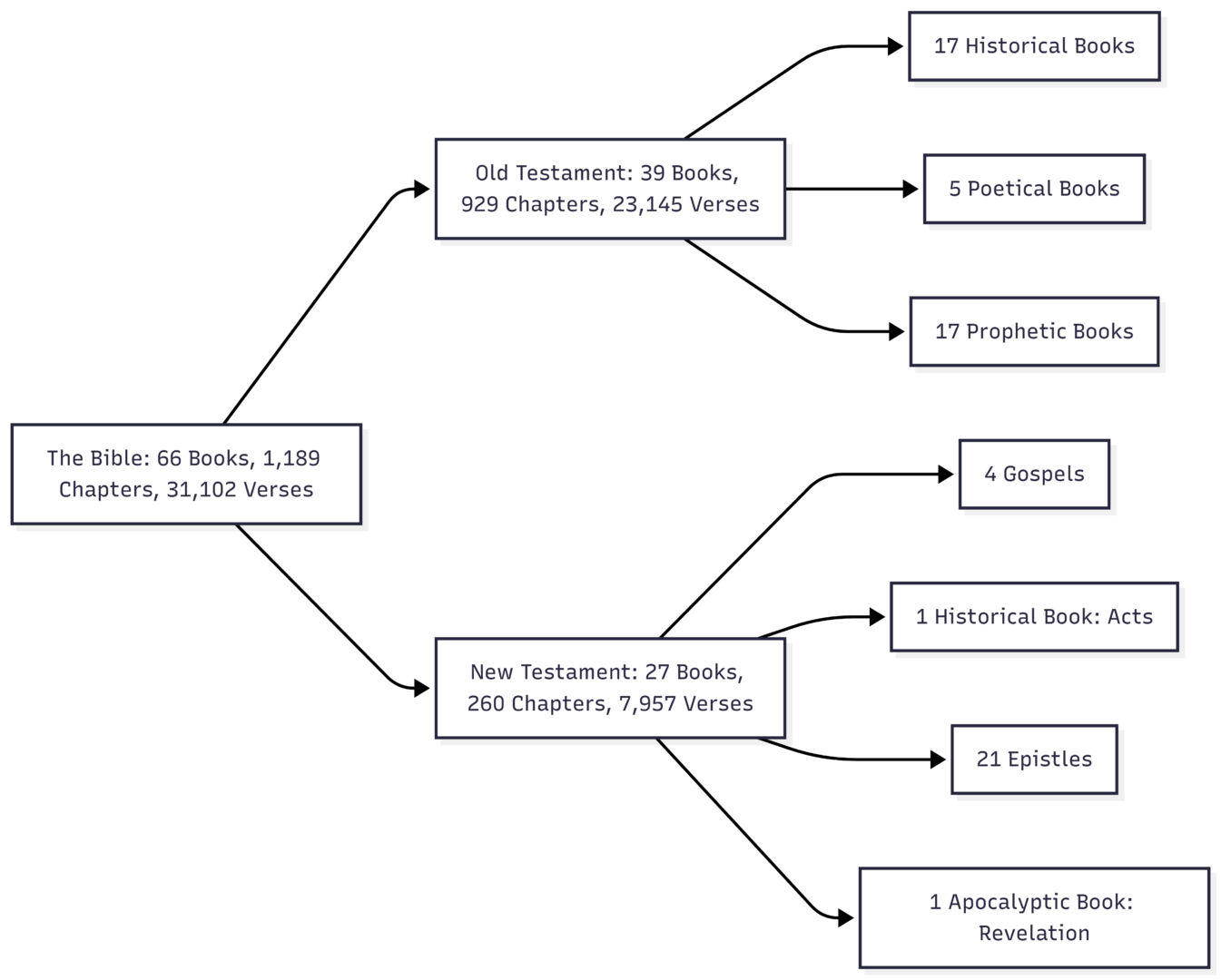
How the Bible Is Organized
Old Testament (39 books):
- 17 Historical Books — Genesis through Esther, covering creation, the patriarchs, the exodus, the conquest of Canaan, and the united and divided kingdoms
- 5 Poetical Books — Job, Psalms, Proverbs, Ecclesiastes, and Song of Songs
- 17 Prophetic Books — Isaiah through Malachi, covering both major and minor prophets
New Testament (27 books):
- 4 Gospels — Matthew, Mark, Luke, and John
- 1 Historical Book — Acts
- 21 Epistles — Letters from Paul and other apostles to churches and individuals
- 1 Apocalyptic Book — Revelation
The History of Chapter and Verse Divisions
The original biblical manuscripts contained no chapter or verse numbers at all — books were written and copied as continuous text, closer in form to a long letter than a modern reference book. This made locating and citing specific passages difficult for centuries.
Chapter divisions were introduced considerably later than the original texts themselves; scholarly accounts differ slightly on the exact date, with most attributing the standard chapter system to work done in the 13th century, generally credited to Archbishop Stephen Langton. Verse numbering followed later still.
The system in common use today was introduced in the 16th century by French printer and scholar Robert Estienne (also known by the Latinized name Stephanus), first appearing in a Greek New Testament and later applied to full Bible editions.
His numbering system was widely adopted because it made citing and cross-referencing specific passages dramatically easier — a practical need that had grown alongside the printing press’s ability to distribute Bibles more widely than hand-copied manuscripts ever could.
Notable Bible Facts and Records
| Category | Detail |
|---|---|
| Longest book | Psalms (150 chapters) |
| Longest chapter | Psalm 119 (176 verses) |
| Shortest chapter (by word count) | Psalm 117 |
| Shortest verse | John 11:35, consisting of two words |
| Longest verse | Esther 8:9 |
| Middle chapter of the Bible | Psalm 117 |
| Middle verse of the Bible | Psalm 118:8 |
| Approximate total word count (English) | Around 785,000 words |
| Number of authors | Traditionally attributed to roughly 40 authors |
| Time span of writing | Roughly 1,500 years |
| Original languages | Hebrew, Aramaic, and Greek |
Psalm 119, the longest chapter in the Bible, is also structured as an acrostic — it’s divided into 22 sections, one for each letter of the Hebrew alphabet, with each section’s lines beginning with that letter in the original Hebrew text.
Why Word Counts Are Harder to Pin Down Than Verse Counts
Unlike chapter and verse divisions, which are standardized across nearly all English translations, word counts vary considerably depending on the specific translation used. This is because translators make different choices about phrasing, sentence structure, and how literally to render certain Hebrew, Aramaic, or Greek constructions into English.
A more literal, word-for-word translation will often have a different total word count than a translation that prioritizes readability and natural phrasing. As a rough estimate, most English translations land somewhere in the neighborhood of 780,000 to 790,000 words, but this figure should be treated as approximate rather than fixed.
Frequently Asked Questions
The standard Protestant Bible contains 31,102 verses: 23,145 in the Old Testament and 7,957 in the New Testament.
There are 1,189 chapters total — 929 in the Old Testament and 260 in the New Testament.
Differences usually come down to how translators handle specific passages based on manuscript evidence, sometimes moving a verse to a footnote rather than the main text. These differences are typically only a handful of verses across the entire Bible.
Psalm 119 is the longest chapter, with 176 verses, and is structured as an acrostic poem following the Hebrew alphabet.
John 11:35 is widely cited as the shortest verse in most English translations, consisting of just two words.
Chapter divisions are generally attributed to work done in the 13th century, while the verse numbering system most Bibles use today was introduced by French printer Robert Estienne in the 16th century, specifically to make referencing and cross-referencing Scripture easier.
Whether you’re studying for a Bible trivia night, planning a memorization schedule, or simply curious about the structure of the text, these numbers offer a useful map of just how vast the Bible actually is — 31,102 verses, spanning 66 books, written across roughly 1,500 years by dozens of different authors, yet organized in a way that’s remained remarkably consistent for centuries.
Please share this Tips to Help You Choose Bulb Brightness and Shade with your friends and do a comment below about your feedback.
We will meet you on next article.
Until you can read, 10 Bible Verses About Marriage