Going Deeper in the Parable of the Good Samaritan
The Parable of the Good Samaritan (Luke 10:25–37) is one of the best-known stories Jesus told. Its phrase has entered everyday language: news headlines praise a “good Samaritan” who rescues a stranded driver or pays for a stranger’s hospital bill. Yet the popular meaning, “someone who helps a stranger,” barely scratches the surface.
In the original setting, calling someone a Samaritan was closer to an insult than a compliment. This guide covers the story, the history behind it, the meaning of each character, the main lessons, and how to apply the parable today.
Quick Summary: What Is the Parable of the Good Samaritan?
- Where it appears: Luke 10:25–37, and only in Luke’s Gospel
- Who tells it: Jesus, in reply to a legal expert
- The question that triggers it: “And who is my neighbor?”
- Core message: Love for neighbor is defined by mercy and action, not by ethnicity, religion, or social status
- Final instruction: “Go and do likewise”
The Setting: A Lawyer’s Test
The parable does not begin with the story. It begins with a conversation. An expert in the Law of Moses stands up to test Jesus and asks what he must do to inherit eternal life.
Jesus answers with a question of his own: What is written in the Law, and how do you read it? This shifts the discussion onto Scripture, which both men accepted as authoritative. Jesus, not the lawyer, is now the one evaluating the answer.
The lawyer responds with two commands: love God with everything you have (Deuteronomy 6:5), and love your neighbor as yourself (Leviticus 19:18). Jesus confirms the answer is correct and tells him to live it.
The lawyer then asks a follow-up because he wants to justify himself: “And who is my neighbor?”
The question assumes some people are not neighbors. If the command has limits, then someone can keep it by drawing the boundary in the right place. The parable exists to destroy that boundary.
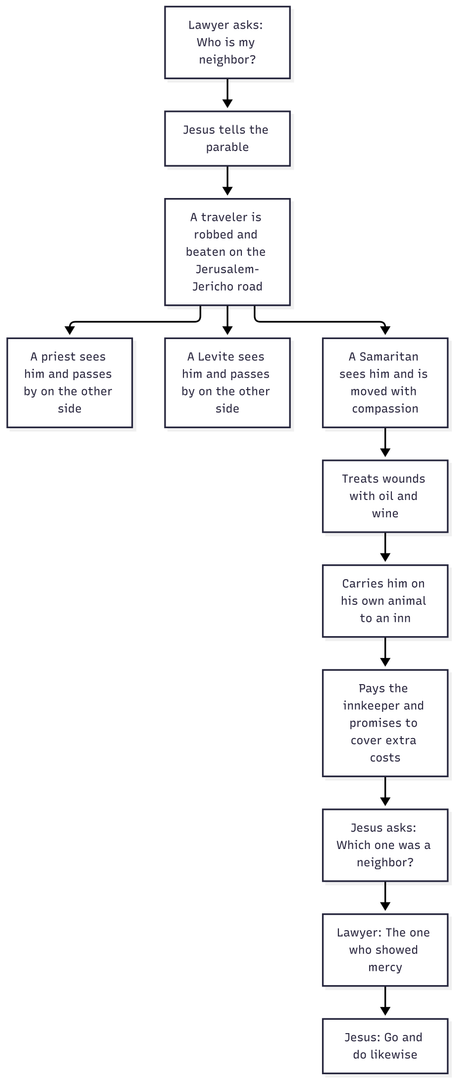
The Story of the Good Samaritan, Step by Step
The Road
The route ran from Jerusalem down to Jericho, a distance of roughly 17 miles (27 km) with a drop of about 3,300 feet (1,000 m) in elevation. The road wound through rocky, desolate terrain with plenty of hiding places, which made it notorious for robbers. Jesus’ listeners would have found the attack completely believable.
The Victim
The man is stripped, beaten, and left half dead. Jesus gives no name, nationality, or religion. That silence is deliberate: the victim represents anyone in need.
The Priest and the Levite
Both men were religious professionals connected with temple worship. Both see the wounded man, and both cross to the other side.
Common explanations include:
- Fear of ritual impurity. Contact with a corpse made a priest ceremonially unclean, and the man appeared to be dead.
- Fear of danger. The robbers might still be nearby, or the injured man might be a decoy.
- Inconvenience. Stopping would cost time, money, and safety.
Jesus does not excuse them. Whatever the reason, religious status did not produce mercy.
The Samaritan
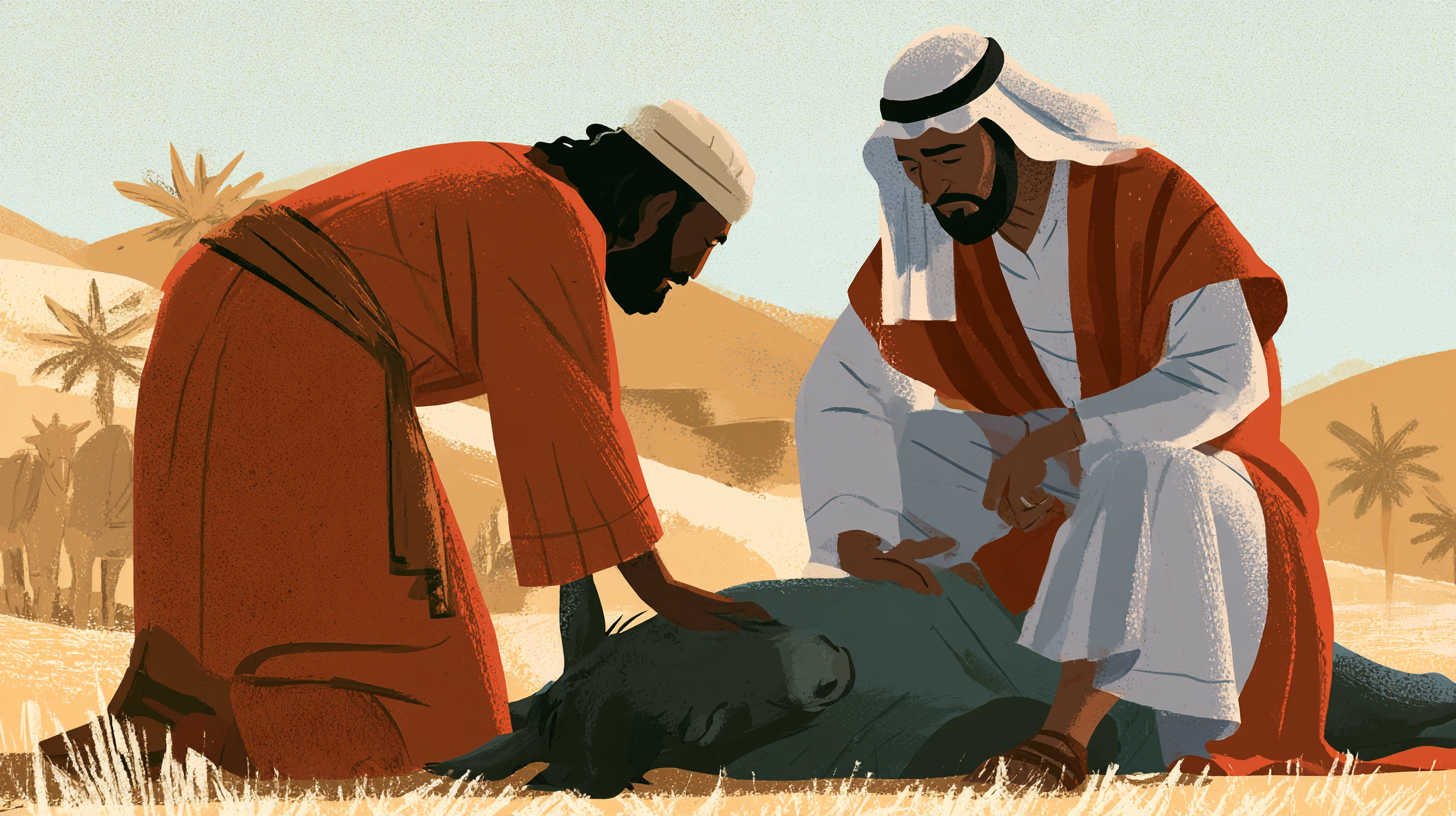
The third traveler is the one nobody expected to be the hero. He feels compassion, gets close, and acts, and everything he does costs him something.
The Eleven Actions of the Samaritan
Luke’s Greek and most English translations pile up verbs to describe what the Samaritan does. The list shows that compassion is not merely a feeling.
| Action | What it looked like | Type of help |
|---|---|---|
| Came to where he was | Approached the victim | Physical presence |
| Saw him | Refused to look away | Attention |
| Had compassion | Was moved with pity | Emotional care |
| Went to him | Closed the distance | Courage |
| Bandaged his wounds | Wrapped the injuries | Medical care |
| Poured oil and wine | Wine cleaned, oil soothed | First aid |
| Set him on his own animal | Gave up his own transport | Sacrifice |
| Brought him to an inn | Traveled with him | Shelter |
| Took care of him | Stayed overnight | Time |
| Paid two denarii | About two days’ wages for a laborer | Financial support |
| Promised to return | Committed to cover extra costs | Long-term commitment |
The Samaritan gives his time, skill, resources, and reputation. He also keeps an open-ended promise, which turns a single act of kindness into a real commitment.
Who Were the Samaritans? Historical Background
To feel the shock of the parable, you need to understand the tension between Jews and Samaritans.
Origins
The Samaritans lived in the region of Samaria, the heartland of the former northern kingdom of Israel. After the Assyrian conquest, foreign settlers were brought into the land (2 Kings 17). Over time, the population became mixed, and Jews viewed the Samaritans as religiously and ethnically compromised. Samaritans, for their part, considered themselves the true keepers of Israel’s faith.
Key Differences
| Feature | Jewish View | Samaritan View |
|---|---|---|
| Sacred texts | Law, Prophets, and Writings | Only the Pentateuch (first five books) |
| Place of worship | Temple in Jerusalem (Mount Zion) | Mount Gerizim |
| Ancestry | Descendants of Judah and the southern tribes | Claimed descent from the northern tribes |
| Social relations | Avoided Samaritans | Reciprocated the hostility |
| Reputation | Viewed as faithful covenant people | Viewed by Jews as compromised and heretical |
The hostility was real and long-lasting. The Gospels reflect it elsewhere: a Samaritan village refuses to welcome Jesus in Luke 9, and in John 4 the Samaritan woman at the well is surprised that a Jewish man would speak to her.
Placing a Samaritan in the role of hero would have been as jarring as telling a story where a hated rival is the only person who does the right thing.
The Concentric Circles of “Neighbor”
Many first-century Jews understood their obligations as a series of expanding circles: family first, then relatives, then fellow Jews, and finally everyone else. Help flowed inward and thinned out toward the edges.

The lawyer’s question fits this model. He is asking where the line falls. Jesus refuses to draw one. Instead, he reverses the question:
- The lawyer asks: Who qualifies as my neighbor? (a question about limits)
- Jesus asks: Which one acted as a neighbor? (a question about character and action)
Neighbor is no longer a category of person you may safely ignore. It describes what you become when you show mercy.
Character Guide: What Each Figure Represents
| Character | Literal Role | What Jesus Exposes or Teaches |
|---|---|---|
| Lawyer | Expert in Mosaic Law | Knowledge without obedience; the urge to self-justify |
| Traveler | Anonymous victim | Any person in need, regardless of identity |
| Robbers | Attackers | The reality of violence and injustice |
| Priest | Temple official | Religious status is no substitute for compassion |
| Levite | Temple assistant | Rules and routine can crowd out mercy |
| Samaritan | Despised outsider | Real love crosses barriers and costs something |
| Innkeeper | Local host | Compassion often works through shared effort |
Key Lessons from the Parable of the Good Samaritan
1. Every Person Has Sacred Worth
Jesus makes the outcast the hero and the victim nameless, which teaches that worth does not depend on ethnicity, religion, or status. Human beings bear God’s image, and that is the basis for treating them with dignity. Love is not limited to people who share your tribe, your politics, or your church.
2. Religion Without Mercy Is Empty
The priest and Levite were the people most expected to help. Jesus shows that a person can be outwardly devout and inwardly indifferent. Worship, study, and ritual are meant to shape a heart that responds to need. When they fail to do that, they become mechanical.
3. Love Must Cost Something
The Samaritan’s care was not convenient. He interrupted his journey, spent his money, took a risk on a dangerous road, and made a lasting promise. Compassion that never costs anything is usually sentiment. In this parable, love shows up as action.
4. Mercy Reaches Enemies
The Samaritan is the one who shows mercy, and the hated group is the one receiving moral praise. The lesson runs both ways: we are called to help those we might consider enemies, and we must be willing to learn from people we would rather dismiss.
5. No One Can Fully Justify Themselves
The lawyer wanted to prove he had done enough. The parable makes that impossible. If the standard is love for every neighbor in need, then everyone has failed at some point. We have all walked past someone. This is why many Christian readers see the parable as pointing to human need for grace, not merely to a moral checklist.
The Lawyer’s Telling Reply
Notice the end of the conversation. Jesus asks which of the three men was a neighbor. The lawyer cannot bring himself to say “the Samaritan.” He replies, “The one who showed him mercy.”
This small detail shows how deep prejudice can run. The lawyer knows the answer but avoids the label. Jesus responds with a simple instruction: “Go and do likewise.”
Two Ways of Reading the Parable
Christians have interpreted the parable in two main ways.
| Approach | Main Idea | Strengths | Concerns |
|---|---|---|---|
| Moral (literal) reading | The parable teaches how to love your neighbor through practical mercy | Matches the context: the lawyer’s question and Jesus’ closing command | May underplay the lawyer’s inability to keep the law perfectly |
| Allegorical reading | The victim is fallen humanity, the Samaritan is Christ, the inn is the church | Has a long history and rich theological imagery | Risks reading details into the text that Luke’s setting does not emphasize |
Many modern interpreters favor the moral reading as the primary meaning because the story is framed by the question “Who is my neighbor?” and ends with “Go and do likewise.” The allegorical reading is often treated as a devotional layer rather than the main point.
Both approaches agree on one thing: the parable challenges self-righteousness.
How to Apply the Good Samaritan Parable Today
A helpful test is to ask, “Who is my Samaritan?” That is, who is the person or group you find it hardest to accept, respect, or help?
Practical Steps
- Notice. The priest and Levite saw the man. Awareness is the first test.
- Get close. Compassion often demands moving toward the need instead of away from it.
- Do what you can. You may not be a medic, but you may be able to call for help, give money, or offer a ride.
- Share the load. The Samaritan involved the innkeeper. Serving well often means working with others.
- Follow through. Ongoing commitment matters as much as the first response.
- Examine your prejudices. Ask which groups you have mentally placed outside the circle of neighbor.
Everyday Examples
| Situation | A Priest-and-Levite Response | A Samaritan Response |
|---|---|---|
| A coworker is struggling quietly | Assume it is not your business | Ask, listen, and offer practical help |
| A stranger needs a ride in bad weather | Keep driving | Stop safely or call for assistance |
| A neighbor from a different background moves in | Keep your distance | Introduce yourself and offer welcome |
| A charity needs volunteers | Assume someone else will do it | Give time or resources consistently |
| Someone you disagree with faces hardship | Feel it is deserved | Show mercy without conditions |
Common Misunderstandings
“The parable is only about being nice to strangers.”
It is broader than that. It confronts prejudice and religious self-satisfaction.
“The priest and Levite were simply following the rules.”
Jesus uses them to show that rule-following without compassion misses the heart of the law.
“Helping others earns eternal life.”
The lawyer’s question was about earning life, and the parable shows how high the standard is. Many readers conclude it exposes our need for grace as much as it commands mercy.
“The Samaritan had nothing to lose.”
He risked his safety, money, time, and reputation. Ministering to a wounded stranger on a robber-infested road was not a low-cost act.
Related Bible Passages
| Passage | Connection |
|---|---|
| Leviticus 19:18 | Origin of the command to love your neighbor as yourself |
| Deuteronomy 6:5 | The command to love God with all your heart, soul, and strength |
| Mark 12:28–34 | Jesus names the two greatest commandments |
| Matthew 5:43–48 | Love your enemies |
| John 4:1–42 | Jesus and the Samaritan woman |
| 1 John 4:7–12 | Love is from God |
| James 2:14–17 | Faith without action |
Frequently Asked Questions
It appears in Luke 10:25–37. No other Gospel contains it.
Love for your neighbor means showing active mercy to anyone in need, regardless of ethnic, religious, or social barriers.
Samaritans were despised by many Jews. Making one the hero forced listeners to confront their prejudice and rethink who counts as a neighbor.
The text does not say. Possible reasons include fear of ritual impurity, fear of danger, or simple unwillingness to be inconvenienced. Jesus’ point is that religious status did not translate into mercy.
A denarius was roughly a day’s wage for a common laborer, so two denarii covered a couple of days of lodging and care.
Parables are teaching stories. Jesus does not identify the events as historical, but the setting, the road, and the social tensions were entirely real to his audience.
It is a direct call to practice mercy, not merely to admire it or debate it.
Final Thoughts
The Parable of the Good Samaritan is much more than a lesson on being kind to strangers. It dismantles the idea that love has borders, exposes the danger of religion that has lost its heart, and asks each listener to look honestly at their own prejudices.
The lawyer wanted a definition. Jesus gave him a mirror. The question is no longer “Who is my neighbor?” but “Will I be a neighbor?”
Please share this Going Deeper in the Parable of the Good Samaritan your friends and do a comment below about your feedback.
We will meet you on next article.
Until you can read, 16 Tips for Successful Online Video Interviews