Proverbs 31 — Sayings of King Lemuel
Proverbs 31 closes out the Book of Proverbs with two distinct sections that are often treated separately, though they were written to work as one unit. The first nine verses record wisdom a king’s mother passed down about ruling justly.
The remaining twenty-two verses form a Hebrew acrostic poem describing a woman of exceptional character — the passage most people mean when they refer to “the Proverbs 31 woman.” Read together, both halves make the same underlying argument: real wisdom shows up in how a person exercises responsibility, treats the vulnerable, and works with diligence and integrity.
This guide breaks down both sections, explains the acrostic structure behind the famous second half, and addresses the pressure many readers feel when this passage gets used as a rigid checklist rather than the illustration of wisdom it was written to be.
Structure of Proverbs 31
| Section | Verses | Focus |
|---|---|---|
| Sayings of King Lemuel | 1–9 | A mother’s instruction to her son on ruling justly |
| The Wife of Noble Character | 10–31 | An acrostic poem illustrating wisdom in daily life |
Part One: The Words of King Lemuel (Verses 1-9)
The chapter opens with wisdom King Lemuel attributes directly to his mother — instruction given to shape how he would lead as a ruler. This alone is notable: one of the clearest statements of royal wisdom in the entire Bible is presented as coming from a mother’s teaching, reinforcing a theme found throughout Proverbs that wisdom is something passed down and received, not self-generated.
Warnings Against Destructive Distractions
Lemuel’s mother warns him against two specific dangers for a ruler: excessive alcohol and relationships that compromise judgment. Her concern isn’t about personal morality in isolation — it’s about the practical consequence for governance.
A king impaired by drink or distracted by destructive relationships is at risk of forgetting the law and failing the people who depend on his fair judgment. The warning is fundamentally about protecting the vulnerable from the failures of those in power, not a generic moral rule.
The Call to Defend the Vulnerable
The second half of this section shifts from warning to instruction: speak up for those who cannot speak for themselves, judge fairly, and defend the rights of the poor and needy. This is the practical outworking of wise leadership — using positional power specifically on behalf of people who have none. It’s a theme that recurs throughout Proverbs and much of the Old Testament: true wisdom is measured by how power gets used on behalf of others, not by personal comfort or self-interest.
Part Two: The Wife of Noble Character (Verses 10-31)
The Acrostic Structure
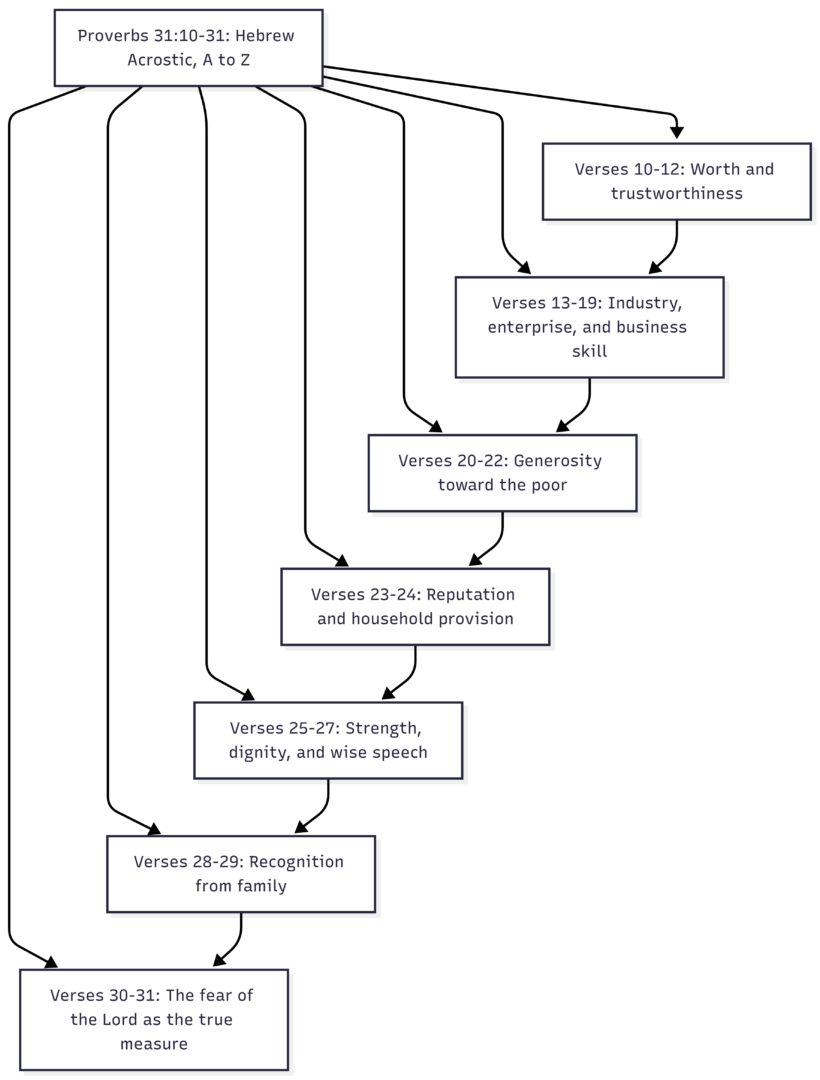
In the original Hebrew, this passage is structured as an acrostic — each of its 22 verses begins with a successive letter of the Hebrew alphabet, from aleph to tav. This literary structure isn’t just decorative.
Acrostics in Hebrew poetry often signal completeness or totality — the sense that a subject has been covered from A to Z, so to speak. Applied here, it suggests this description of wise, capable living is meant to be comprehensive: a full picture of wisdom in action, not a partial sketch.
Key Attributes Described in the Passage
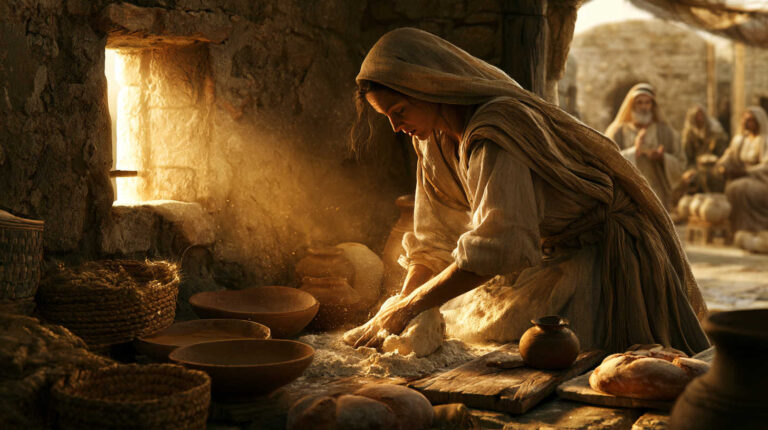
Industry and enterprise. She rises early, manages significant responsibilities, evaluates and purchases property, and runs what amounts to a textile business — selecting raw materials, producing goods, and supplying merchants directly. This isn’t a passive homemaker role; it describes active economic engagement and sound business judgment.
Trustworthiness and reliability. Her husband has full confidence in her judgment and character, described as lacking nothing of value because of it. This trust isn’t automatic — it’s earned through consistent, dependable action across “all the days of her life,” language suggesting sustained character rather than occasional effort.
Generosity toward the vulnerable. She extends her hands to the poor and needy directly, paralleling the instruction given to King Lemuel in the chapter’s first section. The same value — using resources and position on behalf of others — runs through both halves of the chapter.
Strength and confident dignity. She’s described as clothed with strength and dignity, able to face an uncertain future without fear. This isn’t naive optimism; it’s confidence built on preparation, competence, and trust in something beyond her own control.
Wisdom in speech. She speaks with wisdom, with faithful instruction on her tongue — connecting her character directly to the book of Proverbs’ central concern with wise, careful speech.
Household diligence. She watches over her household’s affairs and doesn’t “eat the bread of idleness” — a direct contrast to laziness, a recurring warning throughout Proverbs.
The Chapter’s Concluding Statement
The passage closes with a widely quoted line contrasting charm and beauty, both described as fleeting or deceptive, with the lasting praise due to a woman who fears the Lord. This closing line reframes everything that came before it: the various achievements and qualities described aren’t the ultimate point. The reverence for God underlying them is.
The Acrostic Poem Visualized
Why This Chapter Creates Pressure for Many Readers
For many women, hearing “Proverbs 31 woman” invokes less inspiration and more anxiety — a sense of being measured against an impossible checklist of domestic perfection, professional competence, and constant selflessness, often disconnected from the passage’s actual intent. A few important correctives are worth naming directly:
It was never meant as a to-do list. The passage is poetry, not a job description. Its purpose is to illustrate wisdom through a vivid, idealized example — the same way Proverbs personifies wisdom as “Lady Wisdom” elsewhere in the book — not to provide a literal checklist every reader must complete.
It applies to everyone, not only wives and mothers. The chapter’s first nine verses are addressed to a king, and the entire book of Proverbs is explicitly intended to teach wisdom to anyone willing to receive it, regardless of marital status or gender.
Reading the second half only through the lens of “how to be a good wife” misses the passage’s broader purpose: illustrating what wisdom looks like when lived out practically, in whatever roles and responsibilities a person actually holds.
The standard it points to is ultimately about character, not achievement. The chapter’s closing verse makes this explicit — reverence for God, not accomplishment or outward beauty, is what’s actually being praised.
Read the whole passage as pointing toward that underlying posture, and the specific tasks described become illustrations of a wise, God-honoring life rather than a rigid standard to be individually replicated task for task.
Applying Proverbs 31 Without the Pressure
| Common Misreading | More Accurate Reading |
|---|---|
| “I must run a business, manage a household, and be endlessly generous to measure up.” | The passage illustrates wisdom expressed through diligence, generosity, and integrity — the specific tasks are examples, not requirements. |
| “This chapter is only relevant to wives and mothers.” | The chapter opens with instruction to a king and closes with a universal principle about character; its wisdom is addressed to everyone. |
| “My worth is measured by how much I accomplish.” | The passage’s concluding statement explicitly values fearing the Lord above outward achievement or beauty. |
| “I have to be perfect to reflect this ideal.” | The description points toward Christ as the fullest embodiment of wisdom; readers are invited to grow toward that character over time, not to arrive instantly. |
What the Two Halves of the Chapter Share
Read side by side, King Lemuel’s instructions and the Wife of Noble Character’s description share the same core values: using position and resources on behalf of the vulnerable, exercising diligence rather than laziness or self-indulgence, and grounding action in reverence for God rather than self-interest. The chapter isn’t really two unrelated passages awkwardly stitched together — it’s a single, coherent closing statement for the entire book of Proverbs, illustrated once through the lens of leadership and once through the lens of a capable, wise household manager.
Frequently Asked Questions
King Lemuel isn’t identified with certainty outside of this passage; some scholars propose he may be another name for a known biblical king, while others treat the name as somewhat symbolic. What’s clear from the text itself is that his wisdom is presented as instruction received from his mother.
The passage is widely understood as an idealized literary composite rather than a description of one specific historical woman — a poetic illustration of wisdom in action, using the Hebrew acrostic form traditionally associated with comprehensive or complete descriptions.
No. The chapter opens with wisdom addressed to a king and functions as the concluding illustration for a book explicitly meant to teach wisdom to anyone willing to receive it, regardless of marital status.
Hebrew acrostics, moving through each letter of the alphabet in order, often signal thoroughness or completeness. Here, it suggests the passage is meant to offer a comprehensive illustration of wise, capable living rather than a partial list.
This closing statement reframes the entire preceding description: the various achievements and qualities aren’t valuable in themselves, but as expressions of a deeper reverence for God, which the passage identifies as the true and lasting basis for praise.
Reading the passage as an illustration of wisdom’s practical shape — diligence, generosity, integrity, and reverence for God — rather than a literal checklist of tasks helps preserve its intended purpose: inspiration toward wise living, not a measuring stick for self-judgment.
Proverbs 31 was written as a capstone, drawing together the wisdom of an entire book into two vivid illustrations — a just ruler and a capable, wise household manager. Read as intended, it isn’t a standard to be perfectly met, but a picture worth growing toward: diligence over laziness, generosity over self-interest, and reverence for God over the fleeting value of charm or achievement.
Please share this Tips to Help You Choose Bulb Brightness and Shade with your friends and do a comment below about your feedback.
We will meet you on next article.
Until you can read, Proverbs 3:5-6 — Trust in the LORD With All Your Heart