What Is the Meaning of the Parable of the Mustard Seed?
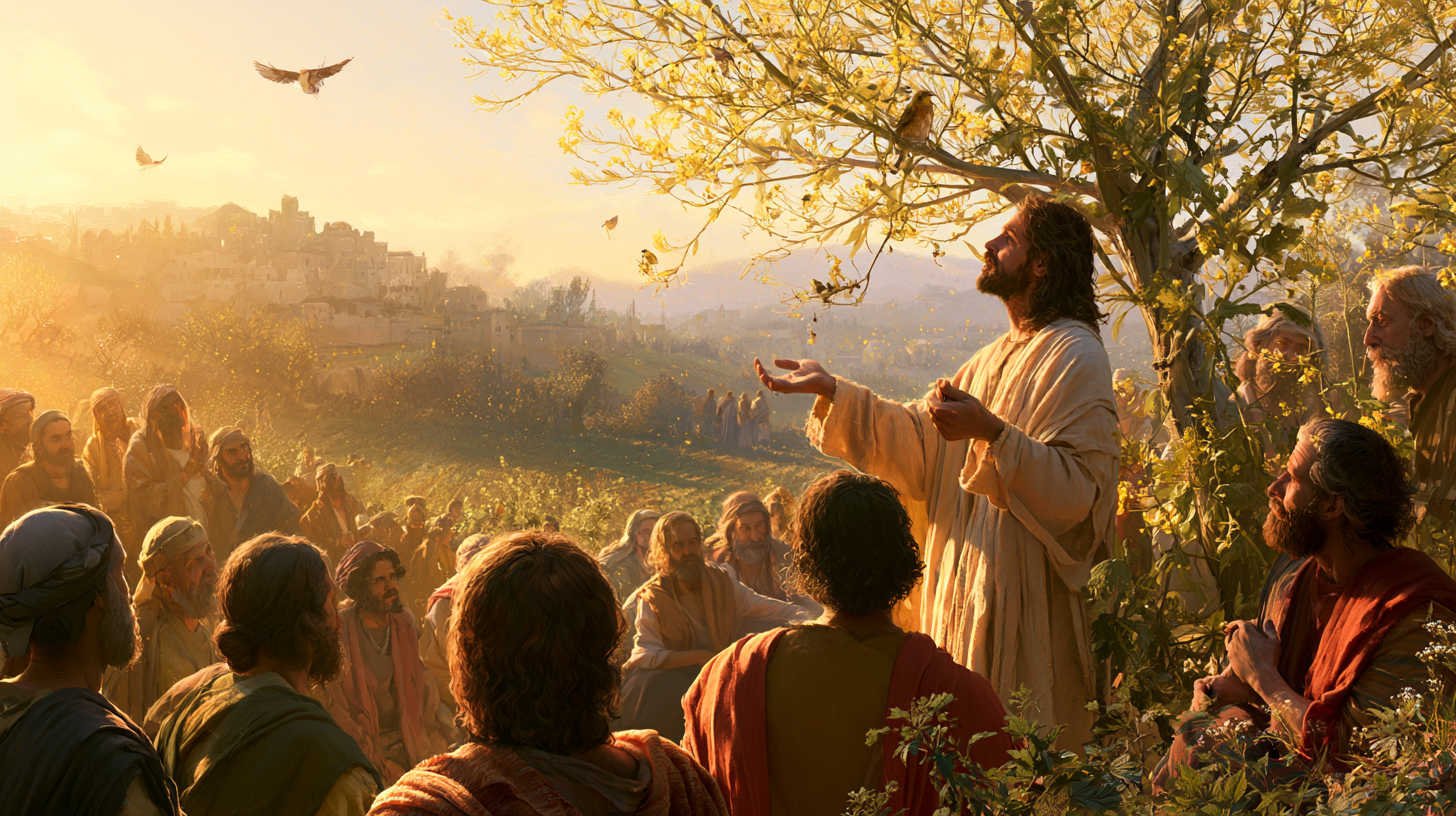
The Parable of the Mustard Seed is one of Jesus’ shortest teachings, but it carries an outsized point. Found in Matthew 13:31-32, Mark 4:30-32, and Luke 13:18-19, it compares the kingdom of heaven to a mustard seed — the smallest seed a first-century farmer would typically plant, yet one that grows into a shrub large enough for birds to nest in its branches.
In a single sentence, Jesus captures a pattern that shows up again and again in Scripture and in church history: God’s work rarely announces itself with fanfare. It starts small, often unnoticed, and grows into something far bigger than its beginning suggested.
This article breaks down the parable’s wording, its Old Testament background, what each image represents, and what it means for anyone trying to trust God with small, uncertain beginnings today.
The Verse
Jesus tells His listeners that the kingdom of heaven resembles a mustard seed a man plants in his field — smaller than every other seed, yet capable of growing into the largest of garden plants, tall enough that birds come and nest in its branches (Matthew 13:31-32).
The Story in Brief
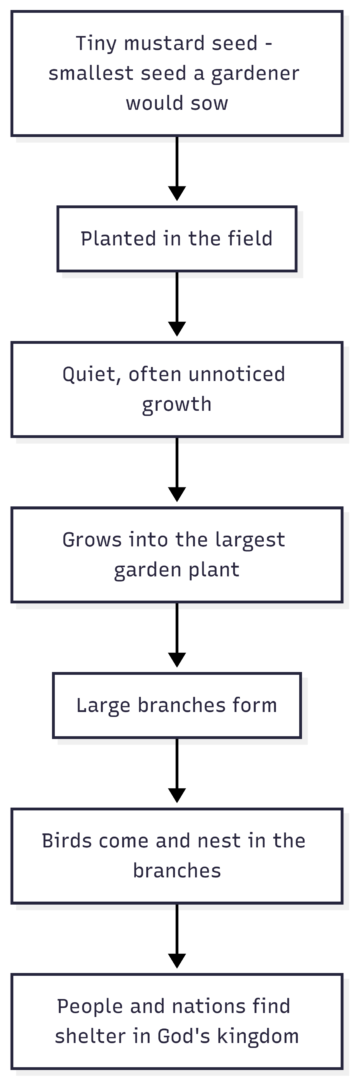
A man takes a mustard seed and plants it in his field. The seed itself is tiny — proverbially the smallest seed a gardener of that era would sow. Once planted, it doesn’t stay small.
It grows into a shrub large enough to be called a tree, with branches substantial enough that birds come to rest and nest in them. Jesus offers no further explanation in the text — the comparison itself is the entire teaching. The kingdom of heaven works the way this seed works: unimpressive at the start, disproportionately large at maturity.
Why the “Smallest Seed” Claim Isn’t a Botany Error
A common objection to this parable points out that the mustard seed isn’t literally the smallest seed on earth — smaller seeds exist in nature. This objection misses how the original audience would have heard the statement.
Jesus is speaking proverbially, not delivering a botanical lecture. Within the everyday experience of a first-century Galilean gardener, the mustard seed was the smallest seed typically sown in a garden — smaller seeds from exotic or unfamiliar plants weren’t part of the comparison Jesus was making.
The exaggeration is deliberate and rhetorical, the same way someone today might say a project started from “literally nothing,” meaning something functionally, not scientifically, negligible. The point is the contrast between the seed’s size and the plant’s eventual scale, not a scientific classification.
What Each Element Represents
| Element | Represents |
|---|---|
| The Mustard Seed | The small, unimpressive-looking beginning of God’s kingdom — Jesus’ ministry, a handful of followers, a movement with no political power or social standing |
| The Man Who Plants It | God, initiating growth that human effort alone couldn’t produce |
| The Growth from Seed to Tree | The expansion of the kingdom of God across history, far beyond its humble origin |
| The Mature Plant/Tree | The fully developed reach and influence of God’s kingdom |
| The Birds Nesting in the Branches | People and nations from every background finding shelter, welcome, and belonging within the kingdom |
Visualizing the Growth Pattern
The Old Testament Background
This image doesn’t appear out of nowhere. Similar language shows up well before the Gospels, most notably in Ezekiel 17:22-23, where God promises to plant a small shoot on a lofty mountain that will grow into a magnificent tree, with birds of every kind nesting in its shade.
Daniel 4:12 uses comparable imagery of a great tree sheltering birds and animals. Jesus’ listeners, familiar with these prophetic images, would have recognized the mustard seed parable as tapping into an established pattern: a tree that shelters “birds of every kind” was already understood as a picture of a kingdom whose reach extends across many peoples, not just one nation.
Jesus is placing His own ministry inside that same prophetic trajectory — small in its earthly appearance, but ultimately as expansive as the trees described by the prophets.
Small Beginnings, Large Outcomes: A Pattern Worth Noticing
| Beginning | Outcome |
|---|---|
| A tiny mustard seed | A shrub large enough for birds to nest in |
| A child born in a feeding trough, in an obscure town | Recognized across history as central to billions of lives |
| A handful of fishermen and a tax collector | A movement that reshaped entire civilizations |
| Twelve disciples in a small, contested region | A global faith spanning every continent |
| A single seed of faith, “the size of a mustard seed” | Described by Jesus as sufficient to move mountains |
The pattern isn’t limited to the parable itself — it’s a recurring structure across the entire biblical narrative: significant, lasting outcomes routinely emerge from starting points that looked unremarkable or even discouraging at the time.
Two Layers of Meaning
Most careful readings of this parable identify two related but distinct applications, and it’s worth separating them clearly.
The Kingdom-Scale Reading. At the broadest level, the parable describes the trajectory of God’s kingdom as a whole — starting with Jesus’ brief earthly ministry and a small circle of followers, and expanding over centuries into a global movement, despite repeated attempts throughout history to suppress or eliminate it. This reading treats the parable primarily as a statement about history and eschatology: the kingdom will keep growing until it reaches its full, global scope.
The Personal-Faith Reading. A second, more individual application draws on Jesus’ related teaching that faith the size of a mustard seed is enough to accomplish extraordinary things. Under this reading, the parable isn’t just about the kingdom writ large — it’s an encouragement to anyone who feels their own faith, effort, or resources are too small to matter. The size of the beginning was never the determining factor; what matters is that the seed gets planted and allowed to grow.
Both readings point in the same direction: smallness at the outset is not a reliable predictor of the eventual outcome, because the growth itself isn’t purely a matter of human scale or effort.
Key Lessons from the Parable
- Don’t judge significance by initial size. The parable directly challenges the instinct to dismiss small, quiet, or unimpressive beginnings as unimportant.
- Growth is often gradual and largely unseen. A mustard seed doesn’t become a shrub overnight; there’s a quiet developmental period before the results become visible, which mirrors how spiritual growth typically unfolds.
- The outcome is disproportionate to the input. The gap between the size of the seed and the size of the mature plant is the entire point — the growth exceeds what the starting point would predict.
- The result offers shelter to others, not just growth for its own sake. The birds nesting in the branches shift the parable’s focus from mere expansion to the practical benefit that expansion provides for others.
- Persistence through opposition doesn’t stop the growth. Historically, movements built around this kingdom have faced sustained attempts at suppression and have continued expanding regardless.
Practical Application: Planting Your Own “Mustard Seeds”
The parable resists being reduced to a motivational slogan, but a few concrete practices reflect its logic when applied to everyday life:
- Don’t wait for ideal conditions to start something meaningful. The seed doesn’t wait for perfect soil conditions to be worth planting — the value is in the planting itself, not in guaranteeing ideal circumstances first.
- Expect growth to take time and happen out of sight. Visible results usually lag behind the actual moment of commitment or beginning; patience is part of the process, not a sign that nothing is happening.
- Measure faithfulness, not just visible scale. A small act of obedience, consistency, or generosity isn’t disqualified from mattering just because it looks unimpressive in the moment.
- Plan for the eventual shelter your growth can provide others. The end goal isn’t growth for its own sake — it’s the capacity to support, welcome, and shelter people once the growth has matured.
Common Misreadings to Avoid
- Treating the parable as a scientific claim about seed sizes. The “smallest seed” language is proverbial, describing common garden seeds of the time, not a comprehensive botanical ranking.
- Reducing the parable to generic motivational advice about starting small. While that principle is present, the parable is specifically about the kingdom of God, not a general life-coaching maxim detached from its theological content.
- Assuming growth means only numeric expansion. The image of birds finding shelter suggests qualitative outcomes — welcome, refuge, belonging — not simply larger head counts.
Frequently Asked Questions
No — smaller seeds exist in nature. Jesus is using proverbial language describing the smallest seed typically sown in a first-century garden, making a rhetorical point about scale and growth rather than a scientific classification.
Most interpreters connect this image to Old Testament passages like Ezekiel 17:23, where a great tree sheltering birds “of every kind” symbolizes a kingdom whose welcome extends across many nations and peoples, not just one.
Both readings appear across serious interpretations — one applies the parable to the historical growth of God’s kingdom as a whole, while the other applies it to the potential of even small personal faith or effort.
The Parable of the Leaven immediately follows in both Matthew and Luke and makes a closely related point using a different image — a small amount of yeast working invisibly through a large batch of dough — reinforcing the same theme of small, hidden beginnings producing large, eventual results.
Don’t dismiss small beginnings, modest resources, or quiet faithfulness as insignificant. The parable’s entire structure argues that meaningful growth routinely starts from points that looked unpromising at the time.
Final Thought
The Parable of the Mustard Seed compresses an entire theology of patience and trust into two sentences. It doesn’t promise instant results, and it doesn’t measure success by how impressive something looks at the outset.
It promises that what looks small now isn’t necessarily small in the end — and that the question worth asking isn’t whether a beginning looks significant, but whether the seed gets planted at all.
Please share this What Is the Meaning of the Parable of the Mustard Seed? your friends and do a comment below about your feedback.
We will meet you on next article.
Until you can read, Parable of the Tower: Verse, Meaning & Lesson