Parable of the Tower: Verse, Meaning & Lesson
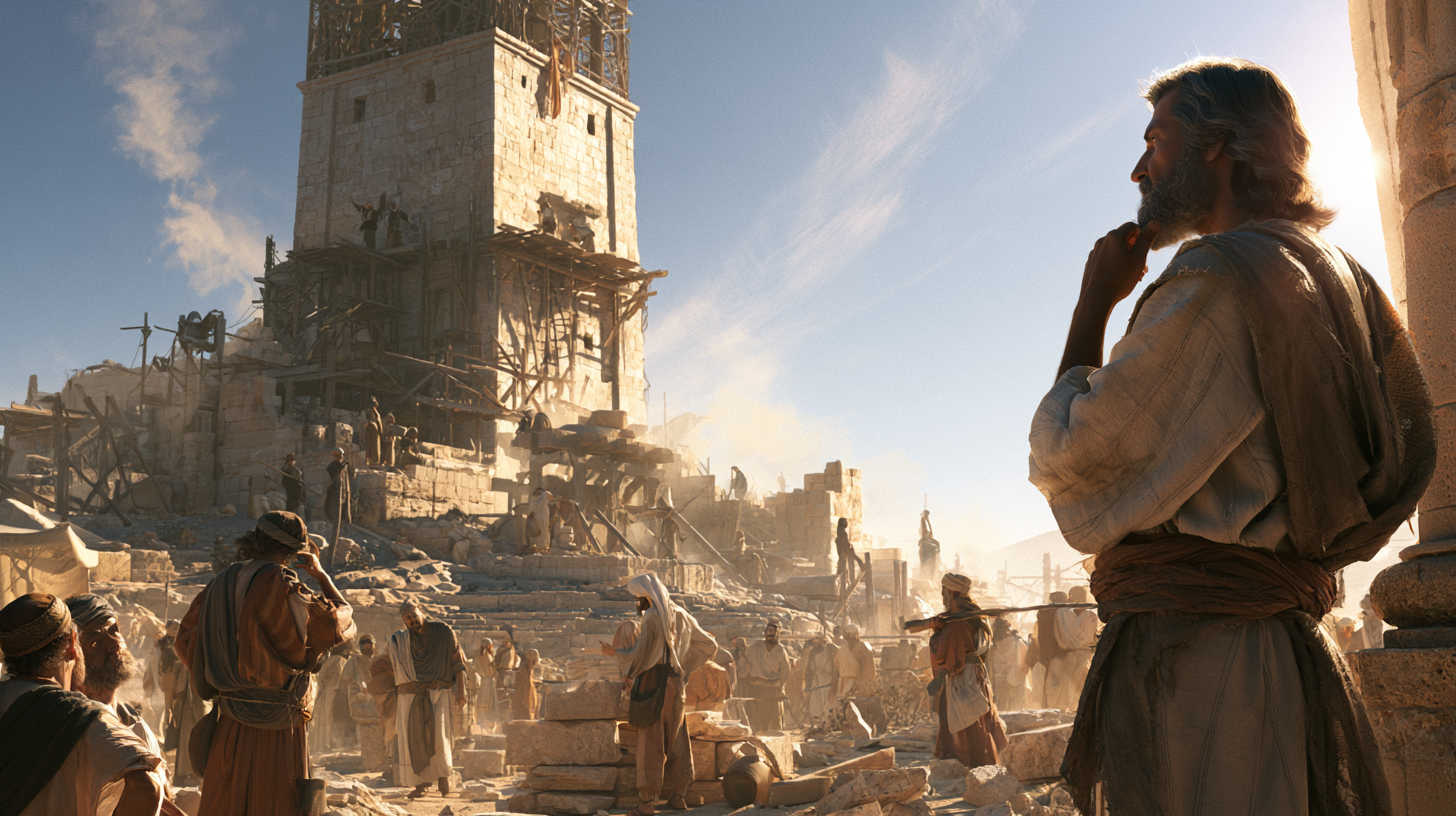
Jesus told this parable to a large, enthusiastic crowd following Him — and rather than encouraging their momentum, He handed them a warning. In Luke 14:28-30, He compares would-be disciples to someone who wants to build a tower but never bothers to check whether they can actually afford to finish it.
The result of skipping that step isn’t just an unfinished building; it’s public ridicule. Paired immediately afterward with a second, similar image — a king deciding whether he can win a war before he commits his army — the passage forms one of the most direct challenges to casual faith found anywhere in the Gospels.
This article breaks down the parable’s verses, its Old Testament echoes, the different ways interpreters have read it, and what “counting the cost” actually requires in practice.
The Passage
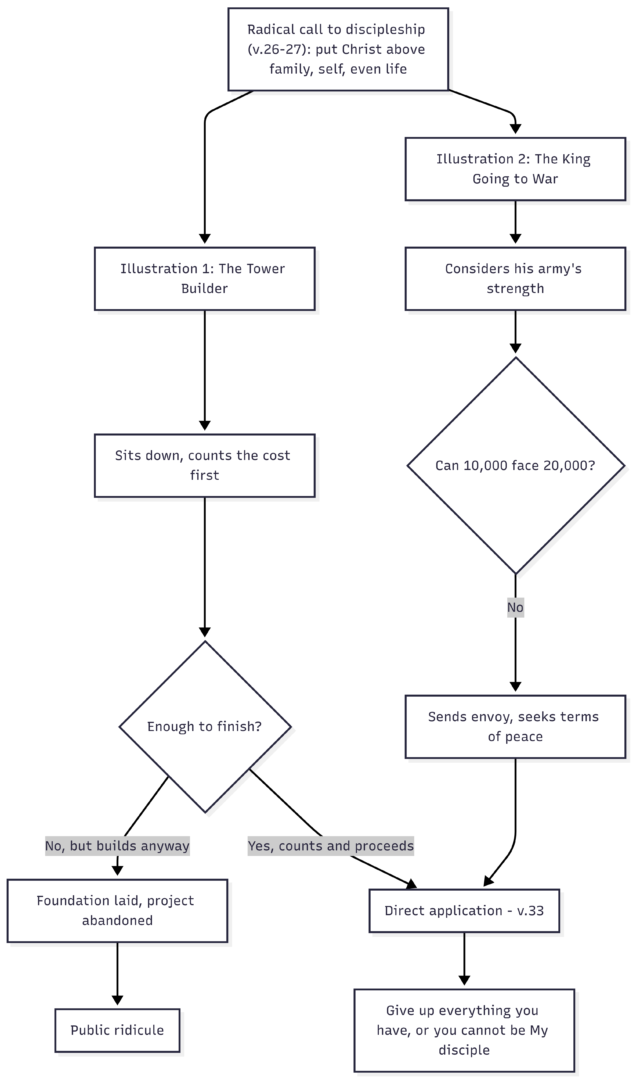
Jesus asks His listeners a rhetorical question: which of them, wanting to build a tower, wouldn’t first sit down and calculate whether they have enough resources to complete it? Otherwise, if the foundation gets laid and the money runs out, everyone who walks by will mock the half-finished structure and the builder who couldn’t see the project through (Luke 14:28-30).
He follows immediately with a second illustration — a king weighing whether his ten thousand troops can stand against an opposing force of twenty thousand, and if not, sending a peace delegation while the enemy is still far off (Luke 14:31-32). Jesus then applies both images directly: anyone unwilling to give up everything they have cannot be His disciple (Luke 14:33).
The Broader Context: A Hard Saying Surrounding a Hard Parable
This parable doesn’t stand alone. It’s sandwiched between two of the most demanding statements Jesus makes in the Gospels. Just before it, He tells the crowd that anyone unwilling to place loyalty to Him above loyalty to father, mother, spouse, children, siblings, and even their own life cannot be His disciple (Luke 14:26).
Just after the two parables, He adds that salt which loses its flavor is fit for nothing and gets thrown out (Luke 14:34-35). Reading the tower and war parables in isolation from these bookends misses the point — they’re not general life advice about planning ahead. They’re specifically about what it costs to follow Jesus, framed by two of His most uncompromising statements about discipleship.
Visualizing the Structure of the Passage
What the Two Illustrations Have in Common
| Element | Tower Builder | King Going to War |
|---|---|---|
| The Task | Constructing a building | Waging a military campaign |
| The Preparation Step | Sitting down to calculate total cost | Sitting down to assess relative strength |
| The Risk of Skipping It | Half-built ruin, public mockery | Catastrophic defeat |
| The Wise Response | Only build if resources are sufficient | Seek peace terms if the odds are against you |
| The Application | Discipleship requires the same honest self-assessment before committing |
Both illustrations share a structure: an ordinary, practical scenario, followed by a decision point that requires honest self-assessment, followed by consequences for skipping that assessment. Jesus uses two different domains — construction and warfare — to make sure the point lands regardless of the listener’s background.
Four Ways Interpreters Read This Passage
Because verse 33 explicitly ties the parables to giving up “all that he hath,” and because the passage is bracketed by such demanding statements about family and self, this text has generated real disagreement among readers over exactly what’s being counted and why. Four main readings are worth understanding.
1. The Straightforward “Count the Cost” Reading. This is the most common interpretation: before committing to discipleship, a person should honestly assess whether they’re prepared for the total demand — full allegiance, ongoing sacrifice, and the possibility of hardship — rather than starting with enthusiasm and quitting partway through. Under this reading, the “cost” is the whole of a person’s life and possessions, and the warning is against superficial or impulsive commitment.
2. The Zeal-and-Perseverance Reading. Some early interpreters read the parable less as a warning about dignity or embarrassment and more as a warning about giving up the effort itself. On this view, the tower represents the resolution to follow Christ, and the “counting” is really about stockpiling enough spiritual determination in advance to finish what’s started — since abandoning the task partway through isn’t primarily humiliating, it’s simply unfinished.
3. The Covenant Contrast Reading. A less common but notable interpretation reads the tower builder and the king as opposite examples: the tower builder represents someone trying to achieve righteousness through their own effort and inevitably failing partway through, while the king who wisely seeks peace terms represents someone who recognizes their own insufficiency early and turns to grace rather than self-reliance. Under this reading, the “salt” that follows in verses 34-35 represents a wisdom or approach that no longer functions and must be discarded.
4. The Persistence-and-Mercy Reading. A fourth reading treats the tower builder as a call to persistence despite imperfection, and the king’s peace delegation as a picture of seeking mercy rather than surrender — a combined message that says: press on toward the goal, while acknowledging you’ll need grace and help along the way, not flawless self-sufficiency from the outset.
These readings aren’t necessarily mutually exclusive — several point toward the same underlying conclusion even while disagreeing on the mechanics of the metaphor: discipleship is not a casual undertaking, it can’t be sustained by willpower alone, and half-measures produce a worse outcome than either full commitment or honest recognition of one’s limits.
What “Counting the Cost” Actually Involves
Whichever reading a person favors, the passage points toward a few concrete elements of what “the cost” includes:
- Relational cost. Loyalty to Christ is placed above the strongest natural bonds a person has — family relationships that would ordinarily come first.
- Personal cost. The demand extends to one’s own life and self-preservation instincts, not just external relationships.
- Material cost. Verse 33 makes this explicit: giving up possessions and material security is part of the equation, not incidental to it.
- Ongoing cost. The tower and the war aren’t one-time transactions; they’re projects that require sustained investment over time, which is exactly why counting the cost in advance matters more than enthusiasm at the starting line.
Why “Hate” Doesn’t Mean What It Sounds Like
The word translated “hate” in verse 26 trips up a lot of readers, since it sits awkwardly next to Jesus’ repeated command to love one’s neighbor. In the idiom of the time, this kind of language functioned more as a comparative statement of priority than an emotional statement of contempt — “hate” in this sense means “love less by comparison,” the way an heir might be said to “love” one parent and “hate” another when the real point is which relationship takes precedence when the two conflict.
Understood this way, Jesus isn’t commanding hostility toward family; He’s insisting that no relationship, however close, can outrank devotion to Him.
Common Misreadings to Avoid
- Treating this as generic life advice about planning ahead. The parables are specifically about the cost of discipleship, not a general principle about budgeting for home renovations or business plans, even though the illustrations are drawn from ordinary life.
- Reading “hate” as license for neglecting family relationships. The point is about relative priority, not permission to mistreat or abandon the people closest to you.
- Assuming the passage teaches earning salvation through sheer effort. Several respected readings of this text explicitly push back against a self-reliant, works-based interpretation, framing the parable instead as a call to honest self-assessment followed by dependence on grace rather than confidence in personal strength.
- Missing the ridicule/consequence element. The tower builder isn’t simply inconvenienced by running out of funds — the story specifically highlights public mockery, which is the point being made about incomplete, half-hearted discipleship.
Practical Application Today
| Modern Situation | Failing to Count the Cost | Counting the Cost Well |
|---|---|---|
| Starting a faith commitment | Enthusiastic beginning, no ongoing practice | Building sustainable habits of prayer, study, and community from the start |
| A major life decision | Committing based on excitement alone | Weighing the full, ongoing demands honestly before committing |
| A long-term project | Starting without securing adequate resources | Assessing capacity honestly, adjusting scope if needed |
| Facing a serious challenge | Charging ahead regardless of the odds | Honestly assessing strength and, where needed, seeking help or terms rather than blind persistence |
Frequently Asked Questions
It means honestly assessing, before committing, whether you’re prepared for the full and ongoing demands of a decision — in this passage, specifically the demands of following Jesus — rather than starting with enthusiasm and abandoning the effort partway through.
The two illustrations reinforce the same point from different angles — one from construction, one from military strategy — both showing that wise action requires an honest assessment of resources or strength before committing to a course of action.
No. In the idiom of the passage, this language expresses relative priority rather than literal hostility — it means placing devotion to Christ above every other relationship when the two come into conflict, not neglecting or mistreating family.
Most interpreters explicitly reject that reading. The parable is generally understood as a call to honest self-examination and full commitment, with several readings emphasizing that ultimate reliance rests on grace rather than self-sufficient effort.
Don’t commit to discipleship — or any major undertaking — based on enthusiasm alone. Understand the full, ongoing cost in advance, and be prepared to see it through rather than starting strong and abandoning it partway.
Final Thought
The image of an abandoned foundation, mocked by everyone who passes it, is deliberately uncomfortable — Jesus isn’t softening the demand of discipleship to make it more appealing. The parable’s real question isn’t whether the cost is high; it plainly is. The question is whether it’s been honestly counted before the first stone is laid.
Please share this Parable of the Tower: Verse, Meaning & Lesson your friends and do a comment below about your feedback.
We will meet you on next article.
Until you can read, What Is the Meaning of the Parable of the Tenants?