Parable of the Faithful Servant (Matthew 24:45-51)
The Parable of the Faithful Servant is one of Jesus’ clearest teachings on readiness, responsibility, and accountability. Found in Matthew 24:45-51 and Luke 12:42-48, it describes a servant left in charge of a household while the master is away. The question it asks is simple: what do you do with your responsibilities when no one seems to be watching?
This guide covers the passage, the meaning of each character, the differences between Matthew and Luke, the key lessons, and practical ways to apply the parable.
Quick Summary: Parable of the Faithful Servant
| Detail | Information |
|---|---|
| Main passages | Matthew 24:45-51; Luke 12:42-48 |
| Also called | Parable of the Faithful and Wise Servant, Parable of the Faithful Steward |
| Speaker | Jesus |
| Setting | Teaching about His return and spiritual readiness |
| Central theme | Faithful stewardship while waiting for the master’s return |
| Key question | “Who then is the faithful and wise servant?” |
| Main warning | Accountability comes at an unexpected time |
The Parable of the Faithful Servant: Matthew 24:45-51
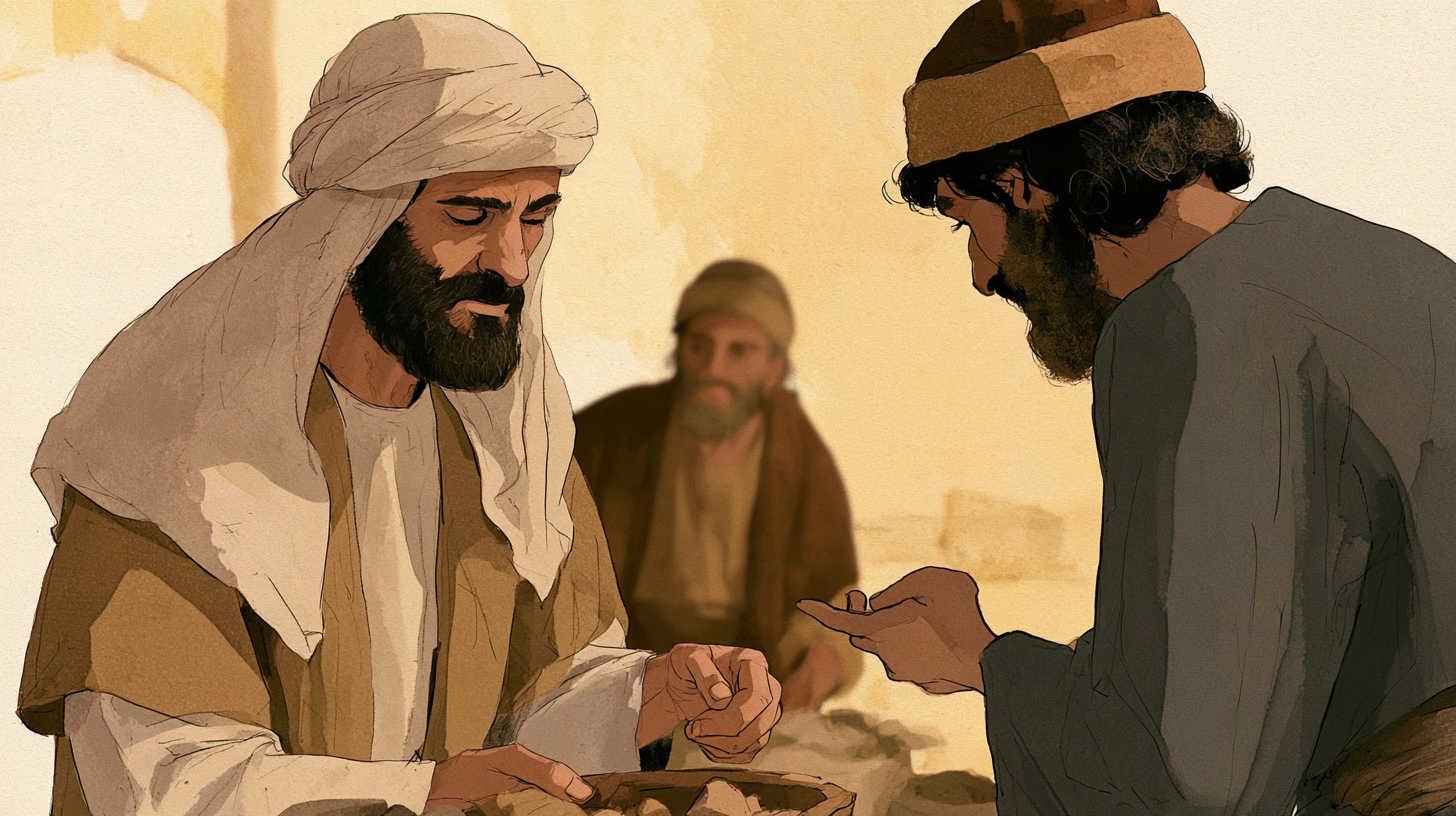
Jesus opens with a question: “Who then is the faithful and wise servant, whom his master has set over his household, to give them their food at the proper time?” The rest of the parable answers it.
- The faithful servant is found doing his assigned work when the master returns. He is rewarded with greater authority, being set over all the master’s possessions.
- The wicked servant tells himself, “My master is delayed.” He then beats his fellow servants and eats and drinks with drunkards. The master returns on a day and at an hour he does not expect, and the servant faces severe judgment among the hypocrites, in a place of “weeping and gnashing of teeth.”
Notice that the faithful servant is not doing anything spectacular. He is feeding the household on schedule. The parable defines faithfulness as reliable, ordinary service.
Context: Where the Parable Fits in Matthew 24-25
The parable belongs to the Olivet Discourse, where Jesus teaches His disciples about the end of the age and His return. It is the last in a sequence of warnings about readiness:

The progression matters. Matthew 24:36-44 says to be ready. The faithful servant shows what readiness looks like in daily conduct. The ten virgins and the talents then deepen the theme, and the sheep and goats conclude with final judgment. Readiness in this section is never passive waiting. It is active, responsible service.
Who Are the Characters in the Parable?
| Character | Represents | Key Trait |
|---|---|---|
| The master | Jesus Christ, who leaves and returns | Returns unexpectedly |
| The faithful and wise servant | A believer or leader who obeys consistently | Reliable, diligent, caring |
| The wicked servant | A professing believer who lives carelessly and selfishly | Presumptuous, abusive |
| The household | God’s people, entrusted to the servant’s care | Dependent on faithful leadership |
| The food at the proper time | Spiritual and practical care for others | Timely, consistent provision |
| The master’s delay | The period before Christ’s return | A test of character |
The servant is “set over” the household, so the parable speaks most directly to people with responsibility for others: pastors, parents, managers, and teachers. Luke records that Peter asked whether Jesus told the parable for the disciples or for everyone, and Jesus answered by returning to the image of the faithful steward. The principle applies to every believer, with leaders held to a higher standard.
What Is the Meaning of the Parable of the Faithful Servant?
The meaning centers on three connected ideas.
1. Faithfulness is revealed in the master’s absence
The wicked servant’s fault begins in his thinking: “My master is delayed.” Because he believes accountability is far off, he abandons his duties and abuses his position. The parable shows that private conduct reveals real character. A person who behaves well only under observation is not yet faithful.
2. Authority is stewardship, not ownership
The servant manages a household that belongs to someone else. His position exists to serve the other servants, not to benefit himself. In a modern workplace, he is like a manager who answers to owners while caring for the team beneath him. He cannot justify mistreating his team by claiming it serves his superiors, because the master’s interests are met only when the household is properly cared for.
3. Readiness is a lifestyle
The master returns “on a day when he does not expect him.” The response Jesus commends is not anxious speculation about timing but steady obedience. Christians are not asked to calculate the date. They are asked to be found doing what they were assigned.
The Parable of the Faithful Servant in Luke 12:42-48
Luke records a parallel version with the same core structure and some important additions. Luke’s servant is called a steward (a household manager), which highlights the idea of managing something belonging to another.
Luke adds a principle of proportional accountability:
- A servant who knew the master’s will and ignored it faces severe judgment (“many stripes”).
- A servant who did not know but still acted wrongly faces lesser judgment (“few stripes”).
- The closing principle: “To whom much is given, of him much will be required.”
This does not mean ignorance excuses wrongdoing. It means responsibility grows with knowledge, opportunity, and resources.
Matthew vs. Luke: Key Differences
| Feature | Matthew 24:45-51 | Luke 12:42-48 |
|---|---|---|
| Servant’s title | Servant (slave) | Steward (household manager) |
| Context | Olivet Discourse on the end of the age | Teaching on watchfulness and treasure in heaven |
| Main emphasis | Readiness and judgment at the master’s return | Stewardship and accountability by knowledge |
| Judgment language | Placed with the hypocrites | Placed with the unfaithful |
| Degrees of punishment | Not mentioned | Many stripes vs. few stripes |
| Closing principle | Weeping and gnashing of teeth | “To whom much is given, much is required” |
| Prompting question | None | Peter asks who the parable is for |
Read together, the two accounts give a full picture. Matthew stresses be ready, and Luke stresses be responsible with what you know and have.
The Two Paths: Faithful vs. Wicked Servant
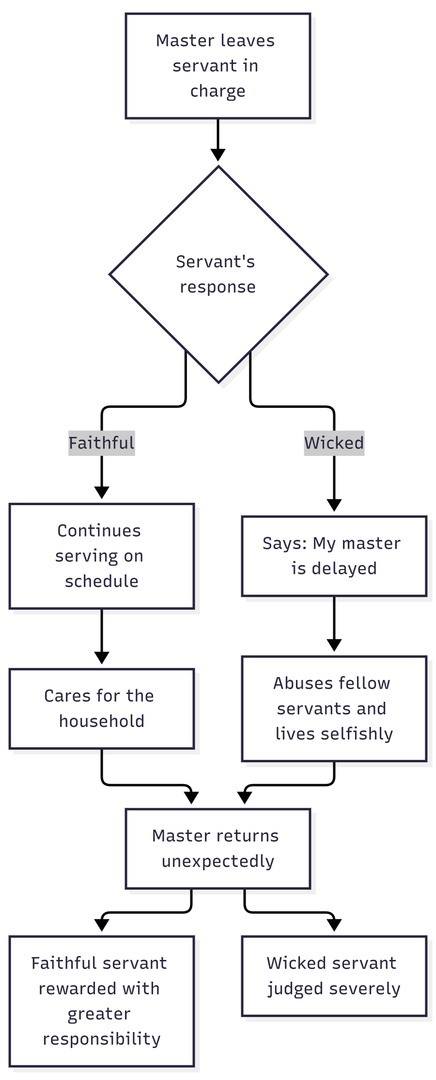
The two servants begin in exactly the same position. Only their response to the delay differs, and that response determines everything that follows.
Faithful Servant vs. Wicked Servant: A Side-by-Side Comparison
| Aspect | Faithful Servant | Wicked Servant |
|---|---|---|
| View of the master | Trusts that he will return | Assumes he is delayed |
| Motivation | Duty and integrity | Self-interest |
| Treatment of others | Provides food at the proper time | Beats fellow servants |
| Lifestyle | Disciplined, attentive | Indulgent, careless |
| Result at the return | Set over all the master’s goods | Cut off and judged |
Key Lessons from the Parable of the Faithful Servant
1. Faithfulness requires consistency
The faithful servant does not serve in bursts of enthusiasm. He keeps providing food at the proper time, day after day. Spiritual maturity is built through small, repeated acts of obedience rather than occasional dramatic ones.
2. Spiritual readiness matters every day
Because no one knows the day or hour, readiness cannot be postponed. Delay is the wicked servant’s temptation, and daily faithfulness is the antidote.
3. Authority must serve, not exploit
The wicked servant uses his position to harm the people he was meant to care for. Jesus consistently teaches that leadership means service. Anyone given influence over others is accountable for how they use it.
4. Greater knowledge brings greater responsibility
Luke’s principle applies to anyone who has learned Scripture, received good teaching, or been given opportunities. Knowing what is right and not doing it carries heavier consequences than not knowing.
5. God’s judgment is fair and certain
The master returns and evaluates each servant according to what they actually did. Faithfulness is rewarded, and hypocrisy and abuse are exposed. The parable assures believers that faithful, unseen work is noticed.
6. Rewards grow with faithfulness
The faithful servant is not merely spared. He is given expanded responsibility. This pattern recurs in the parable of the talents, where faithfulness with a little leads to charge over much.
Related Parables: How They Compare
| Parable | Passage | Central Focus | Key Contrast |
|---|---|---|---|
| Faithful servant | Matthew 24:45-51; Luke 12:42-48 | Faithful service while the master is away | Faithful vs. wicked servant |
| Ten virgins | Matthew 25:1-13 | Preparedness for the bridegroom’s arrival | Wise vs. foolish |
| Talents | Matthew 25:14-30 | Using entrusted resources productively | Productive vs. idle servant |
| Minas | Luke 19:11-27 | Working with what has been given until the king returns | Diligent vs. fearful servant |
| Sheep and goats | Matthew 25:31-46 | Serving the needy as service to Christ | Compassionate vs. indifferent |
The faithful servant stresses how we treat people while waiting. The talents and minas stress what we do with our gifts. The ten virgins stress being prepared. Together they form a complete picture of watchful, productive, compassionate living.
Common Interpretations and Questions
Is the parable about salvation or rewards?
Interpreters differ. Some read the wicked servant as a false professor of faith whose behavior reveals he never truly belonged. Others read the judgment as severe discipline for a genuine believer who lives carelessly. What all readers agree on is the main point: Jesus calls His followers to persevering faithfulness, and He treats neglect and abuse as serious.
What does “cut him in pieces” mean?
The phrase is a strong idiom for severe judgment. It emphasizes how serious it is to abuse authority and disregard the master, rather than describing a literal method of punishment.
What does “weeping and gnashing of teeth” mean?
Jesus uses this phrase repeatedly for the grief and regret of exclusion from God’s kingdom. It describes anguish over lost opportunity and separation.
Does the parable teach fear or motivation?
It does both. The warning is real, but the reward is also real. The strongest motivation in the passage is the master’s trust: the servant has been put in charge of something valuable, and faithfulness is the fitting response.
How to Apply the Parable of the Faithful Servant Today
The parable moves easily from ancient households to modern life. Here are practical applications:
- In your work: Do the same quality of work whether or not your supervisor is watching. Treat the people under your authority as people to care for, not tools to use.
- In your family: Parents are stewards of children entrusted to them. Providing “food at the proper time” includes emotional, spiritual, and practical care.
- In your church or community: Use your position to serve others. Leadership is measured by how well the people you serve are cared for.
- In your spiritual life: Build steady habits such as prayer, Scripture reading, and generosity rather than depending on occasional bursts of motivation.
- In your resources: Treat your time, money, and skills as things entrusted to you. Ask regularly what you are doing with what you have been given.
- In your attitude toward the future: Do not use the delay as an excuse. Live as though accountability is near, because the parable says it may come at an unexpected hour.
A simple self-check
| Question | What It Reveals |
|---|---|
| Do I behave differently when no one is watching? | Integrity |
| Am I using my influence to serve or to benefit myself? | Stewardship |
| Am I putting off obedience because there seems to be time? | Presumption |
| Do I act on what I already know to be right? | Responsibility |
| Are the people under my care better off because of me? | Faithful leadership |
Frequently Asked Questions
It is about a servant put in charge of a household who is judged by how he behaves while the master is away. Faithful, consistent service is rewarded, and selfish, abusive behavior is punished.
In Matthew 24:45-51 and Luke 12:42-48.
Jesus Christ, who will return at a time no one can predict.
Believers in general, and especially those entrusted with leadership and care for others.
Live faithfully and responsibly every day, because accountability will come unexpectedly and responsibility grows with knowledge and opportunity.
The faithful servant focuses on how the servant treats the household and whether he remains diligent. The talents focus on how productively servants use the resources they were given.
Conclusion
The Parable of the Faithful Servant answers the question of how to live between Jesus’ first coming and His return. Faithfulness means steady, unglamorous service. It means treating authority as stewardship and refusing to use the master’s delay as a reason to relax. Matthew’s account calls believers to readiness, and Luke’s adds that responsibility increases with knowledge and opportunity.
The reward is as important as the warning. The servant who keeps working is trusted with more, and the parable’s opening question still stands: “Who then is the faithful and wise servant?” Each person answers it by how they live when no one is watching.
Please share this Parable of the Faithful Servant (Matthew 24:45-51) your friends and do a comment below about your feedback.
We will meet you on next article.
Until you can read, What Does the Gospel of the Kingdom Mean?