
The Speck and the Log: What Matthew 7:1-5 Really Means
Few teachings of Jesus get quoted as often — and as loosely — as “judge not, that you be not judged.” It shows up in arguments about morality, in courtrooms of public opinion, and in everyday conflict as a conversation-ending trump card.
But the full passage, found in Matthew 7:1-5 and echoed in Luke 6:41-42, is far more precise than the one-liner suggests. It’s not a blanket ban on discernment. It’s a pointed warning about hypocrisy, delivered through one of the most vivid images Jesus ever used: a person with an enormous plank sticking out of their own eye, offering to perform delicate surgery on someone else’s eyelash-sized speck.
This article walks through the passage, its parallel in Luke, the Greek wordplay behind it, and what it actually asks of a reader — which is less about staying silent and more about getting your own house in order first.
The Passage
In the Sermon on the Mount, Jesus tells His listeners not to judge, warning that the standard they use to measure others will be used to measure them (Matthew 7:1-2).
He then asks why someone would fixate on a speck of sawdust in another person’s eye while ignoring a plank in their own — and calls anyone who tries to remove the speck without dealing with their own plank a hypocrite (Matthew 7:3-5).
Luke’s version of the same teaching adds a short lead-in about one blind person trying to guide another, with both ending up in a ditch (Luke 6:39-42).
Breaking Down the Two Images
| Element | Greek Term | Literal Meaning | What It Represents |
|---|---|---|---|
| Speck | karphos | A tiny splinter of straw, chaff, or wood dust | A minor, often real, fault in someone else |
| Log / Plank | dokos | A structural beam used to support a roof or building | A major, often unacknowledged, fault in the critic |
| Judging | krino | To separate, evaluate, condemn | The act of pronouncing verdict on another’s character |
| Hypocrite | hypokrites | Literally “actor” or “stage performer” | Someone whose outward correction doesn’t match their inward reality |
The comedic exaggeration is the entire point. No one walks around with an actual roof beam wedged in their eye socket — that’s the joke, and Jesus’ audience would have laughed at the absurdity of it. But the humor carries a serious edge: it’s just as absurd, spiritually speaking, to obsess over someone else’s minor flaw while carrying an untreated major one of your own.
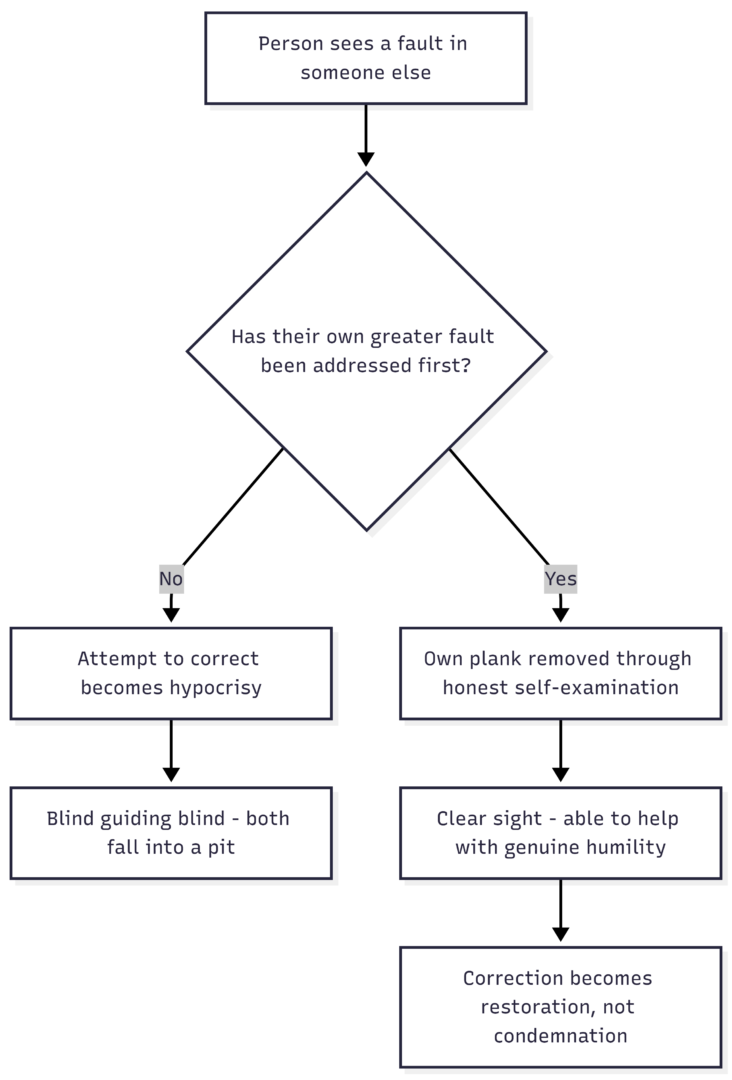
Visualizing the Logic of the Passage
What the Passage Is Not Saying
Because “judge not” gets lifted out of context so often, it’s worth being direct about what this teaching does not mean:
- It’s not a call to ignore wrongdoing. Elsewhere in Scripture, believers are explicitly told to use sound judgment — John 7:24 tells listeners to judge with right judgment rather than by surface appearances, and Galatians 6:1 assumes someone will need to step in when another person is caught in sin.
- It’s not a prohibition on discernment. Recognizing that an action is wrong, unhealthy, or harmful is different from the self-righteous fault-finding Jesus is condemning here.
- It’s not permission to avoid all correction. The passage ends with a path forward — deal with your plank, then help with the speck — not with a command to stay silent forever.
The target of the teaching is a specific posture: pointing out someone else’s flaw while refusing to examine, name, or deal with a bigger flaw in yourself.
Why This Teaching Lands So Hard
Three dynamics make this passage uncomfortable to sit with, and each one shows up constantly in ordinary life, not just in religious settings.
It’s always easier to spot flaws in someone else. Distance creates clarity. Watching another person’s mistake from the outside is simple; recognizing the same pattern in your own behavior, where you have every incentive to rationalize it, is not. The plank isn’t necessarily bigger because the critic’s sin is objectively worse — it’s “bigger” because it’s the one closest to them, the one they have the least excuse for missing, and the one they’re most likely to explain away.
Correcting someone else can feel like a substitute for dealing with yourself. There’s a subtle psychological escape hatch in fault-finding: if the conversation is about your neighbor’s problem, it’s not about yours. Focusing outward can function as a way of avoiding the harder, slower work of internal honesty.
Hypocrisy erodes trust before a single word of correction is even heard. A person can be factually right about someone else’s flaw and still fail to help them, because the messenger’s own unaddressed issues undercut the message. Once the double standard is visible, whatever wisdom might be in the correction gets lost in the discrediting of the messenger.
The Order of Operations Jesus Prescribes
The passage doesn’t end with “so never correct anyone.” It ends with a sequence:
- See your own plank. This requires deliberately looking inward rather than defaulting to outward scrutiny — an active, sometimes uncomfortable act of self-examination.
- Remove it. Naming a fault isn’t the same as dealing with it. The instruction is to actually take the plank out, not simply acknowledge it exists.
- Then help with the speck. Only after that internal work is the person positioned to help — and notably, Jesus doesn’t say the speck disappears or stops mattering. It’s still there, and it’s still worth addressing. The order is what changes, not the goal.
This sequence matters because it protects two things at once: honesty about real faults in other people, and humility about the person doing the correcting.
How This Plays Out in Everyday Situations
| Situation | Speck-Focused Response | Plank-First Response |
|---|---|---|
| A coworker misses a deadline | Publicly calling out their unreliability while regularly running late yourself | Privately raising the issue after reflecting on your own consistency |
| A family member overspends | Criticizing their spending while avoiding your own financial habits | Addressing your own patterns first, then offering to help budget together |
| A friend gossips | Repeating the story to others as proof of their character flaw | Recognizing your own tendency to talk about people, then having an honest conversation |
| Online criticism of public figures | Piling on for a mistake while excusing the same behavior from people you agree with | Applying one consistent standard, including to yourself and your own side |
The pattern holds across contexts: the corrective instinct itself isn’t the problem. The problem is applying a standard to others that hasn’t first been applied at home.
The Broader Context: Matthew 23 and the Danger of Performed Righteousness
This teaching doesn’t stand alone. Later in Matthew, Jesus directly confronts religious leaders who preached one standard while living by another, piling expectations on people while doing nothing to help carry the weight, and performing their righteousness for an audience rather than living it out privately (Matthew 23:3-5).
He goes further, criticizing meticulous attention to minor religious details while neglecting far weightier matters like justice, mercy, and faithfulness (Matthew 23:23). That’s the mature, developed version of the exact problem the speck-and-log image warns against in miniature: intense focus on small, visible infractions while ignoring the much larger issues underneath.
Practical Steps for Self-Examination Before Correction
Anyone trying to apply this teaching honestly can work through a short internal checklist before raising an issue with someone else:
- Ask what’s actually motivating the correction. Genuine concern for the other person looks different from irritation, a need to feel superior, or a desire to control.
- Look for the same pattern in yourself first. It’s common to be most annoyed by traits in others that exist, in some form, in ourselves.
- Separate discernment from condemnation. Noticing something is wrong is not the same as pronouncing a verdict on someone’s character.
- Check the tone you’d want if the roles were reversed. The standard used to correct someone else is, according to this passage, the same standard that will eventually be applied back.
- Aim at restoration, not humiliation. The goal named elsewhere in the New Testament for confronting a fault is gentle restoration, not public exposure.
Frequently Asked Questions
No. The passage condemns hypocritical judgment — correcting others while ignoring a greater fault in yourself — not honest discernment or loving correction offered from a place of humility.
The word for speck (karphos) describes a tiny particle like sawdust or chaff, while the word for log (dokos) refers to a heavy structural beam. The contrast is deliberately extreme to highlight the absurdity of the hypocrite’s position.
Yes, with slight variation. Matthew places it within the Sermon on the Mount; Luke frames it with an added image of one blind guide leading another into a pit, reinforcing the same point about impaired judgment.
It’s a direct preview of Jesus’ later, sharper confrontation with religious leaders in Matthew 23, where He criticizes people who enforce standards on others that they don’t apply to themselves.
Deal with your own greater faults honestly and first. Only then are you in a position — with clear sight and the right motive — to help someone else with theirs.
Who Actually Has Standing to Correct?
Within a faith community, this teaching also shapes who is positioned to offer correction and how. Rather than everyone policing everyone else’s minor faults, most traditions distribute that responsibility across recognized roles — people tasked with teaching and shepherding, people tasked with guarding sound doctrine and providing oversight, and people tasked with tending to practical needs. The point isn’t to create a bureaucracy around correction; it’s to slow down the impulse toward casual, untrained fault-finding and route serious concerns toward people who have already done — or are expected to do — the harder work of self-examination first.
Even outside any formal structure, the same principle applies one-on-one. Before raising a concern with a friend, coworker, or family member, it’s worth asking whether the relationship and the moment can bear it, and whether the correction is coming from someone who has earned enough trust and self-awareness to be heard rather than resented.
Final Thought
The image of a plank in one’s own eye is almost cartoonish, and that’s exactly why it works. It forces a moment of self-recognition that a straightforward command might not. The teaching isn’t anti-correction; it’s anti-hypocrisy. Fix the log first — not because the speck stops mattering, but because clear sight, humility, and credibility are what make any correction worth hearing.
Please share this The Speck and the Log: What Matthew 7:1-5 Really Means your friends and do a comment below about your feedback.
We will meet you on next article.
Until you can read, What Is the Meaning of the Parable of the Sower?