
Parable of the Lost Coin: Verse, Meaning & Lesson
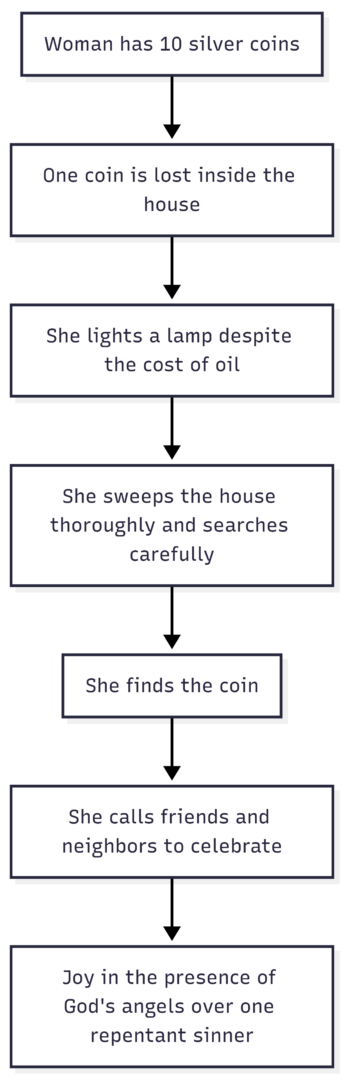
The Parable of the Lost Coin is a short but powerful story told by Jesus in Luke 15:8-10. A woman with ten silver coins loses one, lights a lamp, sweeps her entire house, and searches carefully until she finds it — then calls her friends and neighbors together to celebrate. Jesus explains that this mirrors the joy in heaven “in the presence of the angels of God over one sinner who repents.”
This article covers the full verse, its historical and cultural background, what each detail symbolizes, and the practical lessons believers can draw from it — plus how it connects to the two parables told alongside it in Luke 15.
The Bible Verse: Luke 15:8-10
“Or suppose a woman has ten silver coins and loses one. Doesn’t she light a lamp, sweep the house and search carefully until she finds it? And when she finds it, she calls her friends and neighbors together and says, ‘Rejoice with me; I have found my lost coin.’ In the same way, I tell you, there is rejoicing in the presence of the angels of God over one sinner who repents.”
Context: Why Jesus Told This Parable
Luke 15 opens with a specific scene: tax collectors and “sinners” are gathering to hear Jesus, and the Pharisees and teachers of the law grumble that “this man welcomes sinners and eats with them” (Luke 15:2). In response, Jesus tells three connected parables in a row — the Lost Sheep, the Lost Coin, and the Prodigal Son — each making the same case from a different angle: God actively seeks out what is lost and rejoices when it is found.
The physician-turned-Gospel-writer Luke is often noted by commentators for his attention to people on the margins — women, the poor, outsiders, and the overlooked. The Parable of the Lost Coin fits that pattern directly: its central figure is a woman of modest means, a character type rarely centered in ancient storytelling, searching her own small home for something precious that was nearly overlooked.
What Each Detail in the Parable Represents
| Element | Represents |
|---|---|
| The woman | God, actively and personally searching for the lost |
| The ten silver coins | A group of people (or a whole community) valuable to God |
| The one lost coin | A person who has drifted from or never known God |
| Lighting the lamp | God bringing light and truth into dark, hidden places |
| Sweeping the house | Deliberate, thorough effort — nothing is overlooked |
| Finding the coin | Restoration and repentance |
| Calling friends to rejoice | Heaven’s celebration over one repentant sinner |
Unlike the sheep in the companion parable, which wandered off on its own, a coin cannot move itself. It’s lost through no action of its own — misplaced, dropped, or overlooked. Many commentators highlight this distinction: some people become distanced from God through their own choices, like the wandering sheep, while others become “lost” through neglect, circumstance, or simply being overlooked within a community — like the coin, lost inside the woman’s own house rather than out in the wilderness. This detail is significant: the coin isn’t lost in some distant field — it’s lost inside the home, suggesting that people can be spiritually lost even while remaining inside a religious community or household of faith.
The Cultural and Economic Background
Understanding the coin’s real value sharpens the parable considerably.
The coin’s worth. In the original Greek, the coins are drachmas — silver coins roughly equivalent to a Roman denarius, which represented about a day’s wages for a laborer. Losing one of ten wasn’t a minor inconvenience; it represented a meaningful portion of the woman’s tangible savings.
A subsistence economy. Scholars of first-century Middle Eastern peasant life note that cash was relatively rare in village households, which were largely self-sufficient — growing their own food and making their own cloth. In that context, a lost coin represented far more than its face value; it was a rare and hard-won asset.
Possible sentimental value. Some interpreters suggest the ten coins may have been part of a woman’s headdress or necklace — a piece of jewelry tied to her betrothal or dowry, worn visibly as a symbol of her marriage commitment. While this reading isn’t confirmed by direct textual evidence, it would explain the urgency and thoroughness of her search: this wasn’t just currency, it may have been deeply personal.
The physical setting. Homes in first-century Israel were typically small, dark, and had few or no windows, with hard-packed dirt floors prone to cracks and debris. Finding a small silver coin in that environment genuinely required a lit lamp (an expense in itself, since oil wasn’t cheap) and a careful, room-by-room sweep — which explains why Jesus describes her searching “carefully” rather than casually glancing around.
Visualizing the Parable
Key Lessons from the Parable of the Lost Coin
1. Individual Worth Never Diminishes
Even lying in dust and dirt on the floor, the coin never stopped being valuable. Its worth wasn’t tied to its location or condition — only to whose it was. In the same way, a person’s inherent worth to God doesn’t decrease because of sin, distance, or circumstance.
2. God’s Pursuit Is Active, Not Passive
The woman doesn’t wait for the coin to somehow reappear. She lights a lamp, sweeps, and searches “carefully” — deliberate, sustained effort. This reinforces a theme found throughout Luke 15: God doesn’t sit back waiting to be found; He initiates the search.
3. People Can Be Lost Even Inside a Community
Because the coin is lost inside the woman’s own house — not out in a field, as in the Lost Sheep parable — this version speaks pointedly to those who may be part of a church or religious community and yet remain spiritually distant, unconverted, or disengaged. Being physically present doesn’t guarantee being spiritually found.
4. God Values the Whole, Not Just the Majority
The woman still had nine coins — a 90% success rate by any practical measure — yet she wasn’t satisfied until she found the tenth. This reflects a recurring biblical theme: God’s care doesn’t average out across a group; every individual matters completely.
5. Restoration Produces Shared Celebration
The woman doesn’t celebrate alone — she calls her friends and neighbors to rejoice with her. Likewise, Jesus specifies that heaven itself celebrates when even one person repents. Restoration is meant to be a communal joy, not a private relief.
How the Lost Coin Compares to the Lost Sheep
The Lost Coin is the second of three “lost and found” parables in Luke 15, each escalating in personal stakes and detail.
| Lost Sheep (Luke 15:3-7) | Lost Coin (Luke 15:8-10) | |
|---|---|---|
| What is lost | 1 of 100 sheep | 1 of 10 coins |
| Who searches | A shepherd (a low-status occupation) | A woman (a marginalized figure in that culture) |
| How it became lost | Wandered off on its own | Lost through circumstance, not its own action |
| Where the search happens | Open country / wilderness | Inside the woman’s own home |
| Search method | Actively going out and looking | Lighting a lamp, sweeping, careful searching |
| Value emphasis | Percentage lost is small (1%) but still matters | Object requires real, tangible effort to recover |
| Ending | Rejoicing with friends and neighbors | Rejoicing with friends and neighbors |
Both parables conclude with nearly identical language about heaven’s rejoicing, reinforcing that regardless of how someone becomes lost — through their own wandering or through being overlooked — God’s response to their return is the same: celebration.
Common Questions About the Parable of the Lost Coin
Because ancient homes had dirt floors, poor lighting, and few or no windows, a small coin could easily fall into a crack or be covered by dust or debris. A careful, systematic sweep with the aid of a lamp was a realistic and necessary method for finding something that small in that environment.
No — and that’s central to the parable’s meaning. Unlike a person who might actively seek God, the coin is entirely inanimate. The entire initiative belongs to the woman. This detail underscores that God’s pursuit of the lost doesn’t depend on the lost one’s own effort or ability to “find their way back.”
Both. Literally, a drachma represented roughly a day’s wages, making its loss a real financial concern. Symbolically, the coin represents a person — and Jesus deliberately chose a valuable, tangible object to make the point that people carry real, irreplaceable worth to God.
Luke 15 groups three stories together: a lost sheep, a lost coin, and a lost son. Each escalates in personal cost and detail — an animal, then an object with real financial and possibly sentimental value, then finally a family member. Together, they build toward the same conclusion from increasingly personal angles: God rejoices over anyone who is found, however they came to be lost.
Practical Application
This parable carries direct application for how believers view themselves and others:
- You are not defined by where you’ve been. The coin’s worth didn’t change while it sat in the dirt. A person’s value to God isn’t diminished by sin, mistakes, or distance from faith.
- Being “in the house” isn’t the same as being “found.” Just as the coin was lost inside the woman’s own home, it’s possible to be part of a church community without being spiritually engaged. This parable is a direct challenge to examine whether one is truly “found.”
- Thorough effort matters in seeking others. The woman didn’t glance around once and give up — she searched carefully and systematically. Reaching people who are spiritually lost, especially within a community, often requires the same sustained, intentional effort.
- Celebrate restoration publicly. The woman didn’t quietly pocket her coin and move on — she gathered others to rejoice. Communities of faith are called to celebrate, not merely accept, when someone returns.
Summary
The Parable of the Lost Coin, found in Luke 15:8-10, teaches that God pursues the lost with the same determination as a woman who lights a lamp, sweeps her entire house, and searches carefully until she finds a single missing coin. Unlike the wandering sheep in the parable that precedes it, the coin is lost through no fault of its own — a reminder that people can become spiritually distant not only by wandering away, but simply by being overlooked, even within a familiar household or community of faith.
The lesson is consistent throughout Luke 15: individual worth never diminishes, God’s search is active rather than passive, and heaven responds to restoration with real celebration. Paired with the Parable of the Lost Sheep and the Parable of the Prodigal Son, the Lost Coin completes a threefold picture of relentless, personal, active love — one that insists no person, however they came to be lost, is beyond being found.
Please share this Parable of the Lost Coin: Verse, Meaning & Lesson your friends and do a comment below about your feedback.
We will meet you on next article.
Until you can read, Parable of the Lost Sheep: Verse, Meaning & Lesson