
Parable of the Pearl: Verse, Meaning & Lesson
Tucked into Matthew 13, alongside a cluster of short parables about the kingdom of heaven, is a two-verse story about a merchant, a search, and a single pearl valuable enough to give up everything else for. It’s brief — barely two sentences — but it carries one of the most direct statements in the Gospels about what following Jesus actually costs and what it’s actually worth.
This guide covers the verse itself, its historical background, the two major interpretations scholars have drawn from it, its relationship to the neighboring Parable of the Hidden Treasure, and the practical lessons both readings offer.
The Verse and Its Setting
Matthew 13:45-46 describes the kingdom of heaven as comparable to a merchant searching for fine pearls. When he finds one pearl of exceptional value, he goes and sells everything he owns in order to buy it.
This parable appears as the fifth in a series of seven kingdom parables Jesus tells in Matthew 13, following the Parable of the Sower, the Wheat and the Tares, the Mustard Seed, and the Yeast, and immediately after its closest parallel, the Parable of the Hidden Treasure.
Each of these parables corrects a misunderstanding the disciples and crowds held about what God’s kingdom would look like and how it would arrive — not through immediate, visible conquest, but through something initially small, easily overlooked, and requiring genuine searching or discovery to recognize.
Historical Context: Why a Pearl?
In the ancient Mediterranean world, pearls ranked among the most valuable objects a person could own — frequently considered more precious than gold, silver, or other gemstones, partly because of their rarity and the difficulty involved in harvesting them from oyster beds.
A merchant dealing specifically in pearls would have been a specialist, someone with deep knowledge of quality, rarity, and worth — which matters for understanding the story. This isn’t an amateur stumbling onto something valuable by chance; it’s an expert who recognizes true, matchless value the moment he encounters it and acts decisively.
Two Interpretations of the Parable
Interpretation One: The Kingdom Is the Pearl
This is the more traditional and widely taught reading. In this view, the pearl represents the kingdom of heaven — or Jesus himself — and the merchant represents any person who recognizes the surpassing value of what God offers.
Once that value is truly understood, giving up worldly attachments to obtain it isn’t a painful sacrifice but a joyful, obvious choice. This interpretation emphasizes the priceless nature of salvation and the wholehearted response it calls for: a life reoriented entirely around its supreme worth.
Interpretation Two: You Are the Pearl
A second, less common but theologically rich reading flips the roles: Jesus is the merchant, actively searching, and the pearl represents the person — or the church collectively — being sought and redeemed.
This reading draws on the way pearls are actually formed: an oyster responds to an irritant, a piece of debris that damages its tissue, by covering it in layer after layer of a lustrous substance until something originally painful and ordinary becomes something valuable and beautiful.
Applied metaphorically, this mirrors sanctification — a process by which something flawed is gradually transformed, through God’s ongoing work, into something of genuine worth. Under this reading, Christ’s sacrifice on the cross is the “great price” paid, not by the person seeking salvation, but by God seeking the person.
Both interpretations aren’t mutually exclusive — many readers hold both simultaneously, recognizing the kingdom’s incomparable worth while also embracing the idea that they themselves are deeply sought and valued.
Comparing the Two Interpretations
| Element | Kingdom Is the Pearl | You Are the Pearl |
|---|---|---|
| Who is the merchant? | The believer seeking God | Jesus, seeking the sinner |
| What is the pearl? | The kingdom of heaven / salvation | The individual person or the church |
| What is “sold”? | Worldly attachments and priorities | Christ’s own life, given at the cross |
| Core lesson | Salvation’s value justifies total commitment | Personal worth is established by God’s pursuit, not self-effort |
| Emphasis | Human response to God’s offer | God’s initiative toward humanity |
The Parable of the Pearl vs. the Parable of the Hidden Treasure
The parable immediately preceding this one, the Parable of the Hidden Treasure, tells a strikingly similar story: a man discovers treasure buried in a field and, filled with joy, sells everything he owns to buy that field. The two parables share a structure and a conclusion, but one key detail differs meaningfully.
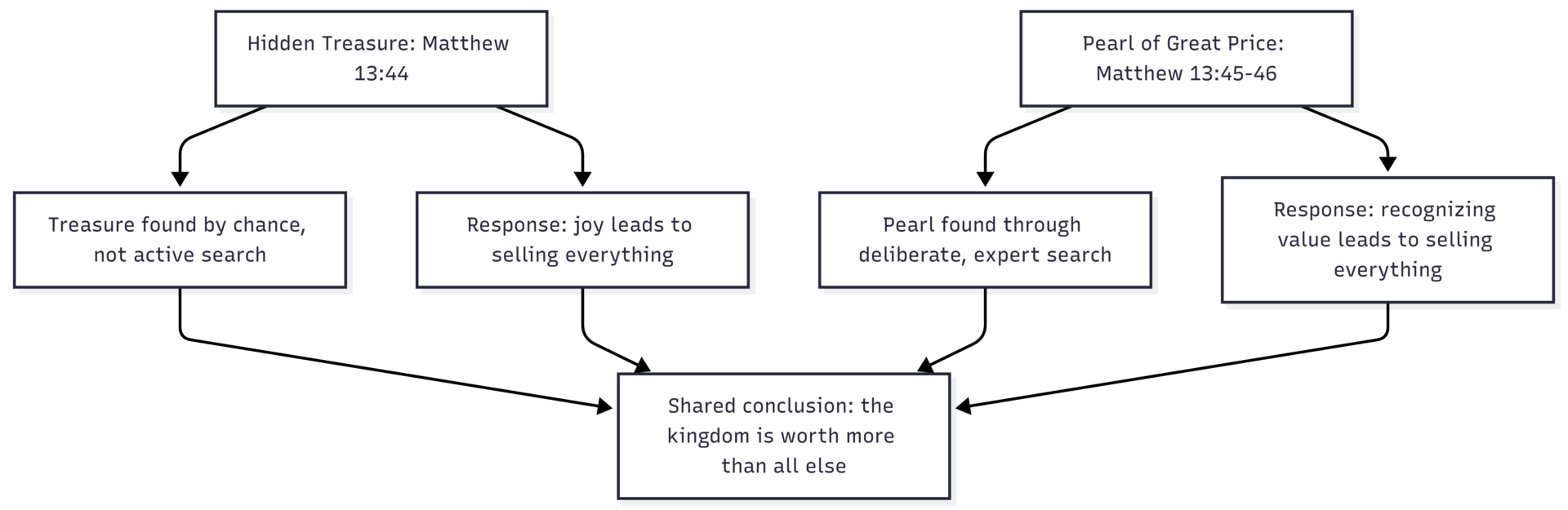
The man in the field wasn’t looking for treasure — he found it seemingly by accident. The merchant, by contrast, was actively and deliberately searching for fine pearls specifically.
Together, the two parables cover both ways people encounter the kingdom: some stumble upon it unexpectedly, while others actively and intentionally seek wisdom, truth, and God before finding what they’re looking for. Neither path is presented as superior — both end in the same response: total, joyful reprioritization once the value of what’s been found becomes clear.
Five Lessons From the Parable
1. The Kingdom’s Value Is Incomparable
Both readings of the parable agree on this point: whatever the pearl represents, its value dwarfs everything given up to obtain it. The comparison isn’t close — it’s not a fair trade weighed carefully, but an obvious exchange once true value is recognized.
2. Genuine Discovery Produces Joy, Not Reluctant Obligation
In the companion Parable of the Hidden Treasure, the man’s response is explicitly joy — he doesn’t sell his possessions grudgingly, but gladly, because what he’s gaining is worth infinitely more. This detail matters: authentic recognition of the kingdom’s worth doesn’t produce a sense of loss or duty, but genuine happiness at the trade being made.
3. Total Commitment Is the Natural Response to Real Value
The merchant “sold all that he had” — not some of it, not the portion he could spare, but everything. This detail illustrates that wholehearted commitment isn’t a separate requirement imposed on top of faith; it’s simply what naturally follows once someone actually understands what’s being offered.
4. Active Pursuit and Sudden Discovery Both Lead to the Same Place
Unlike the man who found treasure by chance, the merchant was actively, deliberately searching. This detail encourages an intentional pursuit of wisdom, truth, and God, rather than passively waiting to stumble upon spiritual insight.
At the same time, the companion parable affirms that not everyone arrives at faith through deliberate searching — some encounter it unexpectedly. Both paths are legitimate; the emphasis lands on the response once value is recognized, not on how the discovery happened.
5. Personal Worth Doesn’t Depend on Self-Improvement First
Under the “you are the pearl” interpretation, transformation happens after being found and valued, not as a precondition for it. The oyster doesn’t wait for the irritant to become valuable before responding to it — the covering, transforming process begins immediately upon contact. Applied to faith, this suggests personal worth and the process of being made new both flow from being sought and claimed, not from earning that status first through self-effort.
What “Selling Everything” Actually Means
A common point of confusion is treating this parable as though salvation could be purchased through sacrifice or good works. That’s not the point being made. Across Scripture, similar language about “buying” spiritual realities — wisdom, truth, salvation — consistently emphasizes securing something as one’s own possession, not literally paying a price for it.
The parable isn’t describing a transaction where human effort earns entry into the kingdom; it’s describing the total reprioritization that naturally follows once someone recognizes what they’ve found. The “great price” ultimately paid for salvation was paid by Christ himself, not by the individual who receives it.
Applying the Parable Today
| Question to Ask Yourself | What It Reveals |
|---|---|
| What would I be unwilling to give up for my faith? | Where competing priorities may be outweighing genuine commitment |
| Do I pursue God intentionally, or only when something happens to prompt it? | Whether faith is actively sought or passively assumed |
| Do I see my own worth as something I’ve earned, or something God has established? | Which interpretation of the parable currently shapes personal identity |
| Does my response to faith feel like joy or obligation? | Whether the kingdom’s value has been genuinely recognized, or only intellectually accepted |
Frequently Asked Questions
The parable illustrates the incomparable value of the kingdom of heaven, showing that recognizing its worth naturally leads to total, joyful reprioritization of everything else in life.
Scholars and commentators offer two main interpretations: the pearl represents the kingdom of heaven or salvation itself, or alternatively, the pearl represents the believer, with Jesus as the merchant who seeks and redeems at great personal cost.
The two parables share the same basic structure and conclusion, but differ in one key detail: the man who found the treasure did so by chance, while the merchant was actively and deliberately searching for pearls specifically.
No. The language of buying and selling in this parable, consistent with similar language elsewhere in Scripture, emphasizes securing something as one’s own possession rather than literally paying for it through works or sacrifice.
Pearls were considered among the most precious items in the ancient world, and a merchant specializing in them would be an expert able to recognize supreme value immediately — reinforcing the parable’s emphasis on the kingdom’s singular, unmatched worth.
Pearls form when an oyster covers a painful, foreign irritant in layer after layer of lustrous material, transforming something originally damaging into something valuable. Applied metaphorically, this parallels how a flawed individual can be gradually transformed through an ongoing, God-initiated process into something of genuine worth.
Whether read as a story about the priceless value of the kingdom or as a story about being sought and redeemed at great cost, the Parable of the Pearl makes the same underlying claim: what’s being offered is worth more than anything given up to receive it, and once that becomes clear, the response isn’t reluctant sacrifice but genuine joy.
Please share this Parable of the Pearl: Verse, Meaning & Lesson with your friends and do a comment below about your feedback.
We will meet you on next article.
Until you can read, Proverbs 31 — Sayings of King Lemuel