What Is the Meaning of the Parable of the Ten Virgins?
The Parable of the Ten Virgins appears in Matthew 25:1-13, right in the middle of Jesus’ Olivet Discourse — His extended teaching about the end times. Ten bridesmaids wait for a bridegroom to arrive so a wedding procession can begin. Five bring extra oil for their lamps. Five don’t. When the bridegroom finally shows up at midnight, the five without oil scramble to find more, miss the procession, and arrive to find the door already shut.
It’s a short, uncomfortable story, and its final line makes the point explicit: “Keep watch, because you do not know the day or the hour” (Matthew 25:13). This article breaks down the wedding customs behind the parable, what the oil represents, why the door gets shut for good, and what “being ready” actually means in practical terms.
The Story in Brief
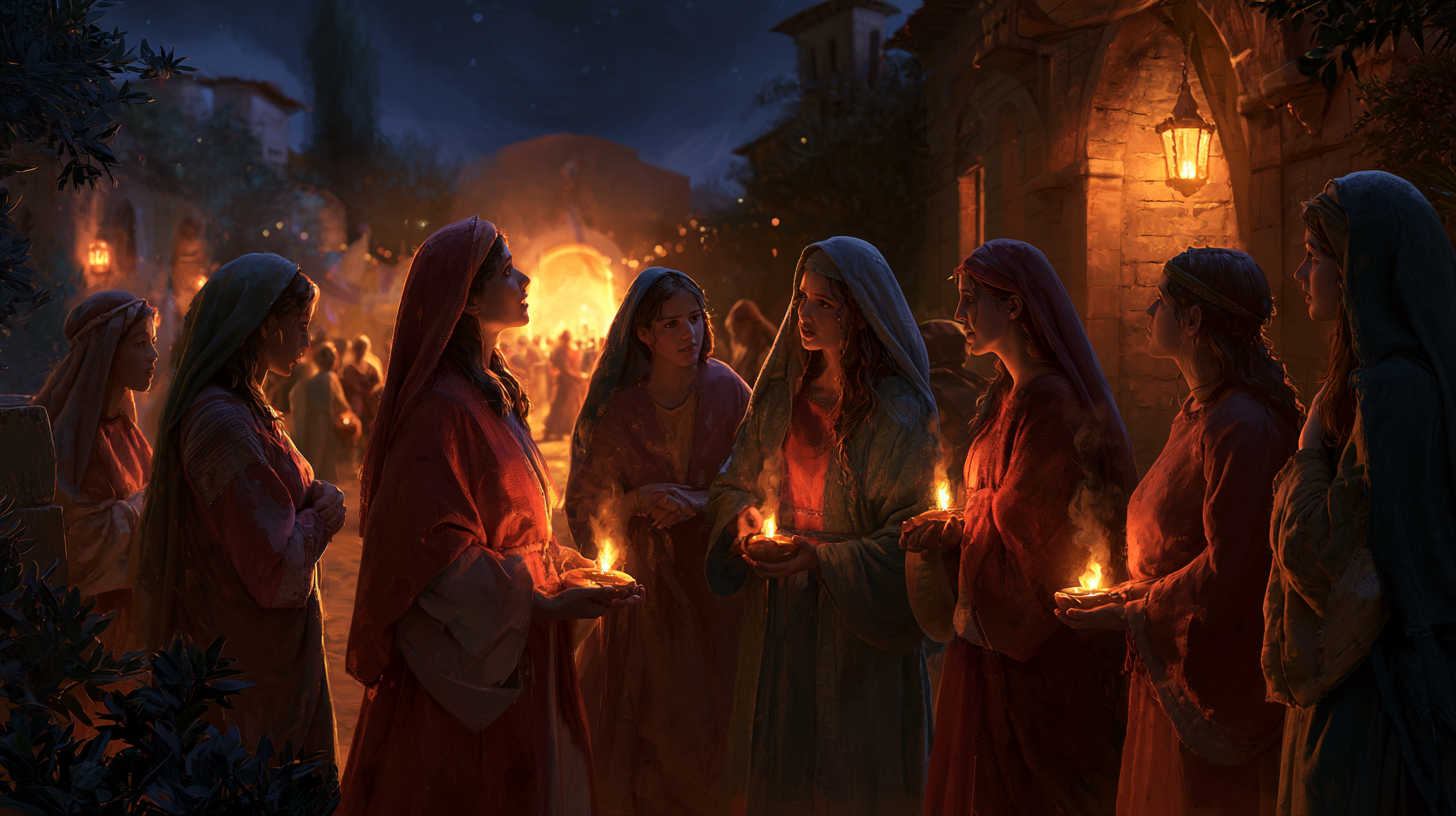
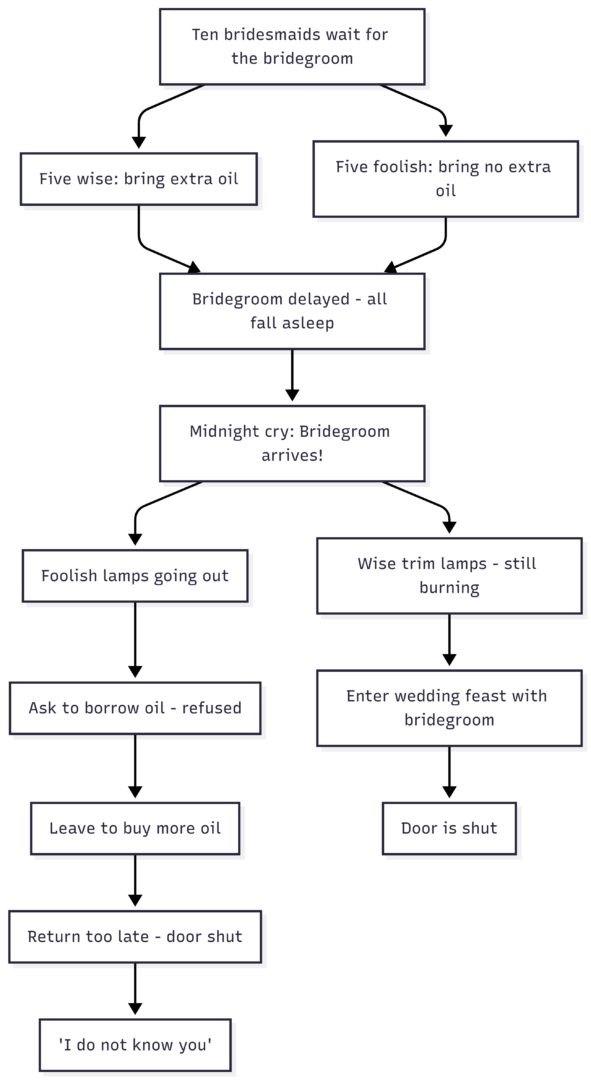
Ten bridesmaids take their lamps and go out to wait for the bridegroom. Five are wise and bring extra oil in flasks; five are foolish and bring only what’s already in their lamps. The bridegroom is delayed, and all ten fall asleep waiting.
At midnight, a shout goes up announcing his arrival. The bridesmaids wake and trim their lamps, but the five without extra oil find their lamps going out. They ask to borrow oil from the other five, who refuse — there isn’t enough to share and still have both groups ready in time.
While the unprepared bridesmaids go off to buy more oil, the bridegroom arrives. The five who were ready go in with him to the wedding feast, and the door is shut. When the other five return and ask to be let in, the response is blunt: “I do not know you.” Jesus closes with the instruction to stay alert, since no one knows the day or hour.
The Wedding Customs Behind the Parable
Understanding first-century Jewish wedding practice makes several odd details make sense. A bridegroom would typically leave his own home, travel to the bride’s family’s house, and negotiate final details with her parents — a process that could be drawn out deliberately, since a longer negotiation was considered a sign of honor toward the bride.
Once released, the groom would proceed through the streets after dark toward his own home, where the wedding feast would begin, joined along the way by bridesmaids carrying lit torches or oil lamps.
Anyone in that procession without a working light source risked being mistaken for a thief or an uninvited guest rather than a member of the wedding party — which is exactly why the oil matters so much in the story. The “delay” in the parable isn’t an unusual glitch; it’s baked into the custom itself, and everyone in the original audience would have expected some amount of waiting.
What Each Element Represents
| Element | Represents |
|---|---|
| The Bridegroom | Jesus Christ, returning at an unknown hour |
| The Ten Virgins | People who outwardly identify as belonging to God’s people, awaiting His return |
| The Wise Virgins | Those genuinely prepared — spiritually ready through real faith |
| The Foolish Virgins | Those outwardly identical but lacking genuine readiness |
| The Oil | Genuine faith and the ongoing presence of the Holy Spirit — something that sustains readiness over time |
| The Lamps | The outward profession or appearance of faith |
| The Delay | The unknown length of time before Christ’s return |
| The Shut Door | Final exclusion — a point after which preparation is no longer possible |
Visualizing the Story
Why the Wise Virgins Refuse to Share
This is the detail modern readers often find harshest — why wouldn’t the prepared bridesmaids simply split what they had? The parable’s logic is deliberate: if they’d shared, none of the ten would have had enough oil to last, and all ten risk being unprepared instead of five.
The point isn’t a lesson in stinginess; it’s that some things genuinely can’t be transferred from one person to another at the last minute. Genuine faith, spiritual maturity, and a settled relationship with God can’t be loaned out in an emergency the way a cup of sugar can. Each bridesmaid was responsible for bringing her own supply, and that responsibility couldn’t be outsourced once the moment arrived.
Why the Door Stays Shut
The most jarring line in the parable is the bridegroom’s response to the latecomers: “I do not know you.” In an ordinary wedding, showing up late might be embarrassing, but it wouldn’t usually result in a total denial of relationship.
That’s exactly why the line stands out — Jesus is making His point through contrast, not similarity. An everyday wedding host might grumble and let latecomers in anyway. The point of the parable is that the eternal wedding feast doesn’t work that way. Once the door closes, it stays closed, and the disqualifying issue isn’t tardiness — it’s that the relationship implied by “I know you” was never actually there.
The phrase “I do not know you” carries specific weight throughout Scripture. To be “known” by God consistently describes a genuine, covenantal relationship — Abraham was known, Moses was known, those who fear God are known. Its absence here isn’t a technicality; it signals that the foolish virgins’ outward association with the wedding party never corresponded to an inward reality.
Two Ways to Read Who the Virgins Represent
Interpreters generally split over exactly who this parable is originally addressed to, and both readings are worth understanding.
Reading One: A Picture of Israel at the End of the Tribulation. Because Matthew 24 and 25 form a continuous discourse focused on Israel’s future, some interpreters read the bridegroom as Christ and the bridesmaids specifically as Israel awaiting her Messiah at His second coming — with the parable answering whether Israel will be ready to receive Him, and concluding that some will and some won’t.
Reading Two: A Warning to the Visible Church. Others apply the parable more broadly to anyone who outwardly identifies with Christ’s kingdom — church members, professing believers, anyone within “the visible church.” Under this reading, the ten virgins represent everyone who shows up, professes faith, and waits alongside genuine believers, while the split between wise and foolish exposes the difference between nominal, professed faith and real, Spirit-sustained faith.
Both readings agree on the central warning: outward participation and inward readiness are not automatically the same thing, and the gap between them only becomes visible when the moment of testing arrives.
The Core Lesson: Readiness Can’t Be Improvised
Strip away the wedding details, and the parable makes one repeated point: spiritual readiness has to be built in advance, because it cannot be manufactured in the moment it’s needed. A few supporting ideas sit underneath that central claim:
- Delay is the whole test. If the bridegroom had arrived on schedule, every bridesmaid would have had enough oil. The delay is precisely what separates real preparation from surface-level preparation — anyone can look ready for a short wait.
- Falling asleep isn’t the failure. All ten bridesmaids doze off; Jesus doesn’t condemn that. The failure is what each one brought (or didn’t bring) before the waiting even began.
- Being part of the group isn’t the same as being ready. All ten are dressed for the same occasion, carrying the same kind of lamp, waiting for the same bridegroom. The difference that matters is invisible until it’s tested.
- The window for preparation eventually closes. The foolish virgins aren’t punished for lacking oil; they’re excluded because they went to get it after the moment for readiness had already passed.
Applying the Parable Today
| Modern Parallel | Wise Approach | Foolish Approach |
|---|---|---|
| Financial preparation | Building savings steadily over years | Assuming there will always be time to start later |
| Spiritual formation | Ongoing prayer, study, and community over a lifetime | Relying on a single past decision with no ongoing depth |
| Emergency readiness | Maintaining supplies and plans before a crisis hits | Deciding to prepare only once the crisis has already started |
| Relationships | Investing consistently over time | Assuming closeness can be manufactured quickly when needed |
The pattern across all of these: whatever “oil” represents in a given context, it has to be accumulated steadily, not assembled at the last minute.
Frequently Asked Questions
Most interpreters see the oil as a picture of genuine faith and the ongoing, sustaining presence of the Holy Spirit — something built up over time rather than something that can be borrowed or improvised at the moment it’s needed.
The parable is illustrating that authentic spiritual readiness isn’t transferable between people. Sharing would have left everyone with too little rather than solving the problem, which is exactly the point: each person is responsible for their own preparation.
Interpreters disagree. Some see it depicting the rapture of the church; others place it at Christ’s second coming after the tribulation, tied closely to the surrounding material in Matthew 24 about Israel’s future. The practical exhortation — stay ready, because the timing is unknown — holds under either reading.
The severity is deliberate. Jesus is contrasting an ordinary wedding, where lateness is awkward but forgivable, with the eternal reality He’s describing, where the issue isn’t timing but whether a genuine relationship existed at all.
Preparation has to happen continually, before the moment it’s tested — not scrambled together once the need becomes obvious.
Final Thought
The Parable of the Ten Virgins isn’t really a story about lamps and oil — it’s a story about the difference between looking ready and being ready, a difference that stays invisible right up until the exact moment it matters most. The warning at its center is simple and unsentimental: don’t assume you can prepare later. By the time the shout goes up at midnight, the time for gathering oil has already passed.
Please share this What Is the Meaning of the Parable of the Ten Virgins? your friends and do a comment below about your feedback.
We will meet you on next article.
Until you can read, What Is the Meaning of the Parable of the Talents?