Mark Bible Trivia Quiz With Questions & Answers
The Gospel of Mark is the shortest of the four Gospels and is widely considered the first written. It moves fast — packed with miracles, confrontations, and action — making it both one of the most readable and most detail-rich books in the New Testament. Whether you are new to the Bible or have read Mark many times, this trivia quiz will challenge your recall and deepen your understanding of the second Gospel.
Scoring: 40 questions total. Give yourself 2.5 points per correct answer. A perfect score is 100.
How to Use This Quiz
Work through each question before checking the answer. Some questions are straightforward recall; others require careful familiarity with specific chapters and verses. Answers include the relevant Bible reference so you can look up the full context.
Section 1: The Beginning of Mark’s Gospel
Q1. How does the Gospel of Mark begin? A) The genealogy of Jesus Christ B) The preaching of John the Baptist in the wilderness C) The birth of Jesus in Bethlehem D) Mary’s visitation to Elizabeth
Answer: B — The preaching of John the Baptist in the wilderness (Mark 1:2–4)
Unlike Matthew and Luke, Mark contains no birth narrative. It opens immediately with John the Baptist preparing the way in the wilderness, quoting the prophets.
Q2. Which Old Testament prophet does Mark quote in his opening verses about “a voice calling in the desert”?
Answer: Isaiah (Mark 1:2–3)
Mark quotes Isaiah 40:3 in his opening lines, though he also references Malachi 3:1. The primary attribution is to Isaiah.
Q3. What event in Jesus’ life does Mark’s Gospel begin with?
Answer: His baptism (Mark 1:9–11)
Mark skips the birth and childhood of Jesus entirely. The Gospel opens with Jesus coming from Nazareth to be baptized by John in the Jordan River, after which the Spirit descends like a dove and a voice from heaven declares, “You are my Son, whom I love; with you I am well pleased.”
Q4. After Jesus was baptized by John, what did He see as He came up out of the water?
Answer: The sky open and the Holy Spirit descending on Him like a dove (Mark 1:10)
Q5. What was Jesus’ first recorded miracle in the Gospel of Mark?
Answer: Jesus cast out an impure spirit from a possessed man (Mark 1:23–26)
This occurred in the synagogue at Capernaum. The crowd was astonished because Jesus commanded the spirit with authority, and it obeyed.
Section 2: The Disciples
Q6. Who were the first two disciples Jesus called?
Answer: Simon (Peter) and Andrew (Mark 1:16–18)
Jesus called them while they were casting nets into the Sea of Galilee. He said, “Come, follow me, and I will send you out to fish for people.”
Q7. What does the Aramaic name “Boanerges,” which Jesus gave to James and John, mean?
Answer: Sons of Thunder (Mark 3:17)
Q8. What was the name of the tax collector Jesus called to follow Him?
Answer: Levi (Mark 2:14)
Levi, the son of Alphaeus, was sitting at the tax collector’s booth when Jesus called him. He is identified with Matthew in the other Gospels.
Q9. Who is the father of Levi according to Mark chapter 2?
Answer: Alphaeus (Mark 2:14)
Q10. What is the last name of Judas, the betrayer, as listed in Mark’s account of the twelve disciples?
Answer: Iscariot (Mark 3:19)
Judas is the only disciple whose future betrayal is noted in the list of the Twelve.
Q11. Who were the three disciples Jesus took with Him when He went to raise Jairus’ daughter?
Answer: Peter, James, and John (Mark 5:37)
These three formed what is sometimes called the “inner circle” — they were also present at the Transfiguration and in Gethsemane before Jesus’ arrest.
Section 3: Miracles of Jesus
Q12. What miracle does Mark describe Jesus performing twice for a crowd?
Answer: Multiplying loaves of bread and fish to feed large crowds (Mark 6:35–44 and 8:1–9)
The first feeding involved 5,000 men; the second involved 4,000. Twelve baskets of leftovers were collected after the first, and seven after the second.
Q13. After feeding the five thousand, how many baskets of food were left over?
Answer: Twelve (Mark 6:43)
Q14. What act did Jesus perform that caused His disciples to think He was a ghost?
Answer: Walking on water (Mark 6:49)
Q15. What did Jesus use to heal a blind man near Bethsaida?
Answer: Spit (Mark 8:23)
Jesus spat on the man’s eyes and laid hands on him. Notably, this healing happened in two stages — one of only a few miracles in the Gospels that required more than a single action.
Q16. What does the Aramaic word “Ephphatha,” spoken by Jesus when healing a deaf and mute man, mean?
Answer: “Be opened!” (Mark 7:34)
Q17. What was the name of the demon-possessed man who lived among the tombs?
Answer: Legion (Mark 5:9)
When Jesus asked his name, he answered “My name is Legion, for we are many.” A Roman legion numbered between 4,500 and 6,000 soldiers — indicating the sheer number of demons described as possessing the man.
Q18. What region did the man called Legion live in?
Answer: The region of the Gerasenes (Mark 5:1)
This area is near the eastern shore of the Sea of Galilee, in what is present-day Jordan.
Q19. According to Mark 5:5, what did Legion do among the tombs night and day?
Answer: He would cry out and cut himself with stones (Mark 5:5)
Q20. What did the demons called Legion ask Jesus before He cast them out?
Answer: To be sent into a nearby herd of pigs (Mark 5:12)
Jesus permitted it. The demons entered approximately 2,000 pigs, which then rushed into the lake and drowned.
Q21. What was the occupation of Jairus, the man whose daughter Jesus raised from the dead?
Answer: Synagogue ruler (Mark 5:22)
The synagogue ruler was typically a layman responsible for the building, worship services, and general administration of the synagogue.
Q22. What disturbing news arrived while Jesus was traveling to Jairus’ house?
Answer: Men came from Jairus’ house to say his daughter had already died (Mark 5:35)
Despite this, Jesus continued and raised the girl, telling the mourners she was only sleeping.
Q23. How many times does Mark mention Jesus calming a storm?
Answer: Once (Mark 4:35–41)
Jesus rebuked the wind and said to the sea, “Peace, be still” — and the wind ceased immediately.
Section 4: Teachings and Parables
Q24. In Mark 4:30–32, Jesus uses what type of seed to illustrate the growth of the Kingdom of God?
Answer: A mustard seed
The smallest of seeds grows into a plant large enough for birds to nest in its branches — an image of how the Kingdom of God would grow from humble origins.
Q25. True or False: The Parable of the Good Samaritan is found in the Gospel of Mark.
Answer: False
The Parable of the Good Samaritan is found in Luke 10:25–37. Mark contains fewer parables than Matthew or Luke, though it shares several key ones.
Q26. What question did the Pharisees and Herodians ask Jesus in an attempt to trap Him?
Answer: “Is it lawful to pay taxes to Caesar, or not?” (Mark 12:14)
Jesus answered by asking whose image was on a coin, then saying, “Give back to Caesar what is Caesar’s and to God what is God’s.”
Q27. When the Pharisees accused Jesus’ disciples of eating with “unclean” hands, what tradition did they claim was being broken?
Answer: The tradition of the elders — ritual washing of hands before eating (Mark 7:3–5)
This was not a Mosaic Law requirement but a later oral tradition that the Pharisees held with equal authority to Scripture.
Q28. In Mark 3:35, how does Jesus describe His true family?
Answer: “Whoever does God’s will is my brother and sister and mother” (Mark 3:35)
This response came after Jesus was told His mother and brothers were outside looking for Him.
Q29. What phrase is used by scholars to describe Jesus’ tendency in Mark to tell people not to spread news about Him?
Answer: The “Messianic Secret”
The term was first used by German theologian W. Wrede in 1901. Multiple times in Mark, Jesus heals someone and immediately instructs them to tell no one. Scholars debate whether this reflects a theological purpose or a historical feature of His early ministry.
Section 5: Key Confessions and Confrontations
Q30. When Jesus asked His disciples “Who do people say that I am?”, what names did they report?
Answer: John the Baptist, Elijah, or one of the prophets (Mark 8:28)
Q31. What did Peter confess when Jesus asked, “But who do you say that I am?”
Answer: “You are the Christ” (Mark 8:29)
Q32. True or False: Jesus cleansed the temple at the beginning of His ministry in Mark.
Answer: False
In Mark, the cleansing of the temple occurs near the end of Jesus’ ministry, during His final week in Jerusalem (Mark 11:15–17) — not at the beginning as some misremember.
Q33. In which place did Jesus say a prophet is without honor?
Answer: His hometown, among his relatives and in his own house (Mark 6:4)
Jesus returned to Nazareth and preached in the synagogue, but the people were offended rather than receptive. Mark notes He could do few miracles there because of their unbelief.
Q34. In Chapter 6, who did King Herod believe Jesus to be?
Answer: John the Baptist, risen from the dead (Mark 6:14)
Herod had previously ordered John beheaded at the request of his stepdaughter. When he heard reports of Jesus’ miracles, his guilty conscience led him to believe John had returned.
Q35. What did Jesus tell the rich young ruler to do in order to inherit eternal life?
Answer: Sell everything he had, give to the poor, and follow Jesus (Mark 10:21)
The man went away sad because he had great wealth. Jesus followed with the famous observation that it is harder for a rich person to enter the Kingdom of God than for a camel to pass through the eye of a needle.
Q36. What did Jesus’ disciples do when people brought their children to Him?
Answer: They rebuked the people and turned them away (Mark 10:13)
Jesus was indignant and said, “Let the little children come to me, and do not hinder them, for the kingdom of God belongs to such as these.”
Section 6: The Passion Week and Resurrection
Q37. What type of tree did Jesus curse when it bore no fruit?
Answer: A fig tree (Mark 11:12–14)
Jesus cursed the fig tree as He left Bethany. When the disciples passed it the next morning, it had withered from the roots. Jesus used it to teach on faith and prayer.
Q38. How many coins did the poor widow give as an offering?
Answer: Two small copper coins (Mark 12:42)
Jesus declared her offering greater than all the wealthy donors because she gave out of her poverty — everything she had — while they gave out of their surplus.
Q39. On what mountain did Jesus sit when He prophesied about the end of the age?
Answer: The Mount of Olives (Mark 13:3)
The disciples asked Jesus privately about the signs of the end times, and His response — known as the Olivet Discourse — spans most of Mark 13.
Q40. Who was compelled by Roman soldiers to carry the cross of Jesus?
Answer: Simon of Cyrene (Mark 15:21)
Q41. What did the inscription above Jesus on the cross read?
Answer: “The King of the Jews” (Mark 15:26)
Q42. True or False: When Pilate asked Jesus, “Are you the King of the Jews?”, Jesus said, “I am.”
Answer: False — Jesus replied, “You have said so” (Mark 15:2)
Q43. What did the Roman centurion say at the moment Jesus died?
Answer: “Truly this man was the Son of God!” (Mark 15:39)
This declaration, made by a Gentile soldier at the foot of the cross, is theologically significant in Mark — it echoes the opening declaration of the Gospel in Mark 1:1.
Q44. Who were the three women who went to the tomb to anoint Jesus’ body?
Answer: Mary Magdalene, Mary the mother of James, and Salome (Mark 16:1)
Q45. What did the women find when they arrived at the tomb?
Answer: The stone had already been rolled away (Mark 16:4)
They did not need to roll it themselves — it was already open. They entered and found a young man dressed in white sitting inside.
Q46. Who was the first to see the risen Jesus according to Mark?
Answer: Mary Magdalene (Mark 16:9)
Q47. What was the message given to the women at the empty tomb?
Answer: “He has risen! He is not here. See the place where they laid him.” (Mark 16:6)
Q48. True or False: The earliest manuscripts of Mark conclude at verse 16:8, with the women fleeing the tomb in fear and telling no one.
Answer: True
The earliest and most reliable manuscripts of Mark end at 16:8. Verses 9–20, which describe appearances of the risen Jesus and the Great Commission, are believed by most textual scholars to be a later addition not found in the original text.
Score Reference Table
| Correct Answers | Score |
|---|---|
| 48 | 100% |
| 43–47 | 90–98% |
| 38–42 | 79–88% |
| 30–37 | 63–77% |
| 20–29 | 42–60% |
| Below 20 | Keep studying! |
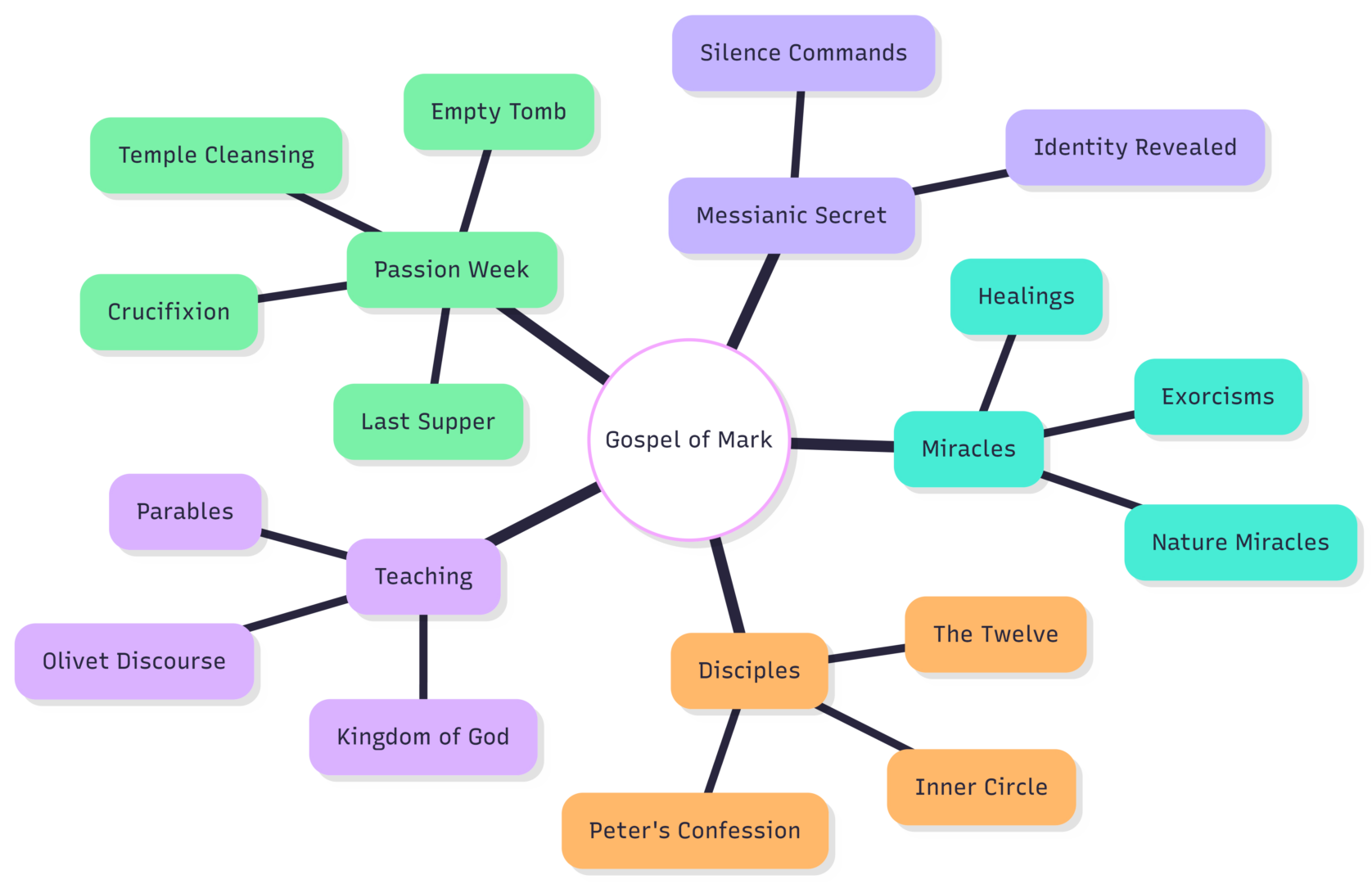
Key Themes to Study Further
About the Gospel of Mark
Mark is universally considered the most action-driven Gospel. The word “immediately” appears over 40 times, keeping the narrative moving at a rapid pace. Mark offers fewer extended discourses than Matthew or Luke but provides more vivid eyewitness-style detail — many scholars believe the Gospel reflects the preaching of Peter, who was closely associated with Mark.
The Gospel covers Jesus’ ministry from His baptism through the empty tomb, with particular emphasis on what Jesus did rather than what He said. For serious Bible study, Mark is an excellent starting point precisely because of its compression and pace — every detail included is there for a reason.
Please share this Mark Bible Trivia Quiz With Questions & Answers with your friends and do a comment below about your feedback.
We will meet you on next article.
Until you can read, All Jesus’ Parables: In Order With Bible Passages By Christ