Ruth Bible Trivia Quiz with Questions & Answers
The Book of Ruth is a short but powerful narrative tucked into the Old Testament, telling the story of a Moabite widow whose loyalty to her mother-in-law changes the course of her life — and, ultimately, the lineage of Israel’s most famous king. Despite its brevity, the book is packed with details about family, custom, faith, and redemption that make for excellent trivia material.
Whether you’re studying the book for a small group lesson, preparing a Sunday school activity, or simply want to see how well you know the story, this quiz works through the people, places, customs, and key turning points of Ruth’s story. Questions are grouped by theme, with a short explanation included after each answer so you can learn something new even if you already know the right response.
Quick Facts About the Book of Ruth
| Category | Details |
|---|---|
| Position in the Bible | Eighth book of the Old Testament, following Judges |
| Number of chapters | 4 |
| Primary setting | Moab and Bethlehem, during the period of the Judges |
| Main characters | Naomi, Ruth, Boaz, Orpah, Elimelech, Mahlon, Chilion, Obed |
| Central themes | Loyalty, redemption, providence, family duty |
| Traditional author | Often attributed to Samuel |
| Genealogical significance | Connects directly to the lineage of King David |
The Story Structure at a Glance
Many readers describe the Book of Ruth as a four-act drama, with each of its four chapters serving as a distinct scene. The diagram below shows how the story moves from loss in Moab to restoration at the city gate of Bethlehem.

Round 1: Characters and Family Relationships
Question 1: Who was Naomi’s husband? Elimelech. He is introduced as a man of Bethlehem who took his family to Moab to escape a famine, and his name is traditionally understood to mean “my God is king.”
Question 2: What were the names of Naomi’s two sons? Mahlon and Chilion. Both married Moabite women, and both died in Moab before the story’s main events unfold, leaving Naomi and her daughters-in-law as widows.
Question 3: What was the name of Ruth’s sister-in-law, who chose to remain in Moab? Orpah. She was married to Chilion and, unlike Ruth, decided to return to her own people and gods rather than travel on to Bethlehem with Naomi.
Question 4: What was Boaz’s relationship to Naomi’s late husband, Elimelech? Boaz was a close relative of Elimelech, which made him eligible to act as a kinsman-redeemer for the family. This relationship becomes central to the resolution of the story.
Question 5: What title did Boaz commonly use when speaking to Ruth? “Daughter.” Several translations preserve this term of address, which many scholars take as a sign that Boaz was considerably older than Ruth.
Round 2: Setting and Historical Context
Question 6: During which period of Israel’s history is the Book of Ruth set? The time of the Judges. The opening verse places the story during this turbulent era, offering a quieter, more personal story in contrast to the chaos described in the preceding book.
Question 7: What event forced Elimelech’s family to leave Bethlehem for Moab? A famine in the land of Israel. This single sentence at the start of the book sets the entire story in motion, sending the family across the border in search of food.
Question 8: What does the name “Bethlehem” mean? “House of Bread.” The name carries extra significance given that the book begins with a famine and ends with a harvest, and Bethlehem later becomes known as the birthplace of Jesus.
Question 9: What agricultural season was underway when Ruth and Naomi arrived back in Bethlehem? The beginning of the barley harvest. Barley was traditionally the first grain harvested each year, which is why Ruth was able to begin gleaning almost immediately after arriving.
Question 10: What was Ruth’s nationality? Moabite. Moab was a region east of the Dead Sea, and its people were considered descendants of Lot. Ruth’s status as a foreigner makes her loyalty and acceptance into the community even more remarkable.
Round 3: Loyalty, Gleaning, and Redemption
Question 11: What new name did Naomi ask the people of Bethlehem to call her, and what does it mean? Mara, meaning “bitter.” After losing her husband and both sons, Naomi felt that her circumstances no longer matched her birth name, which means “pleasant.”
Question 12: What famous declaration of loyalty did Ruth make to Naomi? Ruth told Naomi that wherever she went, she would go too, and that Naomi’s people and God would become her own. This pledge is one of the most quoted passages in the entire book and is still referenced in weddings and ceremonies today.
Question 13: In whose field did Ruth glean grain to support herself and Naomi? Boaz’s field. Gleaning allowed the poor to collect leftover grain after the main harvesters had passed through, and Ruth happened to choose a field belonging to a relative of her late father-in-law.
Question 14: What did Naomi instruct Ruth to do at the threshing floor? Naomi told Ruth to wait until Boaz had finished eating and lain down, then to uncover his feet and lie down there herself. This act, unusual to modern readers, was a culturally understood way of signaling a request for protection and redemption.
Question 15: How did Orpah’s decision differ from Ruth’s? Orpah chose to return to her own people and their gods, while Ruth chose to remain with Naomi and adopt her people, customs, and faith. The contrast between the two women highlights Ruth’s exceptional commitment.
Round 4: Customs, Traditions, and Symbols
Question 16: What object was exchanged to finalize the kinsman-redeemer transaction over Naomi’s land? A sandal. Removing a sandal and handing it to another party was a recognized legal custom that confirmed the transfer of rights and obligations between the two men.
Question 17: Where did the legal transaction to redeem the land and resolve Ruth’s situation take place? At the town gate, in front of the city elders. Town gates served as a kind of public courtroom in ancient Israel, where business and legal matters were settled in front of witnesses.
Question 18: What was the general role of a kinsman-redeemer in this culture? A kinsman-redeemer was a close relative responsible for protecting a family’s property and lineage, which could include buying back family land or marrying a widow to continue the family name.
Question 19: What was Boaz’s first recorded question about Ruth when he noticed her gleaning? He asked his field workers whose young woman she was. The question reflects how identity and protection in this society were closely tied to a woman’s relationship to a male relative.
Question 20: How is the Book of Ruth structured in terms of chapters and scenes? It contains four chapters, often compared to four acts of a play: the departure from and return to Bethlehem, the meeting in the field, the encounter at the threshing floor, and the resolution at the city gate.
Round 5: Legacy and Lineage
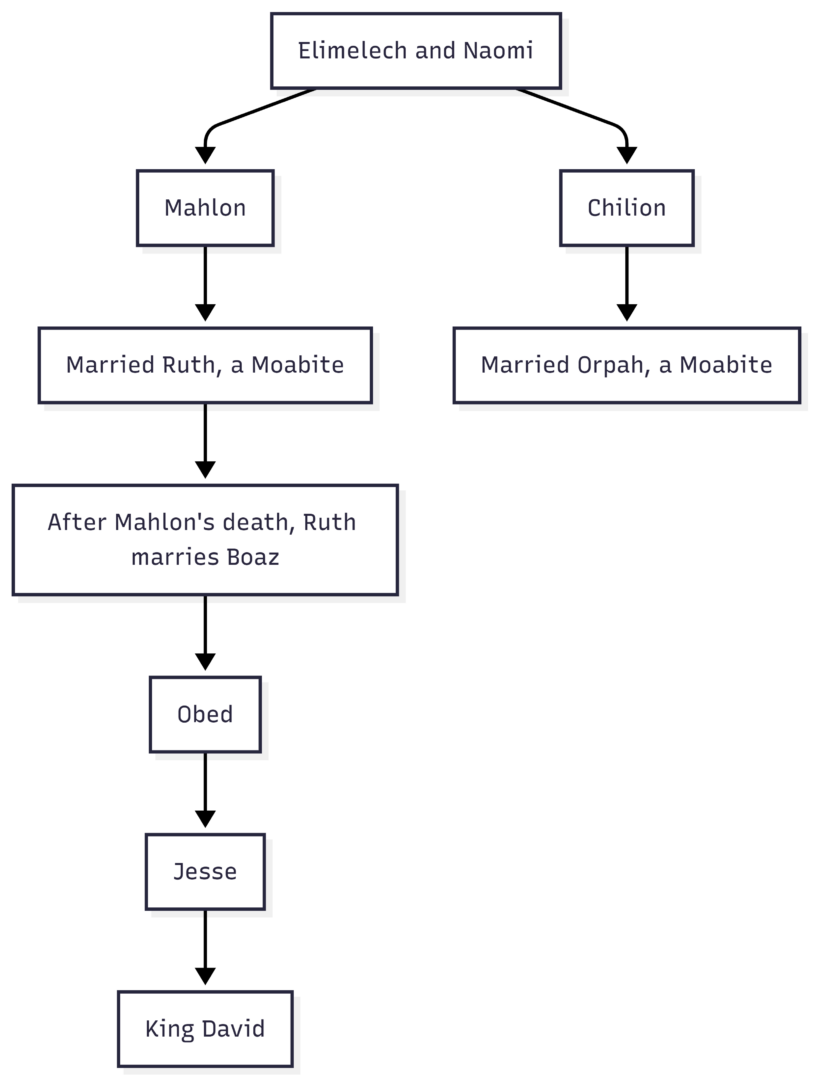
Question 21: What was the name of the son born to Ruth and Boaz? Obed. His birth marks the turning point where Naomi’s family line, which seemed to have ended, is restored and extended.
Question 22: Whose grandfather did Obed eventually become? King David’s. Obed was the father of Jesse, and Jesse was the father of David, placing Ruth directly in the ancestral line of Israel’s most celebrated king.
Question 23: Who is traditionally credited with writing the Book of Ruth? Samuel is the figure most often associated with authorship, though some scholars suggest it may have been compiled later by an unnamed writer using older source material.
Question 24: Which two women did the elders compare Ruth to, as figures who helped build up the family of Israel? Rachel and Leah. The elders expressed hope that Ruth would be like these two matriarchs, both significant ancestral mothers within Israel’s history.
Question 25: How does the Book of Ruth conclude? With a genealogy. Rather than ending on the wedding itself, the book closes by tracing the family line from Obed through to David, tying Ruth’s personal story to the broader story of Israel.
Scoring Guide
This quiz contains 25 questions, with each correct answer worth 4 points for a maximum score of 100.
| Score Range | Result |
|---|---|
| 90–100 | Bible Scholar — you know this book inside and out |
| 70–89 | Well Versed — strong grasp of the story and its details |
| 50–69 | Familiar Reader — good general knowledge, with room to dig deeper |
| Below 50 | Time for a Re-Read — Ruth is short, and well worth another look |
Family Line: From Elimelech to King David
The final chapter of Ruth connects a small, personal story of loss and loyalty to the much larger story of Israel’s monarchy. The diagram below traces that family line.
Frequently Asked Questions
At its core, the book is about loyalty, kindness, and the way ordinary acts of faithfulness can have far-reaching consequences. Ruth’s commitment to Naomi and Boaz’s willingness to act as a redeemer both demonstrate how individual choices ripple outward into the larger story of a family and a nation.
Ruth was a foreigner, a widow, and someone with little social standing, yet she becomes a central figure whose decisions place her directly in the ancestral line of King David. Her story stands out for centering on the choices of a woman from outside Israel’s borders.
Gleaning was the practice of gathering leftover grain after harvesters had passed through a field, a provision that allowed poor and vulnerable members of society to gather food. It gives Ruth a respectable way to provide for herself and Naomi while also placing her in Boaz’s field, setting the rest of the story in motion.
Because another relative had a prior right to redeem Naomi’s family property, Boaz needed to formally and publicly confirm that this closer relative was stepping aside. Settling the matter at the town gate, with witnesses present, made the transaction legally binding within the community.
Beyond its place in the Old Testament narrative, the closing genealogy links Ruth’s family directly to King David, and later writings extend that same family line even further. This connection is part of why the book holds significance well beyond its own four short chapters.
Final Thoughts
The Book of Ruth packs an enormous amount of meaning into a small space — a famine, a journey, a field, a threshing floor, and a city gate are all it takes to tell a story that reshapes a family’s future. Whether you scored a perfect 100 or discovered a few details for the first time, the story rewards a closer look every time it’s read.
Please share this Ruth Bible Trivia Quiz With Questions & Answers with your friends and do a comment below about your feedback.
We will meet you on next article.
Until you can read, Various Bible Translations and Versions