Parable of the Sheep and Goats: Verse, Meaning & Lesson
The Parable of the Sheep and Goats is Jesus’ final teaching before His arrest, and it’s one of the most direct pictures of judgment found anywhere in the Gospels. Recorded in Matthew 25:31-46, it describes the Son of Man returning in glory, gathering every nation before Him, and sorting people into two groups the way a shepherd separates sheep from goats. One group inherits a kingdom; the other is sent away into eternal punishment. The dividing line, on the surface, looks disarmingly simple: what did you do — or fail to do — for “the least of these”?
This article walks through the verse itself, unpacks its meaning line by line, and addresses the question every careful reader eventually asks: does this parable teach that we’re saved by good works?
Where This Parable Fits
This story is the closing scene of the Olivet Discourse, the extended teaching Jesus gives His disciples in Matthew 24-25 about the end of the age. Before this parable, Jesus tells two others in quick succession — the Ten Virgins and the Talents — both warning listeners to stay spiritually alert and to use what they’ve been given faithfully.
The Sheep and Goats parable caps that sequence with a scene of final accounting. Where the previous two stories focus on readiness and stewardship, this one focuses on the visible evidence of a transformed life: how people treated those in need.
The Verse (Matthew 25:31-46)
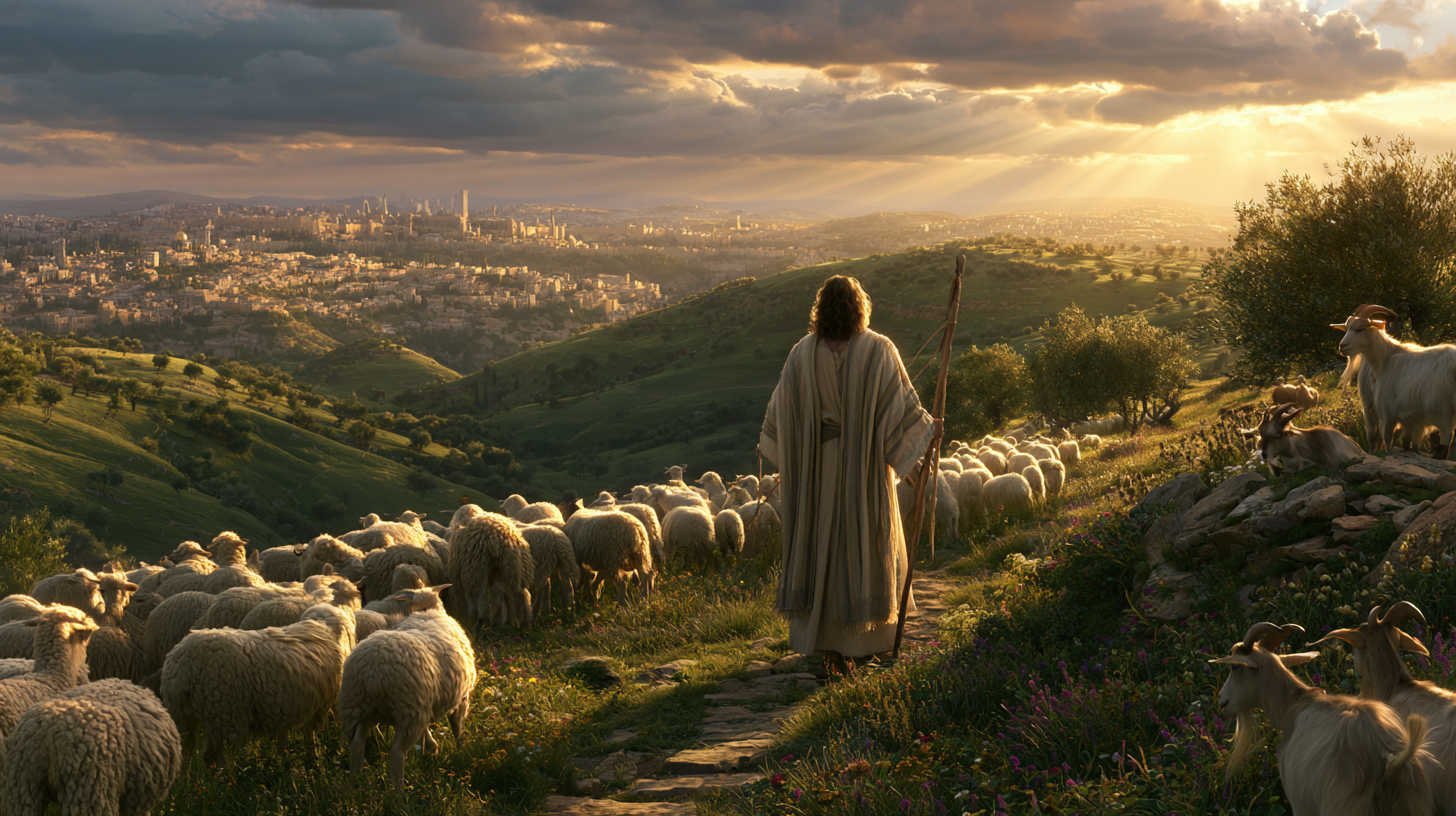
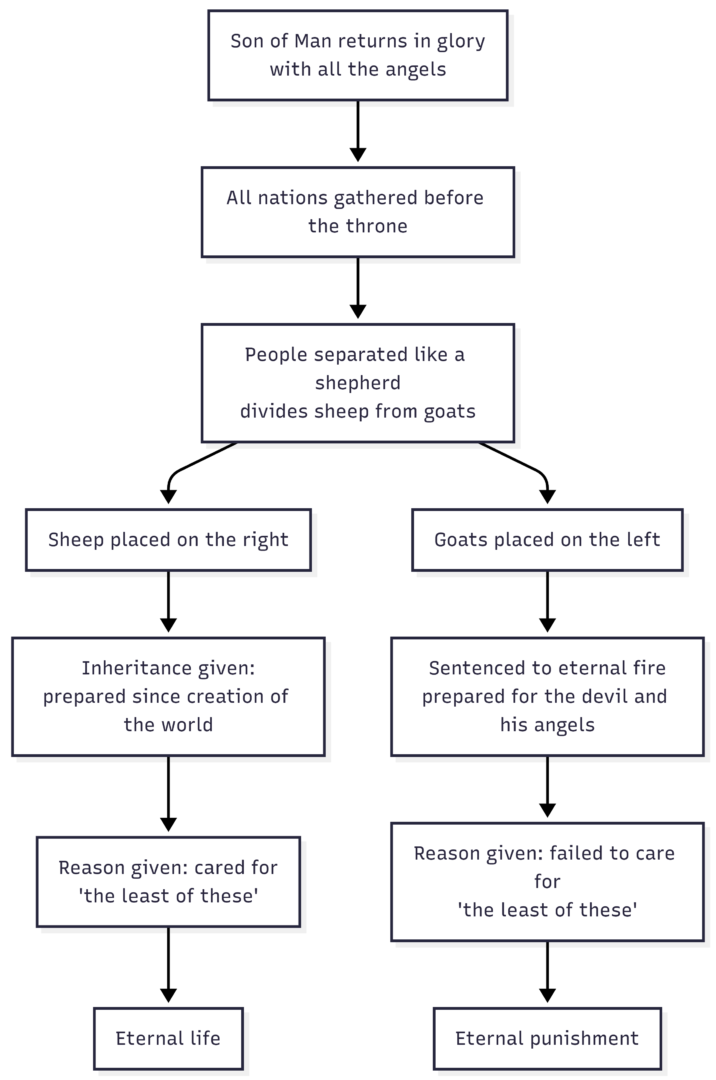
Jesus opens by describing His own return: “When the Son of Man comes in his glory, and all the angels with him, he will sit on his glorious throne. All the nations will be gathered before him, and he will separate the people one from another as a shepherd separates the sheep from the goats” (v. 31-32). The sheep are placed on His right, the goats on His left.
To those on His right, the King says: “Come, you who are blessed by my Father; take your inheritance, the kingdom prepared for you since the creation of the world. For I was hungry and you gave me something to eat, I was thirsty and you gave me something to drink, I was a stranger and you invited me in, I needed clothes and you clothed me, I was sick and you looked after me, I was in prison and you came to visit me” (v. 34-36).
The righteous respond with genuine confusion — they don’t recall ever seeing Christ hungry, thirsty, or imprisoned. The King’s answer becomes the theological center of the entire passage: “Truly I tell you, whatever you did for one of the least of these brothers and sisters of mine, you did for me” (v. 40).
The King then turns to those on His left with the mirror-image verdict: “Depart from me, you who are cursed, into the eternal fire prepared for the devil and his angels. For I was hungry and you gave me nothing to eat…” (v. 41-43). This group is equally confused, having never knowingly refused Christ anything. The reply is the same principle stated negatively: “Truly I tell you, whatever you did not do for one of the least of these, you did not do for me” (v. 45).
The passage closes with the starkest line in the whole parable: “Then they will go away to eternal punishment, but the righteous to eternal life” (v. 46).
Why Sheep and Goats?
The comparison wasn’t random. In first-century Israel, shepherds routinely grazed sheep and goats together during the day but separated them at night, since goats needed more shelter and warmth than the hardier sheep. Anyone listening to Jesus would have immediately understood the imagery — this was a familiar, everyday sorting process, not an exotic metaphor.
The two animals also carried behavioral connotations. Sheep are generally docile, herd-oriented, and dependent on a shepherd’s direction. Goats are more independent, self-directed, and harder to lead. In the parable, that contrast maps onto spiritual posture: the sheep live in dependent relationship with their Shepherd, while the goats operate on their own terms, answering to no one but themselves.
Table: Sheep vs. Goats in the Parable
| Category | The Sheep (Righteous) | The Goats (Unrighteous) |
|---|---|---|
| Position | Right hand of the King | Left hand of the King |
| Behavior toward the needy | Fed, clothed, welcomed, visited | Ignored, withheld help |
| Awareness of their own actions | Surprised — acted without calculating reward | Surprised — didn’t register the neglect as significant |
| Verdict | “Inherit the kingdom prepared since creation” | “Depart into eternal fire prepared for the devil” |
| Outcome | Eternal life | Eternal punishment |
| Underlying cause | Fruit of a transformed nature | Absence of that transformation |
The Question Everyone Asks: Is This Salvation by Works?
Read on its surface, the parable seems to say that eternal destiny is decided by a checklist of charitable acts — feed the hungry, get the kingdom; ignore the prisoner, get the fire. That reading runs directly into the rest of the New Testament’s clear teaching that salvation comes by grace through faith, not by works, “so that no one can boast” (Ephesians 2:8-9; see also Romans 3:22-24 and Galatians 3:6-9).
The parable itself actually resolves this tension, if you look closely at the timing. The King tells the sheep to take the inheritance “prepared for you since the creation of the world” (v. 34). Their inheritance predates their good works entirely — it was already reserved before they existed, let alone before they fed anyone or visited a prison. That detail rules out the good works as the cause of their reward. The works are evidence presented at the judgment, not currency used to purchase entry.
This lines up with how the New Testament consistently frames the relationship between faith and action: genuine faith produces a changed life, and that changed life produces fruit. Galatians 5:22-23 describes this fruit as love, joy, peace, patience, kindness, goodness, faithfulness, and self-control. The sheep’s compassion isn’t a transaction — it’s simply what a transformed life looks like in practice. James makes a related point when he argues that faith without any accompanying action is not genuine faith at all (James 2:14-17) — not because works save, but because real faith always shows up somewhere.
Flow of the Judgment Scene
“The Least of These” — Who Did Jesus Mean?
Jesus identifies Himself directly with the hungry, thirsty, the stranger, the poorly clothed, the sick, and the imprisoned. Whatever is done — or withheld — from people in these conditions, Jesus counts as done to Him personally. That’s a remarkable claim: it means acts of mercy toward the vulnerable aren’t merely good ethics, they’re treated as direct interactions with Christ Himself.
Some interpreters read “the least of these” narrowly, as referring specifically to Jesus’ followers experiencing persecution — a reading with some support from how “brothers” is used elsewhere in Matthew. Others read it more broadly, as any person in need. Either way, the practical takeaway is the same: the way believers treat vulnerable people is treated by God as a direct reflection of their relationship with Him, not a separate category of behavior.
Four Takeaways From the Story
1. Genuine goodness often doesn’t keep score. Both the sheep and the goats are surprised by the King’s verdict. The sheep weren’t performing acts of charity to earn points — they were living out their nature, largely without tracking it. That unselfconsciousness is itself part of what makes their love credible.
2. Small acts carry real weight. The list of commended actions — a cup of water, a visit, a piece of clothing — is deliberately modest. None of it requires wealth or position. The parable insists that no act of mercy is too small to matter.
3. Neglect is judged as seriously as active wrongdoing. The goats aren’t condemned for cruelty; they’re condemned for omission. This is arguably the parable’s sharpest edge — it treats failing to help as morally equivalent to active harm.
4. Compassion takes intention, not accident. Visiting someone in prison or seeking out a stranger rarely happens by chance. The behaviors the King commends all require someone to go looking for an opportunity to help, rather than waiting for one to appear.
How This Parable Should Shape a Life
The parable doesn’t ask believers to perform charity as a means of earning safety. It asks a more searching question: does your life show the natural fruit of a heart that has actually been changed? Jesus makes a nearly identical point elsewhere: “Make a tree good and its fruit will be good… for a tree is recognized by its fruit” (Matthew 12:33). The sheep and goats aren’t distinguished by a scorecard of deeds — they’re distinguished by what kind of tree they are, and the deeds simply reveal it.
That distinction matters because it protects against two opposite errors. The first error is assuming good behavior alone guarantees a right standing with God — the parable is explicit that the sheep’s inheritance was secured before their actions, not because of them. The second error is assuming that faith without any resulting compassion is safe — the parable is equally explicit that a life devoid of mercy toward “the least of these” ends in judgment. Real faith and real love aren’t separable; one produces the other.
Frequently Asked Questions
No. The inheritance given to the sheep is described as prepared “since the creation of the world,” before any works occurred — meaning the works are evidence of salvation, not its cause.
Jesus identifies with the hungry, thirsty, stranger, poorly clothed, sick, and imprisoned. Interpreters differ on whether this refers specifically to persecuted believers or to vulnerable people generally, but the practical application — treat the vulnerable as you would treat Christ — holds either way.
Shepherds in the ancient Near East grazed the two animals together but separated them nightly, since goats required more shelter. The image would have been immediately familiar to Jesus’ original audience, and the animals’ differing temperaments — docile versus self-directed — mirrored the spiritual contrast Jesus was drawing.
The passage describes a future judgment tied to Christ’s return in glory. However, its ethical demand — care for the vulnerable — applies immediately, not only at some future point.
Final Thought
The Parable of the Sheep and Goats doesn’t leave much room for a purely private, inward-only faith. It insists that whatever is happening in the human heart eventually shows up in how a person treats the most powerless people around them. The sheep aren’t rewarded for noticing the King — they’re commended for noticing everyone else, without realizing they were noticing Him the whole time. That’s the parable’s real challenge: not to perform compassion for reward, but to become the kind of person for whom compassion is simply what naturally comes out.
Please share this Parable of the Sheep and Goats: Verse, Meaning & Lesson with your friends and do a comment below about your feedback.
We will meet you on next article.
Until you can read, Parable of the Rich Man and Lazarus: Verse, Meaning & Lesson