Parable of the Yeast: Verse, Meaning & Lesson
The Parable of the Yeast, also called the Parable of the Leaven, is one of the shortest parables Jesus told, appearing in both Matthew 13:33 and Luke 13:20-21. In just two sentences, it compares the kingdom of heaven to yeast mixed into a large batch of flour until the whole mixture rises. Despite its brevity, this parable carries layered meaning rooted in how yeast was understood in the ancient world.
This guide walks through the full text of the parable in both Gospels, its historical background, the two major interpretations scholars have proposed, and the practical lessons it offers today. A summary table and FAQ section are included for quick reference.
The Verse: Matthew 13:33 and Luke 13:20-21
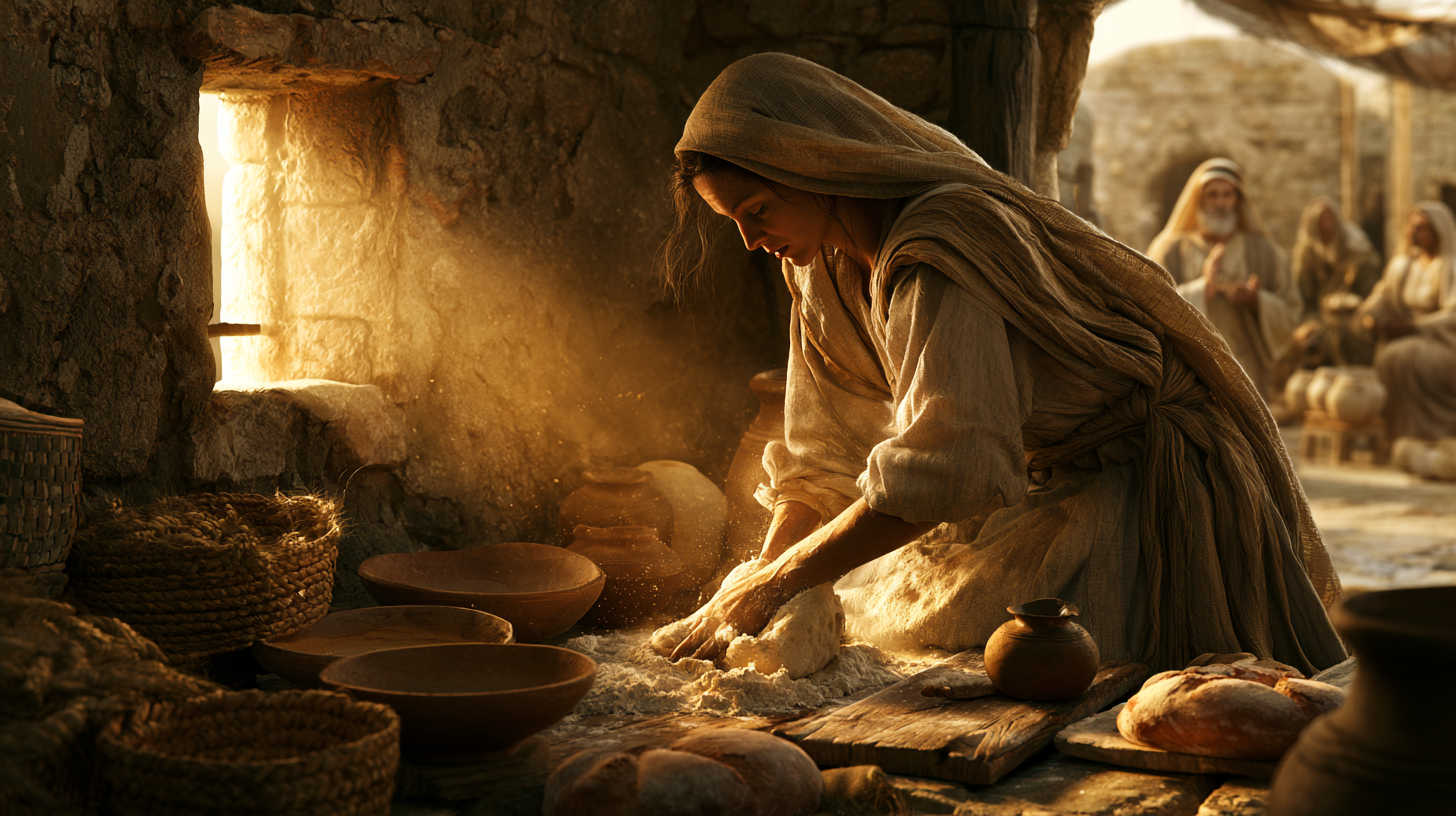
Matthew records the parable this way: “He told them still another parable: ‘The kingdom of heaven is like yeast that a woman took and mixed into about sixty pounds of flour until it worked all through the dough.'”
Luke’s version is nearly identical: “Again he asked, ‘What shall I compare the kingdom of God to? It is like yeast that a woman took and mixed into a large amount of flour until it worked all through the dough.'”
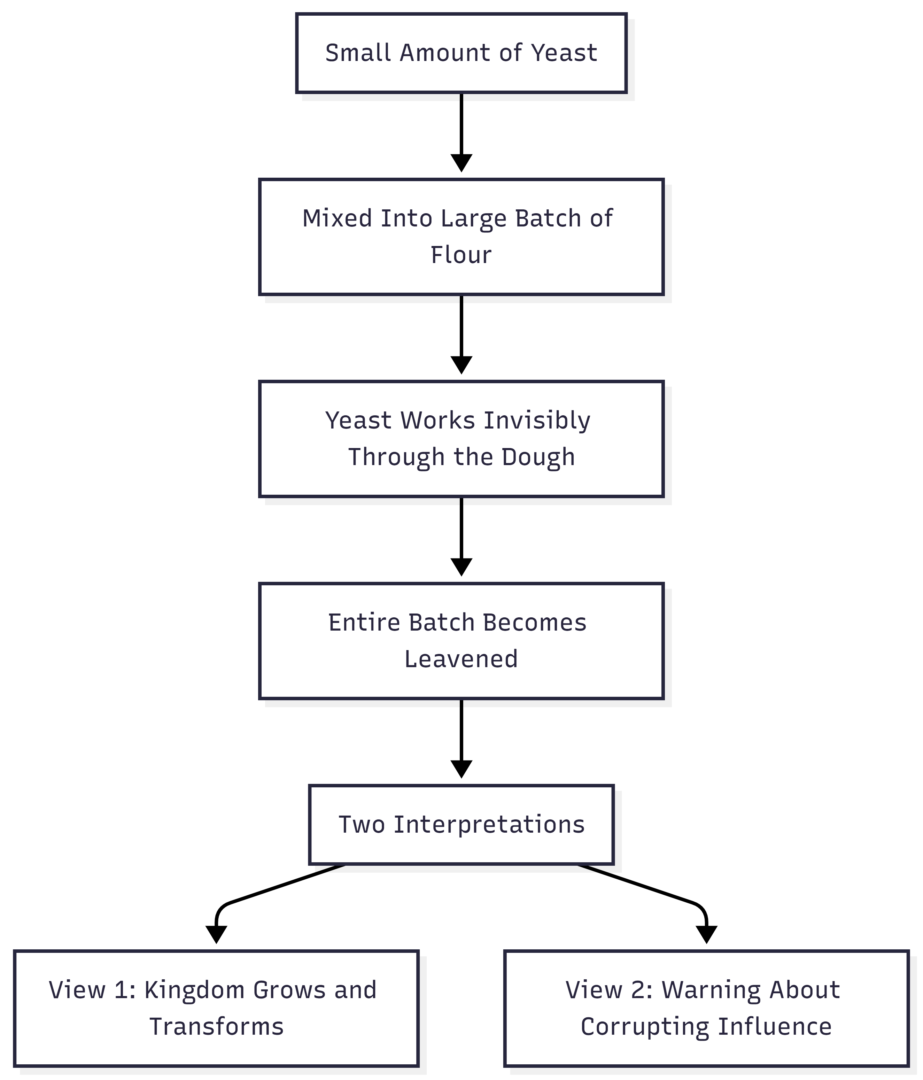
Both accounts describe the same basic action: a small amount of yeast is worked into a very large quantity of flour — traditionally rendered as “three measures,” roughly fifty to sixty pounds — until the entire batch is leavened. Neither Gospel records Jesus offering a direct explanation of the parable’s meaning, unlike some of his other teachings in the same chapter, which leaves its interpretation open to careful reading of the details.
Historical Background: What Yeast Meant in the Ancient World
Understanding this parable requires knowing how yeast, or leaven, was regarded in Jewish tradition. Throughout the Old Testament, leaven consistently symbolizes corruption or impurity rather than growth or blessing. During Passover, Israelites were required to eat unleavened bread and remove all leaven from their homes for seven days, a practice tied directly to purification (Exodus 12:15-20).
This association continues into the New Testament. Jesus himself warns his disciples to “beware the leaven of the Pharisees and Sadducees” (Matthew 16:6), using leaven as a metaphor for hypocrisy and corrupt teaching. Paul uses the same imagery in 1 Corinthians 5:6-8, instructing the Corinthian church to “clean out the old leaven” of sin so they can be a “new batch of dough,” explicitly linking leaven to moral corruption that spreads throughout a community if left unaddressed.
This background makes Jesus’s comparison genuinely surprising to his original audience. Comparing the kingdom of heaven to something consistently used elsewhere in Scripture as a symbol of corruption would have caught listeners off guard, prompting exactly the kind of reflection parables were designed to produce.
Two Interpretations of the Parable
Because Jesus does not explain this parable directly, commentators have proposed two distinct readings, both grounded in the details of the text.
The Growth Interpretation
The more common and widely taught interpretation reads the parable as a positive picture of the kingdom’s expansion. In this view, Jesus intentionally subverts the negative association with leaven, using it instead to illustrate how the kingdom of heaven starts small and hidden, then grows steadily and invisibly until it permeates everything around it. Just as yeast works through dough without visible fanfare, the kingdom expands quietly through changed hearts rather than dramatic, visible displays of power.
This reading pairs naturally with the parable immediately preceding it in Matthew 13 — the Parable of the Mustard Seed — which makes a similar point about small, unimpressive beginnings producing large, significant results. Read together, both parables emphasize that the kingdom’s growth may not look impressive at first, but its ultimate scope and effect are far greater than its modest origin suggests.
The Corruption Interpretation
A minority interpretation takes the consistent biblical use of leaven as a symbol of corruption more literally, arguing that Jesus is not subverting that meaning but reinforcing it. In this reading, the parable describes how corrupting influences — such as hypocrisy, false teaching, or worldly compromise — can spread through a community much like leaven spreads through dough, eventually affecting the whole.
This interpretation notes that the parable appears in Matthew 13 immediately following the Parable of the Weeds, which describes evil coexisting with good until final judgment, and argues that a sudden shift to an entirely positive symbol would be inconsistent with the surrounding material.
Proponents of this view point to the detail of “three measures of meal,” connecting it to Old Testament offerings such as those prepared by Abraham (Genesis 18:6) and Gideon (Judges 6:19), and suggesting the parable warns against corrupting influences entering what should be a pure offering of devotion to God.
Comparing the Two Views
| Element | Growth Interpretation | Corruption Interpretation |
|---|---|---|
| Meaning of yeast | Kingdom growth, subverting its normal negative meaning | Consistent with its usual meaning: corruption or impurity |
| Tone of the parable | Encouraging — the kingdom’s reach exceeds its small start | Cautionary — warns against hidden corrupting influence |
| Consistency with Old Testament use of leaven | Deliberately reversed by Jesus for effect | Maintained and applied to spiritual life |
| Pairing with surrounding parables | Complements the Mustard Seed’s theme of small beginnings | Complements the Weeds’ theme of evil mixed with good |
| Primary application | Trust the quiet, gradual growth of God’s work | Guard against hypocrisy and compromise spreading unnoticed |
Most modern teaching and reference material favors the growth interpretation, largely because of its natural pairing with the Mustard Seed parable and its overall positive tone consistent with the surrounding “kingdom parables” in Matthew 13. However, the corruption interpretation remains a serious scholarly position worth understanding, particularly for readers studying how leaven functions symbolically throughout Scripture as a whole.
Key Lessons from the Parable
| Lesson | Description | Supporting Verse |
|---|---|---|
| Small beginnings can produce large results | A small amount of yeast transforms an entire large batch of dough | Matthew 13:33 |
| Growth is often hidden and gradual | Yeast works invisibly through dough, much like the kingdom works quietly in hearts | Matthew 13:33 |
| Influence spreads exponentially | Once introduced, yeast’s effect on the whole batch becomes inevitable | Luke 13:21 |
| Vigilance against corrupting influence matters | Elsewhere, leaven consistently warns against hypocrisy and sin spreading unchecked | Matthew 16:6, 1 Corinthians 5:6-8 |
| The kingdom’s ultimate reach exceeds expectations | What begins small and unremarkable is not limited in its eventual scope | Habakkuk 2:14 |
Practical Application Today
Regardless of which interpretation a reader favors, this parable offers meaningful application for daily faith and community life.
- Trust gradual, unseen growth. Spiritual growth, whether personal or communal, does not always happen dramatically or all at once. This parable encourages patience with slow, internal transformation rather than expecting immediate, visible results.
- Recognize the exponential nature of influence. Just as a small amount of yeast affects an entire batch, individual choices and character can influence a much wider circle than initially apparent — for better or worse, depending on which interpretation is emphasized.
- Guard against small compromises. If read alongside the “leaven of the Pharisees” warning, the parable is a reminder that small, unaddressed compromises in integrity or teaching can spread through a life or a community if left unchecked.
- Value quiet faithfulness over visible spectacle. The parable’s emphasis on hidden, gradual action pushes back against the assumption that meaningful spiritual impact must be loud or immediately noticeable.
- Read this parable alongside its companion, the Mustard Seed. Both parables appear back-to-back in Matthew 13 and reinforce a similar theme about the disproportion between small beginnings and eventual outcomes.
Frequently Asked Questions
The most common interpretation holds that the parable illustrates how the kingdom of heaven begins small and hidden but grows steadily until it influences everything around it, much like yeast spreading through an entire batch of dough.
Throughout the Old Testament, leaven was excluded from Passover observance and consistently associated with impurity. Jesus later uses it as a metaphor for hypocrisy (“the leaven of the Pharisees”), and Paul uses it as a metaphor for sin spreading through a community, reinforcing this consistent negative association.
No. Unlike the Parable of the Sower and the Parable of the Weeds earlier in Matthew 13, Jesus does not provide a direct explanation of this parable, which has led to two differing scholarly interpretations.
Both parables appear back-to-back in Matthew 13 and Luke 13, and both use small, unremarkable beginnings — a tiny seed and a small amount of yeast — to illustrate how the kingdom’s ultimate impact exceeds its modest start.
Three measures of meal represents an unusually large quantity, roughly fifty to sixty pounds, enough to produce bread for a significant gathering. Some scholars connect this detail to similar offerings in Genesis 18 and Judges 6, adding another layer to the parable’s meaning.
Most commonly, the parable is taught as illustrating the kingdom’s quiet, transformative growth, particularly given its pairing with the Mustard Seed parable. A minority of interpreters read it as a warning about corrupting influence, consistent with leaven’s typical biblical symbolism. Both readings are grounded in careful attention to the text, and studying both offers a fuller picture of the parable’s possible meaning.
Final Thoughts
The Parable of the Yeast packs significant theological weight into a single, brief image. Whether read as an encouraging picture of the kingdom’s quiet, unstoppable growth or as a caution about corrupting influence spreading unnoticed, the parable draws its power from the same core observation: something small, once introduced, does not stay contained. It works through everything it touches until the whole is affected.
Read alongside its companion parable of the Mustard Seed and its broader biblical context, this short teaching remains one of the most compact yet layered images Jesus offers about how the kingdom of heaven actually operates.
Its brevity is part of its strength: in just two sentences, it invites ongoing reflection on how small, often unseen actions and decisions accumulate into outcomes far larger than their beginnings would suggest, whether that growth is understood as the steady advance of the kingdom or a caution about vigilance against compromise.
Please share this Parable of the Yeast: Verse, Meaning & Lesson with your friends and do a comment below about your feedback.
We will meet you on next article.
Until you can read, Parable of the Workers In the Vineyard: Verse, Meaning & Lesson