What Does the Bible Say About Faith?
Faith is one of the most repeated words in Scripture, yet it’s also one of the most misunderstood. It isn’t presented as blind optimism or wishful thinking — it’s defined, tested, and demonstrated through specific people and specific verses across both the Old and New Testaments.
This article breaks down what the Bible actually says faith is, where it comes from, how it relates to hope and works, and which verses are worth memorizing for each stage of a faith journey.
The Bible’s Definition of Faith
The most direct definition of faith in Scripture comes from the book of Hebrews:
Hebrews 11:1 (KJV) — “Now faith is the substance of things hoped for, the evidence of things not seen.”
This single verse does two things at once. First, it frames faith as “substance” — not a vague feeling, but something solid enough to be described as real, even before it’s visible. Second, it frames faith as “evidence” — meaning faith isn’t the absence of proof, but a different category of proof than physical sight. That distinction matters for how the rest of the Bible talks about faith: it’s consistently tied to trust in what God has said, not to the absence of any basis for belief.
A second key verse reinforces where faith originates:
Romans 10:17 (KJV) — “So then faith cometh by hearing, and hearing by the word of God.”
According to this verse, faith isn’t manufactured through willpower. It develops through exposure to God’s word — reading it, hearing it taught, and returning to it repeatedly. This is part of why regular Scripture engagement is treated as foundational to spiritual growth throughout the Bible, rather than optional or supplementary.
Faith vs. Sight
One of the most quoted verses on faith addresses how believers are meant to navigate uncertainty:
2 Corinthians 5:7 (KJV) — “For we walk by faith, not by sight.”
This verse doesn’t suggest ignoring evidence or reason — it addresses situations where visible circumstances and God’s promises seem to conflict. “Walking by faith” means continuing to trust a stated promise even when current, visible circumstances haven’t caught up to it yet. It’s a posture, not a single decision made once.
How Much Faith Is Enough? The Mustard Seed Principle
A recurring theme in the Gospels is that the size of a person’s faith matters less than most people assume:
Matthew 17:20 (KJV) — “If ye have faith as a grain of mustard seed, ye shall say unto this mountain, Remove hence to yonder place; and it shall remove; and nothing shall be impossible unto you.”
A mustard seed is among the smallest seeds a first-century audience would have recognized, yet it grows into a large plant. The comparison isn’t about faith needing to feel large or confident — it’s about faith needing to be genuine, however small it starts. This theme repeats in Mark’s Gospel, where a father asking Jesus to heal his son admits his doubt directly:
Mark 9:24 (KJV) — “Lord, I believe; help thou mine unbelief.”
That verse is often cited as one of the most honest moments in the Gospels — faith and doubt expressed in the same sentence, without one canceling out the other.
Faith and Salvation
Faith occupies a central role in how the New Testament describes salvation — not as something earned, but something received:
Ephesians 2:8–9 (KJV) — “For by grace are ye saved through faith; and that not of yourselves: it is the gift of God: Not of works, lest any man should boast.”
This passage draws a clear line: salvation is described as a gift accessed through faith, not a reward earned through performance. That distinction becomes important in the next section, because it raises an obvious follow-up question — if salvation isn’t earned by works, do works matter at all?
Faith and Works: A Necessary Tension
The book of James addresses this question directly, and its language is some of the most debated in the New Testament:
James 2:17 (KJV) — “Even so faith, if it hath not works, is dead, being alone.”
James isn’t contradicting the idea that salvation comes through faith rather than works — he’s addressing what genuine faith produces. His argument is that real faith naturally results in action; faith that never changes behavior isn’t necessarily proof of a deeper, truer faith.
The two ideas — salvation by faith alone, and faith that produces visible action — are typically read together rather than as competing claims: grace initiates the relationship, and a transformed life is the evidence that follows.
Faith Timeline: Key Figures in Hebrews 11
Hebrews 11, often called the “faith chapter” or the “hall of faith,” walks through a chronological list of Old Testament figures defined by their trust in God despite uncertain outcomes. The chart below outlines the sequence.
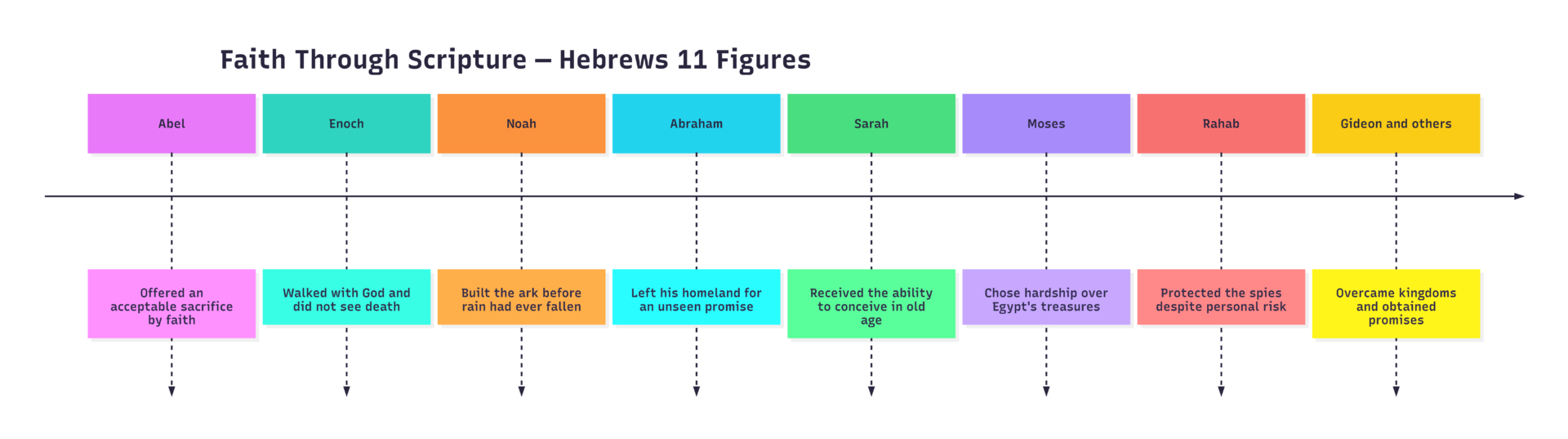
The pattern across every name on this list is the same: each person acted on a promise before seeing its fulfillment. That structure — promise, trust, action, and later confirmation — is the model the rest of Scripture consistently points back to when discussing what faith looks like in practice.
Faith and Hope: How They Work Together
Faith and hope are closely related but not identical. Faith is trust rooted in what has been revealed or promised; hope is the forward-looking confidence that those promises will be fulfilled. Paul places them side-by-side with love in one of the most quoted verses in the New Testament:
1 Corinthians 13:13 (KJV) — “And now abideth faith, hope, charity, these three; but the greatest of these is charity.”
The table below breaks down how these three concepts are typically distinguished in Scripture.
| Concept | Primary Focus | Time Orientation | Key Verse |
|---|---|---|---|
| Faith | Trust in what God has said or done | Present | Hebrews 11:1 |
| Hope | Confident expectation of what God will do | Future | Romans 15:13 |
| Love | Active care for God and others | Ongoing/eternal | 1 Corinthians 13:13 |
Verses About Faith by Category
The following verses are grouped by the situation they most directly address, useful for study, memorization, or a devotional series.
Faith for Salvation
- Romans 10:9 (KJV) — “That if thou shalt confess with thy mouth the Lord Jesus, and shalt believe in thine heart that God hath raised him from the dead, thou shalt be saved.”
- John 3:16 (KJV) — “For God so loved the world, that he gave his only begotten Son, that whosoever believeth in him should not perish, but have everlasting life.”
- Galatians 2:16 (KJV) — a person is justified through faith in Christ, not through works of the law.
Faith for Strength in Hardship
- 1 Corinthians 16:13 (KJV) — “Watch ye, stand fast in the faith, quit you like men, be strong.”
- Habakkuk 2:4 (KJV) — “The just shall live by his faith.”
- Romans 5:3–4 (KJV) — suffering produces patience, patience produces experience, and experience produces hope.
Faith for Prayer
- Mark 11:24 (KJV) — “What things soever ye desire, when ye pray, believe that ye receive them, and ye shall have them.”
- James 1:6 (KJV) — ask in faith, “nothing wavering,” since a doubting mind is described as unstable.
- Matthew 21:22 (KJV) — “All things, whatsoever ye shall ask in prayer, believing, ye shall receive.”
Faith for Guidance and Trust
- Proverbs 3:5–6 (KJV) — “Trust in the Lord with all thine heart; and lean not unto thine own understanding. In all thy ways acknowledge him, and he shall direct thy paths.”
- Isaiah 40:31 (KJV) — those who wait on the Lord will renew their strength.
- Jeremiah 29:11 (KJV) — God’s plans are for welfare, to give “an expected end.”
Common Questions About Faith in the Bible
Scripture treats faith primarily as trust directed at something specific — God’s character and promises — rather than an emotional state. Feelings of confidence may accompany faith, but the biblical examples (like the father in Mark 9:24) show that faith and emotional doubt can coexist in the same person at the same time.
Yes. Romans 10:17 ties faith’s growth directly to exposure to God’s word, and the disciples themselves are recorded asking Jesus to “increase” their faith (Luke 17:5), suggesting it’s something that develops over time rather than a fixed quantity.
In most biblical usage, the two are closely related, though James 2:19 makes a pointed distinction: even demons are described as believing certain facts about God, yet that intellectual acknowledgment isn’t equated with saving faith. Biblical faith involves trust and allegiance, not simply agreeing that something is true.
Paul (in Ephesians and Romans) addresses how a person is initially made right with God — through faith, not earned merit. James addresses what genuine faith produces afterward — a changed life. Most theological traditions read the two as complementary rather than contradictory: grace establishes the relationship, and works are the evidence, not the cause, of authentic faith.
Putting Faith into Practice
Reading verses about faith is a starting point, not an endpoint. A practical framework many believers use looks like this:
- Hear it. Regular exposure to Scripture builds the foundation (Romans 10:17).
- Trust it. Choose to act on a promise before seeing its outcome (Hebrews 11:1).
- Act on it. Let faith show up in tangible decisions and care for others (James 2:17).
- Return to it under pressure. Revisit foundational verses specifically during doubt or hardship (Mark 9:24).
Faith, as Scripture presents it, isn’t a single moment of belief that never needs revisiting. It’s closer to a discipline — built through repeated exposure to God’s word, tested through circumstance, and made visible through action.
Whether you’re new to studying these verses or returning to them after a difficult season, the throughline across every book of the Bible remains the same: faith is not the absence of doubt or uncertainty, but the decision to keep trusting anyway.
Please share this What Does the Bible Say About Faith? your friends and do a comment below about your feedback.
We will meet you on next article.
Until you can read, 10 Scriptures for When You Need Strength