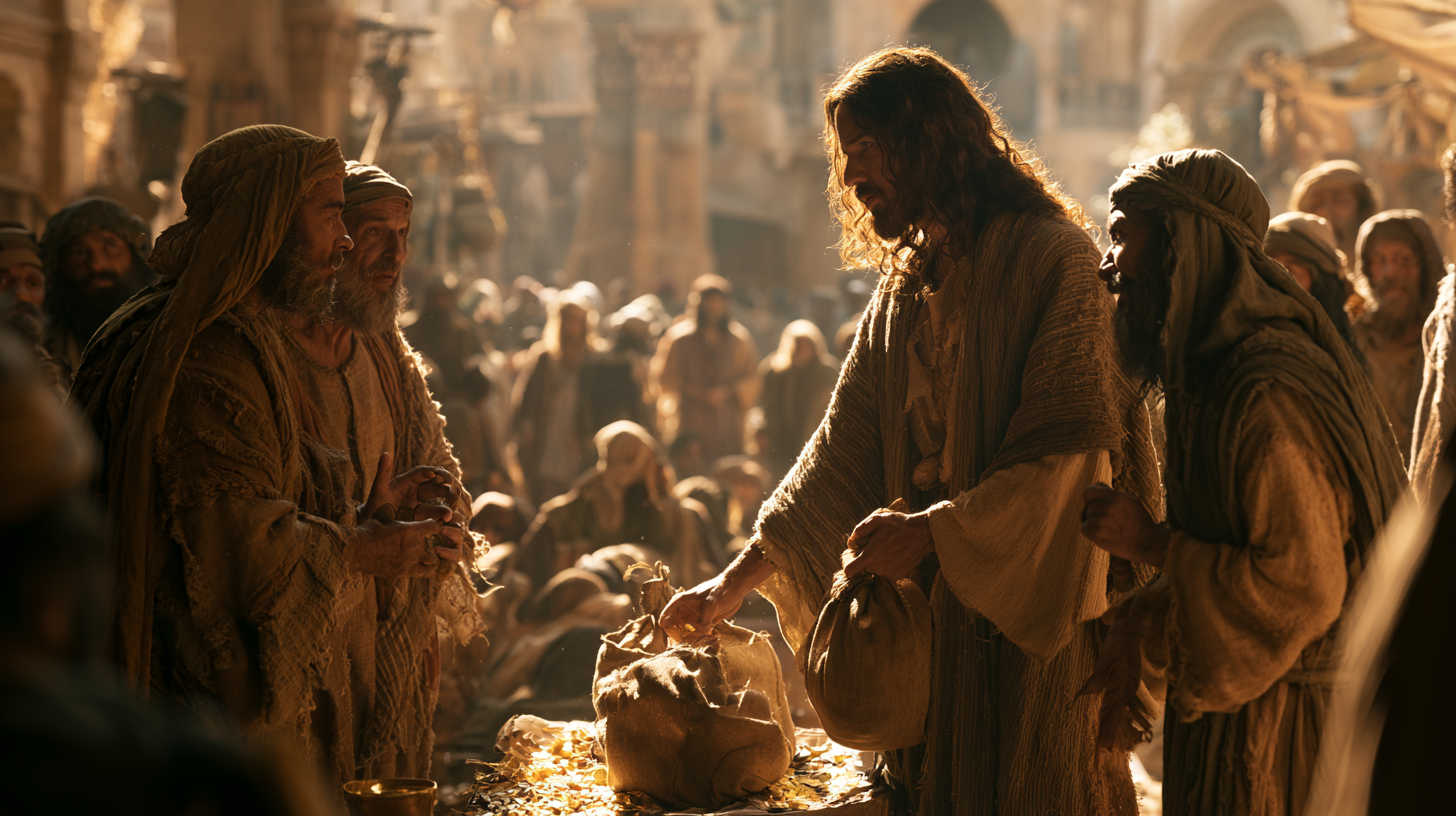
What Is the Meaning of the Parable of the Talents?
The Parable of the Talents is one of Jesus’ last teachings before His crucifixion, recorded in Matthew 25:14-30. A wealthy master prepares for a long journey and divides his money among three servants, giving each an amount matched to their ability.
Two servants put the money to work and double it. The third buries his share out of fear and returns exactly what he was given — nothing more. When the master returns, the first two are praised and promoted; the third is condemned.
It’s a short story with an outsized amount of interpretive weight resting on it. This article walks through what a “talent” actually was, what each character represents, the debate over whether this parable is about works or about faith, and how it applies to work, money, and stewardship today.
The Story in Brief
A man preparing to travel entrusts his wealth to three servants, giving five bags of gold to one, two to another, and one to the third — each portion sized to what the servant could handle. The first two servants immediately put the money to work and double it.
The third digs a hole and hides his portion in the ground. After a long absence, the master returns to settle accounts. The first two servants report having doubled their master’s money and are told, “Well done, good and faithful servant,” and given greater responsibility.
The third servant explains that fear of a demanding master led him to bury the money rather than risk it, and hands back exactly what he was given. The master calls him wicked and lazy, takes the money away, and gives it to the servant who now has ten.
What a “Talent” Was Actually Worth
This is the detail modern readers miss most often. In English, “talent” now means a natural skill — but in the first century, a talent was a unit of weight used to measure silver or gold, and it represented an enormous sum of money: roughly twenty years of a laborer’s wages in one single unit.
| Talents Given | Approx. Modern Value* | Servant’s Response | Outcome |
|---|---|---|---|
| 5 talents | Several million USD equivalent | Traded and doubled it | Praised, given more responsibility |
| 2 talents | Well over a million USD equivalent | Traded and doubled it | Praised, given more responsibility |
| 1 talent | Still an enormous sum — comparable to a life-changing amount today | Buried it out of fear | Condemned, talent taken away |
*Exact modern-dollar equivalents vary by source and depend on which metal and wage assumptions are used, but every serious estimate lands in the six-to-seven-figure range even for the smallest portion. The point Jesus is making with the amounts is not subtle: even the “least” servant was trusted with a life-changing sum, not a trivial one.
Who and What the Parable Represents
| Element | Represents |
|---|---|
| The Master | God or Jesus, the ultimate owner of all resources |
| The Journey | The period between Christ’s ascension and His return |
| The Servants | Believers, entrusted with responsibility during that period |
| The Talents | Resources given according to ability — time, skill, opportunity, money, and (in some readings) the message of the gospel itself |
| The Trading | Active, faithful use of what’s been given |
| The Burying | Fear-driven inaction and refusal to risk anything |
| The Settling of Accounts | A final accounting for how those resources were used |
Visualizing the Parable’s Structure
Two Ways to Read This Parable
Bible teachers generally land in one of two camps on what the parable is fundamentally about, and it’s worth understanding both before drawing conclusions.
Reading One: Stewardship of Gifts.
In this reading, the talents represent the broad range of resources God gives every person — money, skills, time, relationships, opportunities — and the parable is a call to actively use them for good rather than let them sit idle.
The third servant isn’t condemned for failing to hit some impossible target; he’s condemned for doing nothing at all. This reading treats the parable as a teaching about faithfulness in ordinary life and work, addressed to believers who are already secure in their standing with God but accountable for how they use what they’ve been given.
Reading Two: Response to the Gospel Itself.
A second reading, drawn from the parable’s placement immediately after warnings about the end times in Matthew 24, argues the talents represent something more specific: the revelation of God’s kingdom, the truth of the gospel message itself.
Under this reading, the two servants who multiply their talents represent people who receive the gospel with genuine faith and see it bear fruit in their lives, while the servant who buries his talent represents someone who was exposed to the truth but never actually believed it — making the parable less about effort and more about whether faith was ever genuinely present at all.
Both readings agree on the basic moral logic: doing nothing with what you’ve been given is the failure being condemned, not falling short of some competitive standard.
They diverge mainly on how directly the “talent” maps onto material resources versus spiritual truth, and on how much weight to put on the parable’s location within a larger block of end-times teaching that includes the parable of the ten virgins and the parable of the faithful servant.
Why the Third Servant Actually Failed
It’s tempting to read this story as being about a disappointing return on investment — the servant simply didn’t make enough money. That misses the point. The third servant isn’t condemned for falling short of a target; he’s condemned because he did nothing.
He didn’t even take the lowest-risk option available to him, which the master explicitly points out: depositing the money with bankers would have earned modest interest with essentially no risk. Instead, he did the one thing guaranteed to produce zero return.
His stated reason matters just as much as his inaction. He describes the master as harsh and describes his own fear as the reason for burying the money.
But that description of the master doesn’t match how the other two servants describe him — they trade eagerly and are met with warmth and reward, not harshness. The failure isn’t really financial; it’s relational. He acted based on a distorted view of who the master actually is, and that distorted view produced paralysis instead of productive risk-taking.
Key Lessons from the Parable
- Ability determines allotment, not worth. The master gives five, two, and one talent “each according to his ability” — the differing amounts aren’t a ranking of the servants’ value, just a recognition that people are equipped differently.
- Faithfulness is measured by effort, not raw output. The servant who turned two talents into four receives the exact same commendation as the one who turned five into ten. The standard being applied is proportional faithfulness, not an absolute number.
- Doing nothing is treated as a serious failure, not a neutral choice. Burying the talent wasn’t cautious; from the master’s perspective, it was worse than taking a risk and losing, because it guaranteed there would be nothing to show at all.
- Fear, not incapacity, is the root problem. The servant wasn’t unable to trade — he was afraid to. The parable treats fear-driven inaction as a moral failure worth confronting directly.
- A final accounting is coming. Whatever else the parable is teaching, all three servants are eventually called to report back. Nobody’s stewardship goes unexamined indefinitely.
Applying This to Work, Money, and Everyday Life
The parable resists being reduced to a single tidy application, but a few practical takeaways hold up across both major readings:
- Every skill, resource, and opportunity carries an expectation of use, not storage. Whether it’s a professional skill, a sum of savings, a platform, or simply time, the parable pushes against the instinct to protect resources by keeping them untouched.
- Risk aligned with purpose is treated as virtuous, not reckless. The two servants who traded weren’t rewarded for gambling — they were rewarded for putting resources to productive work in line with their master’s interests.
- Comparison to others is beside the point. The five-talent servant and the two-talent servant never compete with each other in the story; each is evaluated only against what they were given.
- Inaction dressed up as caution is still inaction. A common modern parallel: hoarding a skill or resource out of perfectionism or fear of failure produces the same practical result as the buried talent — nothing to show when it counts.
Frequently Asked Questions
A talent was a large unit of weight for precious metal, and in first-century terms it represented roughly two decades of an average worker’s wages — meaning even the smallest amount in the parable (one talent) was a life-changing sum, not a minor gift.
Literally, the parable is about money entrusted to servants for investment. Most interpreters extend the principle to any resource — skills, time, opportunities, relationships — while a smaller group of interpreters argue the “talent” specifically symbolizes the truth of the gospel itself.
Because doing nothing wasn’t a neutral or cautious choice in the story’s logic — it guaranteed zero return when even the safest available option (putting the money on deposit for modest interest) would have produced something. The severity of the judgment reflects wasted opportunity, not simply a low number.
No — most interpreters are careful to separate this parable from a works-based view of salvation. It’s read either as a teaching about faithful stewardship for people already secure in their standing with God, or as a picture of the difference between genuine and false faith rather than a formula for earning acceptance through effort.
Both parables sit inside the same block of end-times teaching in Matthew 24-25 and share a common theme: preparedness and faithfulness while waiting for a return whose timing is unknown, with a clear contrast between those who are ready and those who are not.
Final Thought
Whatever framework a reader brings to this parable, its central image doesn’t soften with time: a servant handed something enormous, who does nothing with it out of fear, and loses even what he started with.
The lesson isn’t about hitting a quota — it’s about the difference between stewarding what you’ve been given and burying it where it’s safe but useless. The invitation of the parable is to trade, risk, and use what’s been entrusted, rather than protect it into irrelevance.
Please share this What Is the Meaning of the Parable of the Talents? your friends and do a comment below about your feedback.
We will meet you on next article.
Until you can read, The Speck and the Log: What Matthew 7:1-5 Really Means