Acts Bible Trivia Quiz With Questions & Answers
The Book of Acts is the only historical narrative of the early church in the New Testament. Written as a sequel to the Gospel of Luke, it traces the spread of the Christian faith from Jerusalem to Rome — through Pentecost, persecution, missionary journeys, miraculous escapes, and the conversion of both Jews and Gentiles. This trivia quiz covers the full scope of Acts, from the first chapter through Paul’s arrival in Rome.
Scoring: 40 questions. Give yourself 2.5 points per correct answer. Perfect score: 100.
Section 1: Foundations — Author, Audience, and the Early Church
Q1. Who wrote the Book of Acts?
Answer: Luke
Although the author is never named in the text, all internal and external evidence points to Luke — the physician and companion of Paul who also wrote the third Gospel. Acts opens with a direct reference back to a “former account” (Luke 1:1), confirming both books share the same author.
Q2. To whom is the Book of Acts addressed?
Answer: Theophilus (Acts 1:1)
Both the Gospel of Luke and Acts are addressed to Theophilus, a name meaning “friend of God” or “one who loves God.” Whether Theophilus was a specific individual, a patron, or a literary device for a general believing audience is debated — but most scholars consider him a real person, possibly a Roman official or patron supporting Luke’s work.
Q3. What is the first word of Acts in the King James Version?
Answer: “The”
Acts 1:1 reads: “The former treatise have I made, O Theophilus, of all that Jesus began both to do and teach.”
Q4. What event marked the beginning of the Holy Spirit’s descent upon the disciples?
Answer: The Day of Pentecost (Acts 2)
Pentecost is the Greek name for the Jewish Feast of Weeks — a harvest festival held 50 days after Passover. When the disciples gathered in Jerusalem, the Spirit descended with the sound of a rushing wind, tongues of fire, and the ability to speak in other languages. Many consider this moment the birth of the Christian church.
Q5. Pentecost comes how many days after Passover?
Answer: 50 days
The word Pentecost derives directly from the Greek word for “fiftieth.” In the Christian calendar, Pentecost falls 50 days after Easter. The disciples had been waiting in Jerusalem for approximately 10 days following Jesus’ Ascension when the Spirit arrived.
Q6. What miraculous ability did the Holy Spirit grant the disciples at Pentecost?
Answer: The ability to speak in other languages (Acts 2:4)
Visitors from across the known world heard the disciples speaking in their own native languages. This was the reversal of the confusion at Babel — instead of language dividing people, it now united them in hearing the gospel.
Q7. Who preached the first Gospel sermon on the Day of Pentecost?
Answer: Peter (Acts 2:14–41)
Peter stood before the crowd and declared that Jesus — crucified and raised — was both Lord and Christ. About 3,000 people believed and were baptized that day.
Q8. Who was chosen to replace Judas Iscariot as the twelfth apostle?
Answer: Matthias (Acts 1:23–26)
Two candidates were put forward: Matthias and Joseph called Barsabbas. The group prayed and cast lots, and the lot fell to Matthias. He was then numbered with the eleven apostles.
Section 2: Key Figures in the Early Church
Q9. How is Stephen described when he is first mentioned in Acts 6:5?
Answer: Full of faith and of the Holy Spirit
Stephen was one of seven men chosen to oversee the fair distribution of food to Grecian Jewish widows who had been overlooked. His name appears first in the list of seven, indicating he was recognized as a leader among them.
Q10. Who was the first martyr of the early church?
Answer: Stephen (Acts 7)
After delivering a lengthy defense before the Sanhedrin — a speech tracing Israel’s history of rejecting God’s messengers — Stephen was dragged outside the city and stoned. As he died, he prayed: “Lord, do not hold this sin against them” (Acts 7:60), echoing Jesus’ words from the cross.
Q11. What did Stephen pray for the men who were stoning him?
Answer: “Lord, do not hold this sin against them” (Acts 7:60)
Q12. What occurred immediately after Stephen and the six other men were presented to the apostles in Acts 6?
Answer: The apostles prayed and laid their hands on them (Acts 6:6)
This act of commissioning — laying on of hands with prayer — became a standard practice for authorizing ministry roles in the early church.
Q13. Who was the first recorded Gentile convert to Christianity?
Answer: Cornelius (Acts 10)
Cornelius was a Roman centurion stationed in Caesarea — a devout, God-fearing man who gave generously to the poor and prayed regularly. His conversion, preceded by visions both to him and to Peter, marked a turning point: the gospel was explicitly for all nations, not only Israel.
Q14. What was the occupation of Cornelius?
Answer: Centurion of the Italian Regiment (Acts 10:1)
A centurion commanded 100 soldiers. Cornelius is one of several centurions in Acts and the Gospels who are portrayed favorably — disciplined, devout, and receptive to the message of Christ.
Q15. Where did Cornelius live?
Answer: Caesarea (Acts 10:1)
Caesarea was the Roman administrative capital of Judea, located on the Mediterranean coast approximately 60 miles northwest of Jerusalem.
Q16. What was Lydia’s occupation, and where did Paul encounter her?
Answer: She was a dealer in purple cloth, encountered in Philippi (Acts 16:11–14)
Purple cloth was associated with royalty and was extremely expensive to produce — requiring thousands of shellfish to yield a small amount of dye. Lydia was likely a prosperous merchant. She became the first recorded Christian convert in Europe, and her household was baptized immediately after her conversion.
Q17. What was the name of the queen whose treasury official Philip encountered on the road from Jerusalem?
Answer: Candace (Acts 8:27)
The title “Candace” was a traditional designation for the queen mother of Ethiopia, who handled secular governance while the king was considered too sacred for such duties. Philip explained the scroll of Isaiah to her official, who was baptized on the spot.
Section 3: Saul’s Conversion and Paul’s Ministry
Q18. What was Paul’s original name before his conversion?
Answer: Saul (Acts 9; 13:9)
Saul of Tarsus was a zealous Pharisee who actively persecuted the early church — overseeing Stephen’s execution and obtaining letters authorizing him to arrest Christians in Damascus.
Q19. What was the purpose of Saul’s journey to Damascus?
Answer: To arrest and persecute Christians (Acts 9:1–2)
Saul had gone to the high priest and obtained letters allowing him to take Christians prisoner and bring them back to Jerusalem.
Q20. What significant event happened to Saul on the road to Damascus?
Answer: He was confronted by the risen Jesus and blinded by a great light (Acts 9:3–4)
The light struck him down at about noon — bright enough to blind him even in full daylight. He heard the voice of Jesus ask, “Saul, Saul, why do you persecute me?” He remained blind for three days, neither eating nor drinking.
Q21. Where was Saul coming from when the light came down from heaven?
Answer: Jerusalem (Acts 9:1–4)
Saul had obtained his authorization from the high priest in Jerusalem before setting out for Damascus to arrest believers.
Q22. How did Paul escape from Damascus when his life was threatened?
Answer: He was lowered in a basket through an opening in the city wall (Acts 9:25)
After his conversion, Paul began preaching in Damascus and immediately drew opposition from those who wanted to kill him. His followers helped him escape by night, lowering him in a large basket through a gap in the wall.
Q23. True or False: Ananias and Sapphira were struck down for lying about money they donated to the church.
Answer: True (Acts 5:1–11)
The couple sold property but secretly kept part of the proceeds while claiming to donate the full amount. Peter confronted each of them separately, and both died immediately. The event established the seriousness of integrity before God within the new community.
Q24. Who was the silversmith in Ephesus who stirred up a riot against Paul?
Answer: Demetrius (Acts 19:24)
Demetrius made silver shrines of the goddess Artemis and saw his trade threatened by Paul’s preaching that handmade gods were not gods at all. He rallied other craftsmen and sparked a city-wide riot.
Q25. What city was Paul in when he received a vision of a man from Macedonia saying, “Come over to Macedonia and help us”?
Answer: Troas (Acts 16:8–10)
This vision redirected Paul’s second missionary journey westward into Europe — a pivotal moment in the geographic spread of Christianity.
Q26. What were the names of the tentmakers who helped Paul in Corinth?
Answer: Aquila and Priscilla (Acts 18:1–3)
Paul worked alongside this married couple — making tents together — and they became important figures in the early church, eventually instructing the eloquent Apollos more fully in the faith.
Section 4: Miracles and Imprisonments
Q27. What miracle did Peter and John perform at the Beautiful Gate of the temple?
Answer: They healed a man who had been lame from birth (Acts 3:1–10)
The man had been carried to the gate daily to beg. Peter said, “Silver or gold I do not have, but what I do have I give you. In the name of Jesus Christ of Nazareth, walk.” The man jumped to his feet. About 5,000 people believed as a result of this miracle.
For how long had the lame beggar been crippled? Over 40 years — he was more than 40 years old and had been paralyzed from birth (Acts 4:22).
Q28. How did Peter escape from prison after Herod Agrippa ordered his arrest?
Answer: An angel freed him (Acts 12:6–17)
Herod had assigned four squads of four soldiers to guard Peter — one squad for each watch of the night. The night before his trial, an angel appeared, woke Peter, removed his chains, and led him past the guards and through the iron city gate, which opened on its own.
Q29. According to Acts 12:4, how many soldiers were assigned to guard Peter?
Answer: Four squads of four soldiers — sixteen soldiers total
The arrangement ensured constant surveillance through every watch of the night.
Q30. Where was Rhoda visiting when Peter appeared at the gate after his miraculous release?
Answer: The home of Mary, the mother of John Mark (Acts 12:12)
The household had gathered to pray for Peter’s release. When Peter knocked, Rhoda recognized his voice and ran to tell the others — but left him standing outside in her excitement. This Mary’s son, John Mark, is believed to be the author of the Gospel of Mark.
Q31. In which city were Paul and Silas imprisoned?
Answer: Philippi (Acts 16:12, 23)
Paul and Silas had driven a spirit from a slave girl who had been generating income for her owners through fortune-telling. When the spirit left, her owners could no longer profit from her — so they had Paul and Silas arrested, beaten, and thrown into the inner prison with their feet fastened in stocks.
Q32. Why were Paul and Silas arrested in Philippi?
Answer: Because they drove a fortune-telling spirit from a slave girl, eliminating her owners’ income (Acts 16:19)
Q33. What happened at midnight when Paul and Silas were praying and singing hymns in prison?
Answer: A violent earthquake shook the prison, opened all the doors, and loosened every prisoner’s chains (Acts 16:26)
The terrified jailer, assuming the prisoners had escaped and knowing he would be held responsible with his life, drew his sword to kill himself. Paul called out to stop him, and the jailer fell trembling before them and asked, “What must I do to be saved?”
Section 5: Paul’s Journeys and Trials
Q34. On his first missionary journey, Paul and Barnabas sailed first to which island?
Answer: Cyprus (Acts 13:4–5)
The church at Antioch set them apart and sent them off after prayer and fasting. On Cyprus, they preached in Salamis and later confronted the magician and false prophet Bar-Jesus (also called Elymus) at Paphos.
Q35. What was the Jewish name of the magician Elymus on Cyprus?
Answer: Bar-Jesus (Acts 13:6)
The name means “son of Jesus” — referring to his father’s name, not the Christ. Paul called him “an enemy of all righteousness” and struck him with temporary blindness, after which the pro-consul Sergius Paulus believed.
Q36. Who did Barnabas want to take on the second missionary journey, leading to a dispute with Paul?
Answer: John Mark (Acts 15:37–39)
Paul refused because Mark had previously abandoned them in Pamphylia. The disagreement was sharp enough that Paul and Barnabas parted ways permanently for this journey — Barnabas took Mark to Cyprus, while Paul chose Silas. The relationship between Paul and Mark was later restored, as Paul commends him in his final letter to Timothy.
Q37. What was the purpose of the Council of Jerusalem described in Acts 15?
Answer: To settle whether Gentile converts needed to follow Jewish law, including circumcision
The council concluded that Gentile believers were not required to be circumcised or observe the full Mosaic Law — only to abstain from food sacrificed to idols, from blood, from strangled animals, and from sexual immorality. Judas Barsabbas and Silas were sent to Antioch to deliver this letter.
Q38. For how many days was Paul’s ship battered by a storm on the Mediterranean?
Answer: 14 days (Acts 27:27)
The storm was so severe that the crew threw cargo and tackle overboard. An angel appeared to Paul, assuring him no one would die — though the ship would be lost. There were 276 people aboard.
Q39. On which island was Paul shipwrecked on his voyage to Rome?
Answer: Malta (Acts 28:1)
After the ship ran aground and broke apart, all 276 people made it safely to shore. On Malta, Paul was bitten by a viper and suffered no harm, and he healed the father of the island’s chief official.
Q40. True or False: The Book of Acts concludes with Paul under house arrest in Rome, freely preaching the gospel.
Answer: True
Acts ends with Paul in Rome, living in his own rented house under guard for two years — welcoming all who came to him, preaching the Kingdom of God and teaching about Jesus Christ with no one stopping him.
Score Reference Table
| Correct Answers | Score |
|---|---|
| 40 | 100% |
| 36–39 | 90–98% |
| 30–35 | 75–88% |
| 22–29 | 55–73% |
| Below 22 | Keep studying! |
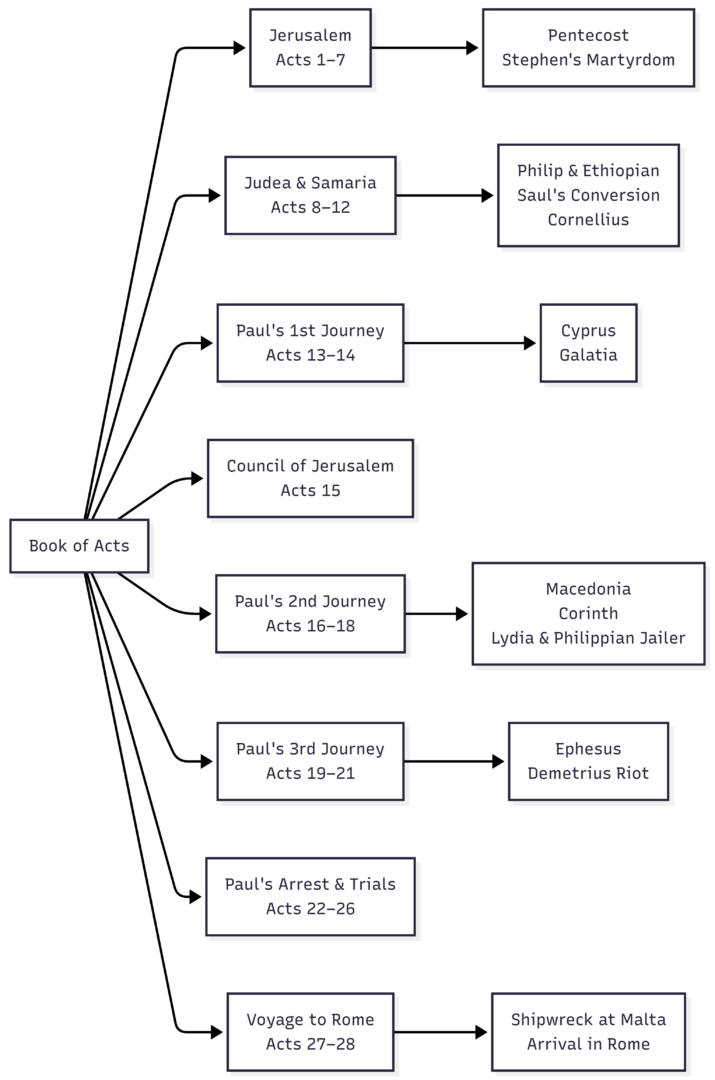
Structure of Acts at a Glance
Key Characters in Acts
| Character | Role | Key Reference |
|---|---|---|
| Peter | Led early Jerusalem church; first major preacher | Acts 2–12 |
| Stephen | First martyr; one of the seven deacons | Acts 6–7 |
| Philip | Evangelist; baptized the Ethiopian eunuch | Acts 8 |
| Saul / Paul | Persecutor turned apostle; missionary to Gentiles | Acts 9–28 |
| Barnabas | Encourager; companion of Paul | Acts 4, 11–15 |
| Cornelius | First Gentile convert | Acts 10 |
| Lydia | First European convert; dealer in purple cloth | Acts 16 |
| Silas | Paul’s companion on second journey | Acts 15–18 |
| Aquila & Priscilla | Tentmakers; co-workers of Paul | Acts 18 |
| Demetrius | Silversmith who incited riot at Ephesus | Acts 19 |
Acts spans the entire first generation of the church — from 120 believers in an upper room to a movement stretching across the Roman Empire. Studying it closely reveals not just history, but a model for how communities of faith grow, endure opposition, and carry a message across cultural and geographic boundaries.
Please share this Acts Bible Trivia Quiz With Questions & Answers with your friends and do a comment below about your feedback.
We will meet you on next article.
Until you can read, Mark Bible Trivia Quiz With Questions & Answers