Sri Lanka’s Digital Nomad Visa, launched in February 2026, lets foreign remote workers, freelancers and business owners live in Sri Lanka for one year (renewable) while working for clients or employers abroad. You must remit at least $2,000 a month in foreign currency to Sri Lanka, pay a $500 fee per person per year, get a recommendation from the Ministry of Digital Economy, and pass police and medical clearances. Local employment is not allowed.
In this guide
- Sri Lanka digital nomad visa at a glance
- Sri Lanka DNV requirements and documents
- How to apply for the Sri Lanka digital nomad visa
- How the $2,000 income rule works
- Do digital nomads pay tax in Sri Lanka?
- What the visa lets you do
- How much does it cost to live in Sri Lanka as a digital nomad?
- Practical tips for working remotely in Sri Lanka
- How Sri Lanka compares with other nomad visas
- Frequently asked questions
Sri Lanka digital nomad visa at a glance
| Requirement | Details |
|---|---|
| Who can apply | Foreign nationals aged 18+ working remotely for an employer or business registered outside Sri Lanka |
| Minimum income | $2,000/month remitted to Sri Lanka in foreign currency |
| Families | Spouse and dependants allowed; +$500/month for each dependant beyond two |
| Fee | $500 per person per year |
| Length | 1 year, renewable (no published maximum) |
| Renewal | Requires registration with the Inland Revenue Department |
| Work allowed | Remote work for foreign employers/clients only — no local employment |
| Issued by | Department of Immigration and Emigration (Residence Visa Division) |
Last checked: October 29, 2026, against the official launch information and Fragomen’s February 2026 alert. Procedures are new and may change — confirm with the Department of Immigration and Emigration.
Sri Lanka DNV requirements and documents
- Completed application form and a personal request letter
- Passport valid for at least six months, plus two recent photos
- Recommendation from the Ministry of Digital Economy
- Security clearance form
- Police clearance certificate issued within the last three months
- Medical clearance report (completed in Sri Lanka)
- International health insurance that covers treatment in Sri Lanka
- Proof of remote employment or business ownership outside Sri Lanka
- Proof of the monthly income remittance ($2,000+)
- For family members: marriage certificate and children’s birth certificates
How to apply for the Sri Lanka digital nomad visa
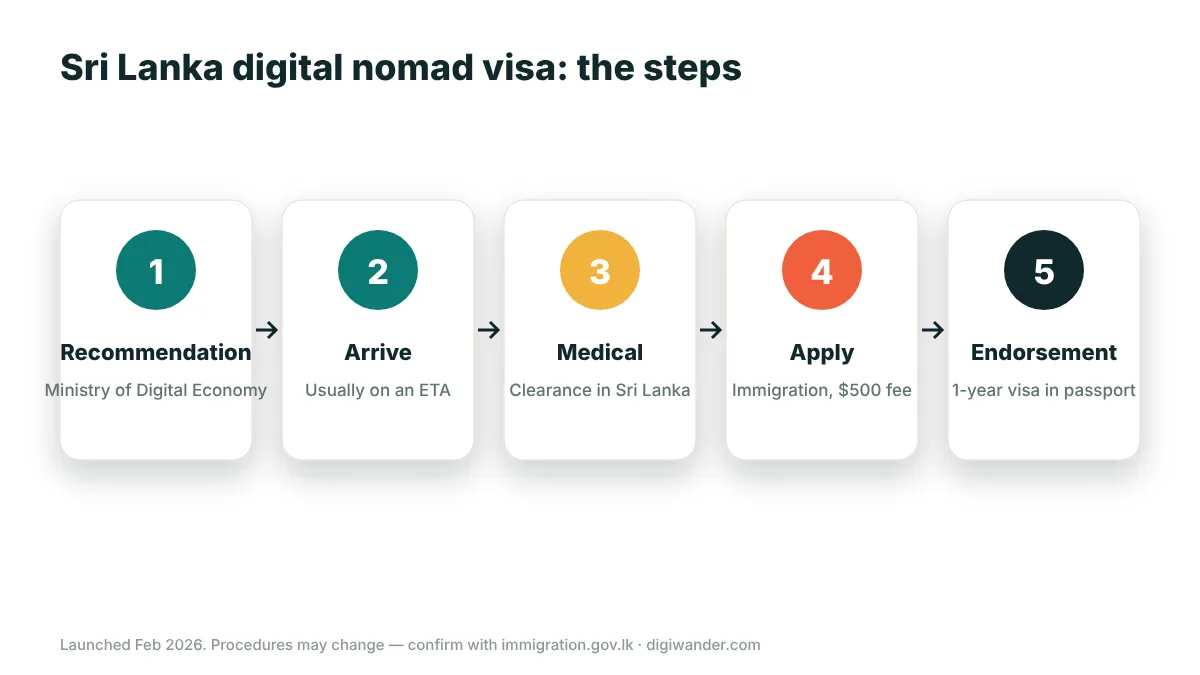
- Get the Ministry of Digital Economy recommendation for your remote work or business.
- Travel to Sri Lanka — most visitors enter first on an Electronic Travel Authorization (ETA).
- Complete the medical clearance in Sri Lanka.
- Submit your application and documents to the Residence Visa Division of the Department of Immigration and Emigration (Suhurupaya, Battaramulla). An online application option was announced at launch — check the department’s website for the current method.
- Pay the $500 fee and wait for evaluation.
- Receive the visa endorsement in your passport.
No official processing time has been published yet, so leave plenty of time on your entry visa.
How the $2,000 income rule works
Unlike most nomad visas, Sri Lanka focuses on money arriving in Sri Lanka: you need to remit at least $2,000 a month in foreign currency through the banking system. That means keeping a clean trail — payslips or client invoices, plus bank records showing the monthly transfer into Sri Lanka. Choosing a low-fee way to move money matters; compare options in our guide to the best banks for digital nomads and to accounts for receiving foreign payments.
Do digital nomads pay tax in Sri Lanka?
The visa does not make your income tax-free. If you spend 183 days or more in Sri Lanka in a 12-month period, you become a tax resident. Under current rules, foreign-currency service income received through a bank and remitted to Sri Lanka is taxed at a maximum of 15%, while other income falls under the normal progressive rates (up to 36%). Earlier exemptions for foreign income ended on April 1, 2025. Renewal also requires Inland Revenue registration, so get advice from a Sri Lankan tax adviser before you arrive.
What the visa lets you do
- Live in Sri Lanka long term and sign a property lease
- Open a personal bank account and set up utilities and internet
- Work from coworking spaces for your overseas employer or clients
- Enrol your children in international or private schools
How much does it cost to live in Sri Lanka as a digital nomad?
Sri Lanka is one of the more affordable nomad bases in Asia, but costs vary a lot. Colombo and the popular south-coast surf towns (Weligama, Ahangama, Mirissa) have higher rents in the November–April season, while hill-country towns like Kandy are cheaper. Budget for a private rental, coworking, a local SIM with plenty of data, health insurance and transport by tuk-tuk or ride-hailing apps. Our nomad budget guide helps you build a realistic monthly number — and the $2,000 remittance rule means you need at least that much income anyway.
Practical tips for working remotely in Sri Lanka
- Internet: fibre is available in Colombo and many towns; mobile 4G data is cheap and a good backup. Check speed before you book — see how much internet speed remote work needs.
- Seasons: the south and west coasts are driest roughly from November to April; the east coast is best from about May to September.
- Getting around: trains are scenic but slow; tuk-tuks and ride-hailing apps are easiest in towns. Our public transport tips help on day one.
- Insurance: international health insurance is mandatory for the visa — card insurance is not enough (see what cards cover).
How Sri Lanka compares with other nomad visas
At $2,000 a month, Sri Lanka sits among the lower-cost nomad visas, alongside Malaysia’s DE Rantau and below most European options (€2,849–€3,680 a month). Compare every country in our complete list of digital nomad visas. Indian remote workers can see their options in our guide to the digital nomad visa for Indian citizens.
Not legal advice. This visa is new and its procedures may change. Always confirm current requirements, fees and the application method with Sri Lanka’s Department of Immigration and Emigration.
Frequently asked questions
Does Sri Lanka have a digital nomad visa?
Yes. Sri Lanka launched its Digital Nomad Visa in February 2026 for foreign remote workers, freelancers and business owners earning income from outside Sri Lanka.
How much income do I need for the Sri Lanka digital nomad visa?
You must remit at least $2,000 a month in foreign currency to Sri Lanka, plus $500 a month for each dependant beyond two.
How much does the Sri Lanka digital nomad visa cost?
The fee is $500 per person per year, including the spouse and each dependant.
How long is the Sri Lanka digital nomad visa valid?
It is issued for one year and can be renewed. Renewal requires registration with the Inland Revenue Department.
Do digital nomads pay tax in Sri Lanka?
If you stay 183 days or more in 12 months you become tax resident. Foreign-currency service income received through a bank and remitted to Sri Lanka is taxed at a maximum of 15% under current rules.
Sources
- Department of Immigration and Emigration, Sri Lanka
- Fragomen — Sri Lanka launches new visa options (Feb 2026)
- Newsfirst — Sri Lanka launches digital nomad visa
Last updated . Fees, rules and prices change often — confirm current details with the official source before you act. This article is for information only and is not financial advice. See our disclaimer.