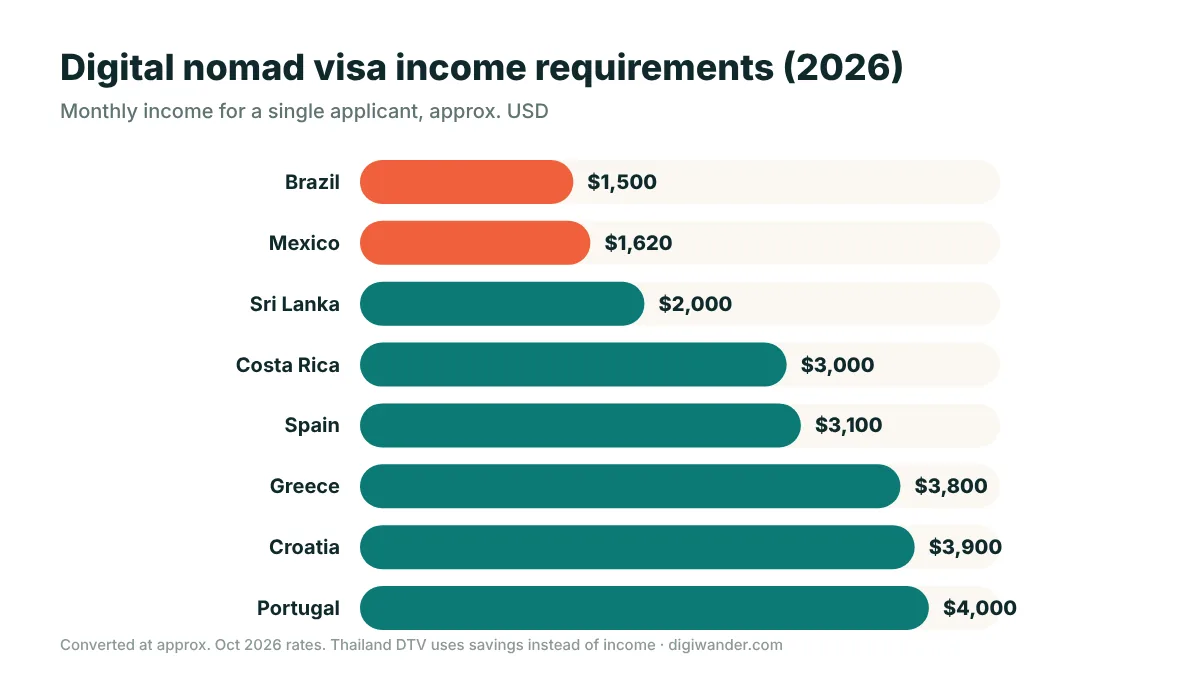
More than 25 countries now offer a digital nomad visa or remote-worker permit that lets you live there legally while working for clients or an employer abroad. The cheapest income requirements in 2026 are in Latin America and Asia: Brazil asks for $1,500 a month, Mexico about $1,620, and Thailand’s DTV asks only for savings of 500,000 baht. Europe’s visas usually need €2,800–€3,700 a month, from Spain at €2,849 to Portugal at €3,680. The table below lists every major programme with its income rule, length and the date we last checked it.
In this guide
- What is a digital nomad visa?
- Digital nomad visas in Europe
- Digital nomad visas in the Americas and Caribbean
- Digital nomad visas in Asia, the Middle East and Africa
- Cheapest and easiest digital nomad visas
- Common requirements for almost every nomad visa
- How to choose the right visa
- Frequently asked questions
What is a digital nomad visa?
A digital nomad visa (also called a remote-worker visa or nomad permit) lets a foreigner stay in a country for months or years while earning money from outside that country. In return, you usually prove a minimum income, buy health insurance and show a clean criminal record. You generally cannot work for local companies or clients.
It is different from a tourist visa or visa-free entry, which in most countries is for tourism only. Our guide Can I work remotely in Thailand on a tourist visa? explains why that difference matters.
Digital nomad visas in Europe
| Country | Income requirement (single applicant) | Length | Tax note |
|---|---|---|---|
| Portugal (D8) | €3,680/month + ~€11,040 savings (~$4,000) | 1-year temporary stay, or 2-year permit (renewable) | Tax resident after 183 days |
| Spain | €2,849/month (+€916 spouse, +€305 per child) (~$3,100) | 1-year visa, or up to 3-year permit applied in Spain | Special expat regime may apply |
| Croatia | €3,622.50/month, or €43,470 savings (~$3,900) | Up to 1 year | Foreign income exempt from Croatian income tax |
| Greece | €3,500/month after tax (~$3,800) | 1 year, then residence permit | Tax resident after 183 days |
| Italy | About €25,000/year (consulates may ask more) (~$2,250) | 1 year, renewable | Tax resident after 183 days |
| Cyprus | €3,500/month net (~$3,800) | 1 year, renewable | Check residency rules |
| Hungary (White Card) | €3,000/month net for the past 6 months (~$3,250) | 1 year, renewable once | Check residency rules |
| Malta (Nomad Residence Permit) | €42,000/year gross (~$3,800) | 1 year, renewable | Special nomad tax rules |
| Romania | 3× Romania’s average gross salary, each of last 6 months | 1 year, renewable | Check residency rules |
| Iceland | ISK 1,000,000/month (~$7,500) | Up to 180 days | No Icelandic tax on foreign income during stay |
Digital nomad visas in the Americas and Caribbean
| Country | Income requirement | Length | Tax note |
|---|---|---|---|
| Brazil | $1,500/month, or $18,000 in savings | 1 year, renewable once | Check residency rules |
| Mexico (temporary residence) | Over ~$1,620/month (or savings) — consulates vary | 1 year, renewable up to 4 years | Tax resident if home is in Mexico |
| Colombia | About 3× the Colombian minimum wage | Up to 2 years | Tax resident after 183 days |
| Costa Rica | $3,000/month ($5,000 with family) | 1 year, renewable once | Foreign income exempt |
| Barbados (Welcome Stamp) | $50,000/year | 12 months | No Barbados income tax on foreign income |
| Antigua & Barbuda | $50,000/year | Up to 2 years | No local income tax on foreign income |
Digital nomad visas in Asia, the Middle East and Africa
| Country | Income / funds requirement | Length | Fee / note |
|---|---|---|---|
| Thailand (DTV) | No income rule; 500,000 THB savings | 5-year multi-entry, 180 days per entry (+180 extension) | 10,000 THB fee |
| Malaysia (DE Rantau) | About $24,000/year for digital roles | 12 months, renewable | ~$270 fee; job must fit approved digital categories |
| Indonesia / Bali (E33G) | $60,000/year + $2,000 bank balance | 1 year, not extendable | No Indonesian clients |
| Sri Lanka (DNV, launched 2026) | $2,000/month remitted to Sri Lanka | 1 year, renewable | $500 per person per year |
| Philippines (EO 86) | About $24,000/year | 12 months + 12 | Only for nationalities offering Filipinos a similar visa |
| Japan | ¥10 million/year | 6 months | Limited to eligible nationalities |
| UAE / Dubai | $3,500/month (employee); $5,000 (business owner) | 1 year, renewable | No personal income tax |
| Mauritius (Premium Visa) | $1,500/month | Up to 1 year, renewable | — |
| Cape Verde | €1,500 average bank balance | 6 months, renewable | — |
Last checked: October 27, 2026. Figures come from official announcements and the sources listed at the end. Many thresholds are tied to local wages and change every year — always confirm with the embassy or official portal before applying. USD conversions are approximate.
No visa needed? Some countries let many nationalities stay a long time visa-free. Georgia allows citizens of 95+ countries to stay 365 days — but since March 1, 2026 it requires work permits for local employment, and remote work for foreign clients is a grey area. Always check rules for your passport.
Cheapest and easiest digital nomad visas
- Thailand DTV — no monthly income rule, just 500,000 THB in savings.
- Brazil — $1,500 a month or $18,000 in savings.
- Mauritius — $1,500 a month.
- Mexico — around $1,620 a month, depending on the consulate.
- Sri Lanka and Malaysia — about $2,000 a month.
- Spain — the cheapest major EU option at €2,849 a month.
Work out whether your income really covers living costs with our guide on how much money you need to become a digital nomad.
Common requirements for almost every nomad visa
- Proof of remote income: employment contract, client contracts and invoices, and 3–12 months of bank statements.
- Health insurance valid in the country for the whole stay. Card travel insurance is rarely enough — compare what credit card insurance covers before relying on it.
- Clean criminal record, often apostilled or legalised.
- Valid passport (usually 6–12+ months beyond your stay).
- Accommodation proof such as a lease or booking.
- Application fee and sometimes a local tax number (e.g. Portugal’s NIF).
How to choose the right visa
- Check your passport. Some visas (Japan, the Philippines) only accept certain nationalities.
- Match the income rule to your real earnings — consulates want stable income, not one good month.
- Think about tax. Staying 183+ days usually makes you tax resident. Some countries (Croatia, Costa Rica, UAE) don’t tax your foreign income.
- Consider the long term. Portugal and Spain offer a path to residency; others are short, one-off stays.
- Compare living costs on Nomad List and in our city guides.
Freelancer? Many visas accept contracts and invoices from several clients. Need remote work first? Start with the best websites to find remote work, and set up an account for getting paid by foreign clients.
Not legal advice. Visa rules, income thresholds and fees change often and can differ by consulate. Use this page to shortlist countries, then confirm every detail with the official embassy or immigration website.
Frequently asked questions
Which countries offer digital nomad visas in 2026?
More than 25 countries offer them, including Portugal, Spain, Croatia, Greece, Italy, Malta, Hungary, Cyprus, Romania, Costa Rica, Brazil, Mexico, Colombia, Thailand (DTV), Malaysia, Indonesia, Sri Lanka, Japan, the UAE and Mauritius.
What is the cheapest digital nomad visa?
Thailand’s DTV has no monthly income rule (it needs 500,000 baht in savings). Brazil and Mauritius ask for $1,500 a month, and Mexico around $1,620. In the EU, Spain is the cheapest major option at €2,849 a month in 2026.
What is the easiest digital nomad visa to get?
Visas with low income rules and simple documents — such as Thailand’s DTV, Brazil and Malaysia’s DE Rantau for digital professionals — are usually the most accessible. Ease also depends on your passport and the consulate.
Do I pay tax on a digital nomad visa?
It depends on the country and how long you stay. Many countries make you tax resident after 183 days, while some, such as Croatia and Costa Rica, exempt nomad visa holders’ foreign income. Your home country may also tax you.
Can I work for local companies on a digital nomad visa?
Usually not. Digital nomad visas are designed for income from employers or clients outside the country. Working for local businesses normally needs a separate work permit.
Sources
- The Local — Digital nomad visa income requirements compared (Feb 2026)
- Jobbatical — Spain’s 2026 income requirement
- Remote Work Europe — Croatia’s 2026 threshold
- WhereToEmigrate — European nomad visas (official figures, Oct 2026)
- The Thaiger — Thailand DTV 2026
- Newsfirst — Sri Lanka launches digital nomad visa
Last updated . Fees, rules and prices change often — confirm current details with the official source before you act. This article is for information only and is not financial advice. See our disclaimer.