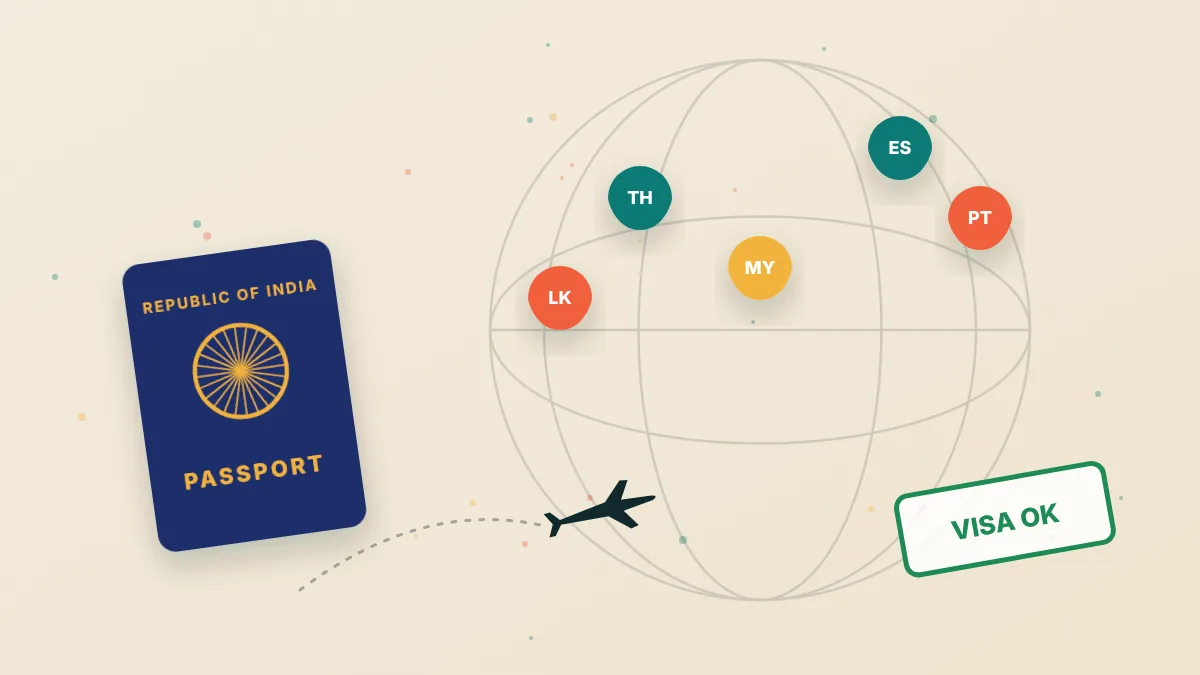
The best digital nomad visa options for Indian citizens in 2026 are Thailand’s DTV (500,000 baht in savings, no income rule), Malaysia’s DE Rantau (about $24,000 a year), Sri Lanka’s new DNV ($2,000 a month), Spain (€2,849 a month) and Portugal’s D8 (€3,680 a month). All of them accept Indian passport holders, and most can be applied for from India, online or through a visa centre. Japan’s nomad visa is not open to Indians.
In this guide
- Digital nomad visas Indian citizens can apply for
- What is the easiest digital nomad visa for Indians?
- The best options in detail
- Which nomad visas are not open to Indians?
- Documents Indians usually need
- How to show foreign income in an Indian bank account
- Moving money abroad: LRS and TCS
- How to apply from India: step by step
- Frequently asked questions
Digital nomad visas Indian citizens can apply for
| Country | Income / funds needed | Approx. in ₹ | Where Indians apply |
|---|---|---|---|
| Thailand (DTV) | 500,000 THB savings | ~₹13.5 lakh in the bank | Online, Thai e-visa website |
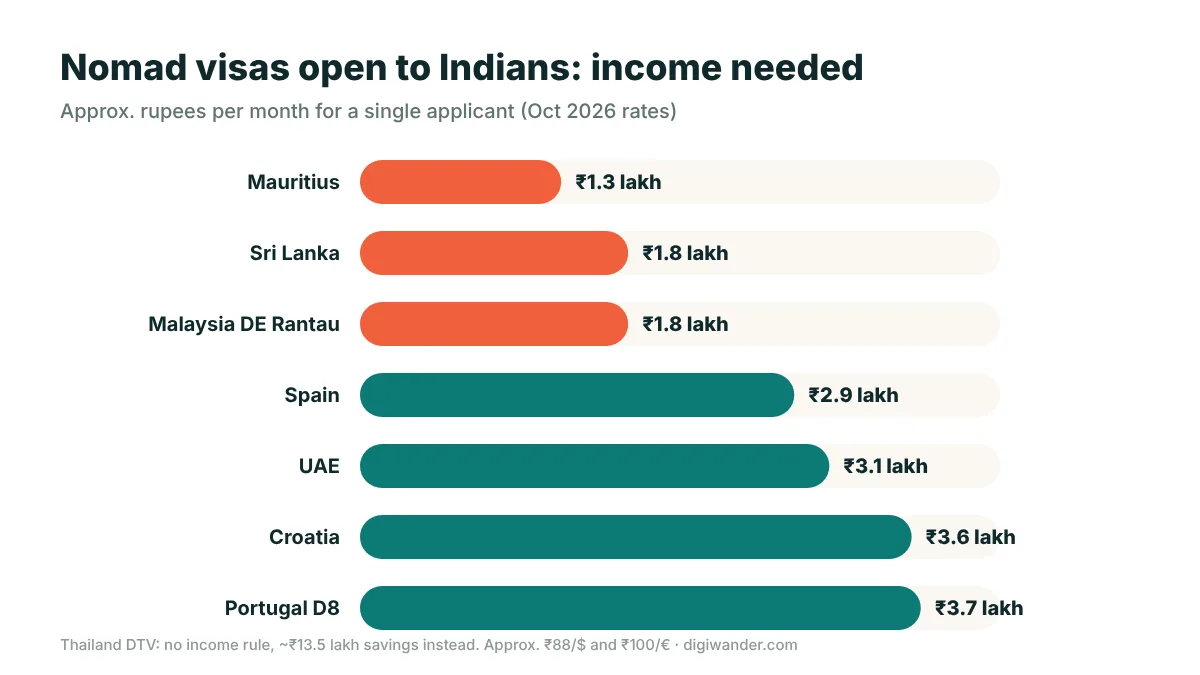
| Malaysia (DE Rantau) | ~$24,000/year (digital roles) | ~₹1.8 lakh/month | Online, MDEC portal |
| Sri Lanka (DNV) | $2,000/month remitted | ~₹1.8 lakh/month | Ministry recommendation, then Department of Immigration |
| Mauritius (Premium Visa) | $1,500/month | ~₹1.3 lakh/month | Online application |
| Spain | €2,849/month | ~₹2.9 lakh/month | Spanish consulate via its visa centre in India |
| Portugal (D8) | €3,680/month + savings | ~₹3.7 lakh/month | Portuguese consulate via its visa centre in India |
| Croatia | €3,622.50/month | ~₹3.6 lakh/month | Croatian embassy or online (Ministry of Interior) |
| UAE (Dubai remote work visa) | $3,500/month | ~₹3.1 lakh/month | Online (Dubai/UAE portals) |
| Indonesia / Bali (E33G) | $60,000/year | ~₹4.4 lakh/month | Online, Indonesian e-visa website |
Last checked: October 29, 2026. Rupee amounts are rough conversions (about ₹88 per US dollar and ₹100 per euro) and move with the currency. Confirm current amounts on each official site before applying. See every country in our complete list of digital nomad visas.
What is the easiest digital nomad visa for Indians?
For most Indian remote workers, the easiest options are:
- Thailand DTV — no monthly income test, online application, five-year validity. You need about ₹13.5 lakh held in your account for roughly three months, plus proof of remote work.
- Sri Lanka DNV — close to home, $2,000 a month, and a one-year stay. New in 2026, so expect paperwork to evolve.
- Malaysia DE Rantau — low income bar for tech and digital roles, applied online. Your job must fit the approved digital categories.
If you earn more than about ₹2.9 lakh a month and want Europe, Spain is the cheapest major EU option and can lead to longer residence.
The best options in detail
Thailand DTV
The Destination Thailand Visa is open to Indian passport holders and is applied for online from outside Thailand. It needs 500,000 THB in savings (embassies increasingly want to see the money held for around three months), a 10,000 THB fee, and proof that you work for employers or clients outside Thailand. It is valid for five years with stays of up to 180 days per entry. Note that visa-free tourist stays for Indians are now 30 days, and are for tourism only — read why you can’t work on a tourist entry.
Malaysia DE Rantau Nomad Pass
Malaysia’s pass needs about $24,000 a year for digital professionals (non-tech roles face a much higher bar), costs around $270, and lasts 12 months, renewable. The most common rejection reason is a job that doesn’t fit the official digital categories, so describe your role clearly.
Sri Lanka Digital Nomad Visa
Launched in February 2026, it requires you to remit at least $2,000 a month in foreign currency to Sri Lanka, costs $500 a year, and lasts one year, renewable. Your income must come from outside Sri Lanka. Full details are in our Sri Lanka digital nomad visa guide.
Spain Digital Nomad Visa
Spain asks for €2,849 a month in 2026 (+€916 for a spouse and +€305 per child). Applicants generally need a university degree or around three years of professional experience, and employees must work for a company that has existed for at least a year. Apply through the Spanish consulate’s visa centre in India, or from inside Spain for a longer residence permit.
Portugal D8
Portugal needs €3,680 a month (four times its minimum wage) and about €11,040 in savings. Indians apply through Portugal’s visa centre in India and need a Portuguese tax number (NIF) before applying. The residence route can lead to permanent residence after five years. See our Portugal D8 guide.
Which nomad visas are not open to Indians?
- Japan — its six-month nomad visa is limited to an approved list of nationalities, and India is not on it.
- Philippines — its new nomad visa only accepts citizens of countries that offer Filipinos a similar visa.
- Georgia — popular with nomads because many passports get 365 days visa-free, but Indian citizens are not on that list and need a visa.
Documents Indians usually need
- Passport valid well beyond your planned stay.
- Police Clearance Certificate (PCC) — apply on the Passport Seva website and visit a Passport Seva Kendra or POPSK. Many European countries also want it apostilled by the Ministry of External Affairs.
- Proof of remote income — employment letter or client contracts, plus 3–12 months of bank statements.
- Income tax returns (ITR) for the last one to three years — consulates like to see consistent income.
- Foreign inward remittance proof (FIRC/FIRA from your bank or payment provider) if you are a freelancer paid from abroad.
- Health insurance valid in the destination for the whole stay.
- Degree certificate (some countries, such as Spain), often apostilled.
How to show foreign income in an Indian bank account
Consulates want to see stable income at or above the threshold every month. If you are paid in rupees by an Indian employer, that usually counts as foreign income for the destination country — the key is that the money doesn’t come from the country you’re moving to. Freelancers paid by overseas clients should keep the payment trail clear: invoices, platform statements and FIRC/FIRA documents for each payment. A dedicated account for client payments makes this much easier — compare options in our guide to accounts for getting paid by foreign clients.
Moving money abroad: LRS and TCS
Under the RBI’s Liberalised Remittance Scheme (LRS), resident Indians can send up to $250,000 per financial year abroad. Tax Collected at Source (TCS) is charged on remittances above ₹10 lakh a year: at 20% on the amount above ₹10 lakh for purposes such as investments, gifts or moving savings, with lower rates for education and medical purposes after Budget 2026. TCS is not an extra tax — you can claim it back against your income tax — but it ties up cash, so plan large transfers (for example, to meet Thailand’s or Portugal’s savings requirement) in advance and check current rates with your bank.
Tax residency: if you spend most of the year abroad you may stop being an Indian tax resident, and your destination may start taxing you after 183 days. Rules depend on days spent in India, your income type and tax treaties — speak to a chartered accountant before you move.
How to apply from India: step by step
- Pick your visa by comparing income rules with your real earnings and budget — our digital nomad budget guide helps.
- Get your PCC and any apostilles early — they often take the longest.
- Collect income proof: contracts, bank statements, ITRs and remittance certificates.
- Buy health insurance valid in the destination.
- Apply online or at the right visa centre, and keep copies of everything.
- Set up money tools before you fly — see the best banks and cards for digital nomads.
Still building remote income? Start with the best websites to find remote work.
Not legal or tax advice. Visa rules, income thresholds and TCS rates change. Confirm everything with the official embassy, visa centre or portal, and with a chartered accountant for tax.
Frequently asked questions
Which countries offer a digital nomad visa to Indian citizens?
Indian passport holders can apply for Thailand’s DTV, Malaysia’s DE Rantau, Sri Lanka’s DNV, Mauritius’ Premium Visa, Spain, Portugal (D8), Croatia, the UAE remote work visa and Indonesia’s E33G, among others. Japan’s nomad visa is not open to Indians.
What is the easiest digital nomad visa for Indians?
Thailand’s DTV is often the easiest: there is no monthly income test, only 500,000 baht in savings, and you apply online. Sri Lanka and Malaysia are also accessible at around $2,000 a month.
How much income do Indians need for a digital nomad visa?
It ranges from about ₹1.3 lakh a month (Mauritius) and ₹1.8 lakh (Sri Lanka, Malaysia) to about ₹2.9 lakh for Spain and ₹3.7 lakh for Portugal, based on October 2026 exchange rates.
Can I get a digital nomad visa while working for an Indian company?
Usually yes. Most nomad visas only require that your employer or clients are outside the country you move to, so a salary from an Indian company typically counts. Check each country’s rules.
Do I pay TCS when moving money abroad for a nomad visa?
Under the LRS, TCS applies to remittances above ₹10 lakh a year — at 20% for purposes like investments or moving savings. TCS can be claimed back against your income tax, but plan large transfers early.
Sources
- The Thaiger — Thailand DTV 2026
- Outlook Money — Budget 2026 TCS changes
- Passport Seva — Police Clearance Certificate
Last updated . Fees, rules and prices change often — confirm current details with the official source before you act. This article is for information only and is not financial advice. See our disclaimer.