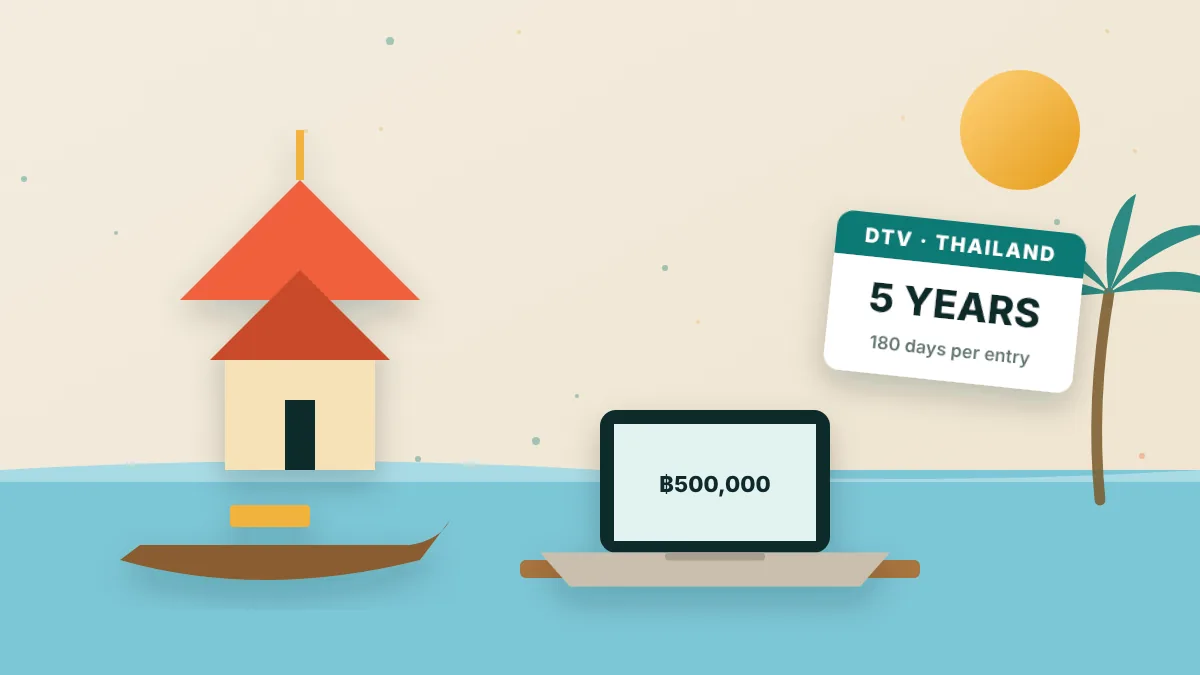
The Thailand DTV visa (Destination Thailand Visa) is Thailand’s visa for remote workers and freelancers. In 2026 it needs 500,000 baht in savings (about $15,000), costs a 10,000 baht fee, and is valid for five years with stays of up to 180 days per entry, extendable once by another 180 days. You apply online through the Thai e-visa system from outside Thailand. Your employer or clients must be outside Thailand. Since August 31, 2026, applicants also need a police clearance certificate.
In this guide
Thailand DTV visa at a glance
| Requirement | Details (November 2026) |
|---|---|
| Savings | 500,000 THB (about $15,000), usually shown as a steady balance for around 3 months |
| Visa fee | 10,000 THB, paid in the currency of the embassy handling your case |
| Validity | 5 years, multiple entry |
| Stay per entry | Up to 180 days, plus one 180-day extension per entry (1,900 THB) at an immigration office |
| Age | 20 or older |
| Work allowed | Remote work for employers or clients outside Thailand only. No Thai employer, Thai clients or work permit |
| Police clearance | Required for applications made on or after August 31, 2026 |
| Where to apply | Online at thaievisa.go.th, from outside Thailand, through the Thai mission covering your nationality or country of residence |
Last checked November 11, 2026, against Erickson Immigration Group (September 2026), Asia Lifestyle Magazine and The Thaiger. Each Thai embassy publishes its own document list, so check the page of the one handling your application.
Who qualifies for the DTV?
The DTV has two main groups. Most digital nomads apply under the “workcation” category:
- Remote workers and freelancers: people employed by a company registered outside Thailand, or freelancers whose clients are outside Thailand. You prove this with an employment contract or letter, or for freelancers a portfolio plus client contracts and invoices.
- “Soft power” activities: people coming for activities such as Muay Thai training, Thai cooking courses, medical treatment, concerts or long-term courses. You need a booking or enrolment letter from the Thai provider.
- Dependants: a spouse and children under 20 of a DTV holder can apply. They need the same 500,000 THB savings proof (or the main applicant’s) plus marriage or birth certificates.
There is no monthly income rule, which makes the DTV one of the easiest nomad visas to qualify for. Compare it with income-based visas in our complete list of digital nomad visas.
DTV documents checklist
- Passport valid for at least 6 months, plus a recent photo.
- Bank statements showing at least 500,000 THB (or the equivalent in your currency). Many embassies want 3–6 months of statements, and a recent lump-sum deposit is a common reason for refusal.
- Proof of remote work: employment contract or letter from a foreign company, or a portfolio, client contracts and invoices if you’re a freelancer. Some embassies also ask for the employer’s company registration.
- Police clearance certificate: from your country of nationality or the country where you apply. Under the August 2026 changes, documents not in English or Thai need an English translation.
- Proof of residence in the country where you apply, if that isn’t your country of citizenship (for example, a residence permit).
- Soft-power applicants: a confirmation letter from the gym, school or clinic instead of the work documents.
What changed on August 31, 2026: applications must go through the Thai mission covering your nationality or permanent residence, not any embassy you choose, and a police clearance certificate is now required. Applications with the fee fully paid before that date are assessed under the old rules, and existing DTV holders aren’t affected. Some embassies (London, for example) add extra rules, such as police certificates issued within the last six months.
How to apply for the Thailand DTV visa, step by step
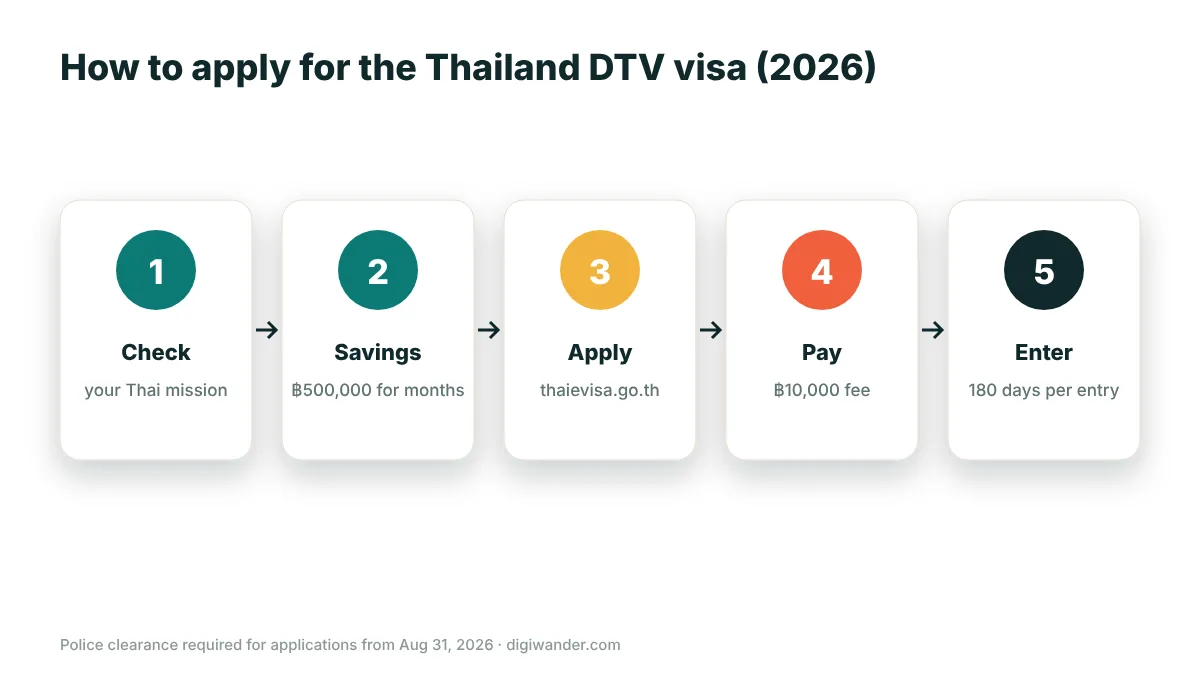
- Check your mission: find the Thai embassy or consulate that covers your nationality or country of residence and read its DTV page.
- Build your savings trail: keep at least 500,000 THB in one account for a few months before you apply.
- Apply online at the official Thai e-visa website (thaievisa.go.th). Choose the DTV category and upload your documents as PDFs.
- Pay the 10,000 THB fee in the local currency shown. The fee isn’t refunded if you’re refused.
- Wait for the decision, usually by email. Processing times vary by embassy, from about a week to several weeks.
- Enter Thailand with the e-visa and your passport. Your 180-day stay starts on each entry.
You can’t apply from inside Thailand. If you’re already there on a tourist entry, you need to leave and apply from abroad. Our guide can I work remotely in Thailand on a tourist visa? explains why that tourist status isn’t meant for remote work.
How long can you stay on the DTV?
Each entry gives you up to 180 days. Before it runs out, you can extend once by another 180 days at a local immigration office for 1,900 THB, so up to about a year per entry. After that, you leave Thailand and re-enter to start a new 180-day stay. You can repeat this as often as you like until the visa expires after five years. The DTV can’t be renewed, so you apply again afterwards.
Remember to file the 90-day report with immigration if you stay more than 90 days in a row. It can be done online, by post or in person.
Do DTV holders pay tax in Thailand?
Possibly. If you spend 180 days or more in a calendar year in Thailand, you become a Thai tax resident. Since 2024, Thai tax residents can be taxed on foreign income that they bring into Thailand, depending on when it was earned and on any tax treaty with your home country. The DTV itself gives no tax exemption. Keep records of when and how money enters Thailand, and speak to a Thai tax adviser before a long stay. Choosing the right accounts helps too — see the best banks for digital nomads.
Common reasons DTV applications are refused
- Savings deposited just before applying instead of held for months.
- Weak proof of remote work, such as a freelancer with no contracts or invoices.
- Applying through the wrong embassy since the August 2026 changes.
- Missing police certificate or one without an English translation.
- Thai clients or a Thai employer, which the DTV doesn’t allow.
DTV vs other visas in Asia
The DTV is the strongest long-stay option in Southeast Asia for most remote workers. Indonesia’s E33G asks for $60,000 a year in income (see does Bali have a digital nomad visa?), and Vietnam has no nomad visa at all — nomads in cities like Da Nang use 90-day e-visas instead. If you hold an Indian, Pakistani or Nigerian passport, see how the DTV compares in our guides for Indian, Pakistani and Nigerian citizens. Health insurance isn’t a formal DTV requirement at every embassy, but you’ll want it — compare SafetyWing vs Genki.
Not legal or tax advice. DTV rules and document lists change and differ between embassies. Confirm current requirements on the official Thai e-visa website and your embassy’s DTV page before you apply.
Frequently asked questions
How much money do I need for the Thailand DTV visa?
You need at least 500,000 baht (about $15,000) in savings, usually shown as a steady balance in bank statements for around three months. There’s no monthly income requirement.
How much does the DTV visa cost?
The visa fee is 10,000 baht, paid in the currency of the embassy handling your application. Extending a stay by 180 days costs 1,900 baht at an immigration office.
How long can I stay in Thailand on a DTV?
Up to 180 days per entry, extendable once by another 180 days. The visa is valid for five years with multiple entries, so you can leave and re-enter for new stays.
Can I apply for the DTV from inside Thailand?
No. You apply online through the Thai e-visa website from outside Thailand, through the Thai mission covering your nationality or country of residence.
Do I need a police clearance certificate for the DTV?
Yes, for applications made on or after August 31, 2026. It must come from your country of nationality or the country where you apply, with an English translation if needed.
Sources
- Erickson Immigration Group — Thailand updates DTV document requirements (Sept 2026)
- Asia Lifestyle Magazine — DTV changes from 31 August 2026
- The Thaiger — Thailand DTV 2026
- Thailand official e-visa website
Last updated . Fees, rules and prices change often — confirm current details with the official source before you act. This article is for information only and is not financial advice. See our disclaimer.