Bible Verses for Kids: Help Kids Know & Love God
Teaching a child to memorize Scripture is one of the most lasting gifts a parent, grandparent, or Sunday school teacher can give. But memorization alone isn’t the goal — helping kids actually understand and apply God’s Word is what turns a recited verse into a lifelong anchor of faith. This guide brings together the best short, easy-to-learn Bible verses for kids of every age, organized by theme, along with practical strategies for making Scripture stick.
Why Bible Memorization Matters for Kids
Children absorb language faster than adults, and what they memorize young tends to stay with them for life. Psychologists call this “childhood amnesia resistance” — information learned repetitively and emotionally in early childhood is stored differently than facts learned later, which is part of why so many adults can still recite verses they learned in preschool decades earlier.
But there’s a catch. Simply requiring word-perfect recitation, without any explanation of meaning, teaches children to treat Scripture like a trivia answer rather than a living guide for life. Even the most rigorously accurate rote memorization program does little good if a child forgets the words five minutes after reciting them — a common problem in a purely performance-based approach. A better model combines three elements:
- Memorization — building the words into long-term memory.
- Comprehension — explaining, in age-appropriate language, what the verse actually means.
- Application — connecting the verse to something happening in the child’s real life.
When all three are present, a verse becomes more than a party trick. It becomes a tool the Holy Spirit can use to shape a child’s character, decisions, and relationship with God.
How to Choose the Right Verses by Age
Not every verse is right for every stage. The table below offers a general framework for matching Scripture to developmental readiness.
| Age Group | Focus | Verse Length | Example Reference |
|---|---|---|---|
| Toddlers (2–3) | Single concept, repetition | 3–6 words | 1 John 4:8 |
| Preschool (4–5) | Simple sentences, concrete images | One short sentence | Genesis 1:1 |
| Early Elementary (6–8) | Cause and effect, basic doctrine | One to two sentences | Philippians 4:13 |
| Upper Elementary (9–12) | Abstract concepts, life application | Full verse or short passage | Proverbs 3:5–6 |
A good rule of thumb: if a preschooler can say the alphabet, they can memorize a full short verse — reading ability is not a prerequisite for Scripture memory. Waiting until a child can read on their own often means missing the years when memorization comes easiest.
Easy Bible Verses for Toddlers and Preschoolers
These verses use short words, concrete images, and simple grammar — ideal for a child just starting out.
- 1 John 4:8 — “God is love.”
- Genesis 1:1 (KJV) — “In the beginning God created the heaven and the earth.”
- Psalm 56:3 (KJV) — “What time I am afraid, I will trust in thee.”
- Philippians 4:13 (KJV) — “I can do all things through Christ which strengtheneth me.”
- 1 Peter 5:7 (KJV) — “Casting all your care upon him; for he careth for you.”
- Luke 6:31 (KJV) — “And as ye would that men should do to you, do ye also to them likewise.”
Each of these can be introduced with a simple explanation. For example, when teaching Genesis 1:1, a parent might ask, “Who made the sun, the trees, and you?” before revealing the answer in the verse itself. That question-first approach primes a young child’s curiosity and makes the verse feel like the answer to something they wondered about, rather than an arbitrary sentence to repeat.
Verses About God’s Love and Kindness
Children respond strongly to the theme of being loved unconditionally — it’s often the doctrinal starting point that makes every other lesson make sense.
- 1 John 3:1 (paraphrased) — God’s love is so great that we are called His children.
- John 3:16 (KJV) — “For God so loved the world, that he gave his only begotten Son, that whosoever believeth in him should not perish, but have everlasting life.”
- Ephesians 4:32 (KJV) — “And be ye kind one to another, tenderhearted, forgiving one another, even as God for Christ’s sake hath forgiven you.”
- Proverbs 17:17 (KJV) — “A friend loveth at all times.”
- 1 John 4:19 (KJV) — “We love him, because he first loved us.”
Pair these verses with a real-life moment — a sibling disagreement, a new friendship, a moment of forgiveness — so the child sees the verse in action, not just on a page.
Verses About Courage and Overcoming Fear
Fear is one of the most common emotions children ask adults to help them navigate, whether it’s a thunderstorm, a new school, or the dark. These verses give kids concrete language to draw on.
- Joshua 1:9 (KJV) — “Have not I commanded thee? Be strong and of a good courage; be not afraid, neither be thou dismayed: for the Lord thy God is with thee whithersoever thou goest.”
- Psalm 27:1 (KJV) — “The Lord is my light and my salvation; whom shall I fear? the Lord is the strength of my life; of whom shall I be afraid?”
- Psalm 4:8 (KJV) — “I will both lay me down in peace, and sleep: for thou, Lord, only makest me dwell in safety.”
- James 4:7 (KJV) — “Submit yourselves therefore to God. Resist the devil, and he will flee from you.”
Verses About Salvation and Who Jesus Is
As children grow, they begin asking bigger questions about why Jesus came and what it means to be saved. These core verses lay a doctrinal foundation without requiring adult-level theology.
- Romans 3:23 (KJV) — “For all have sinned, and come short of the glory of God.”
- Romans 6:23 (KJV) — “For the wages of sin is death; but the gift of God is eternal life through Jesus Christ our Lord.”
- Romans 10:13 (KJV) — “For whosoever shall call upon the name of the Lord shall be saved.”
- John 14:6 (KJV) — “I am the way, the truth, and the life: no man cometh unto the Father, but by me.”
- 1 John 1:9 (KJV) — “If we confess our sins, he is faithful and just to forgive us our sins, and to cleanse us from all unrighteousness.”
Verses About Obedience, Trust, and Daily Living
- Colossians 3:20 (KJV) — “Children, obey your parents in all things: for this is well pleasing unto the Lord.”
- Proverbs 3:5–6 (KJV) — “Trust in the Lord with all thine heart; and lean not unto thine own understanding. In all thy ways acknowledge him, and he shall direct thy paths.”
- Psalm 119:105 (KJV) — “Thy word is a lamp unto my feet, and a light unto my path.”
- Philippians 4:4 (KJV) — “Rejoice in the Lord alway: and again I say, Rejoice.”
- Philippians 4:6 (KJV) — “Be careful for nothing; but in every thing by prayer and supplication with thanksgiving let your requests be made known unto God.”
- Psalm 139:14 (KJV) — “I will praise thee; for I am fearfully and wonderfully made.”
A Framework for Teaching Memory Verses at Home or Church
Here is a simple weekly rhythm many parents and children’s ministry leaders use successfully:
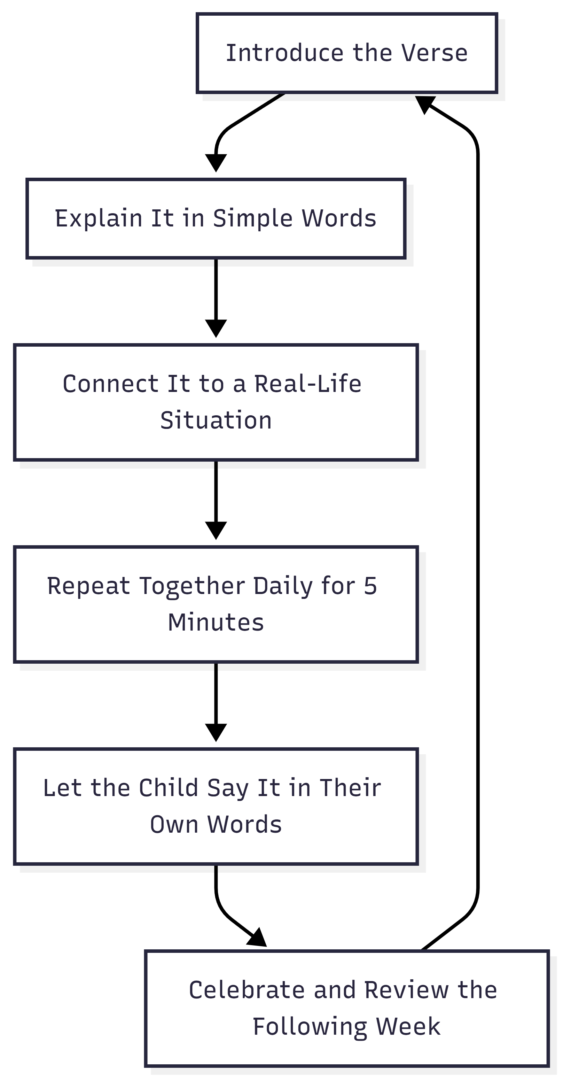
This cycle repeats every week with a new verse, while briefly reviewing verses from prior weeks to reinforce long-term retention. The key departure from a strict word-for-word test is step E — allowing a child to paraphrase the verse in their own words is often a better indicator of true understanding than a flawless recitation, and it keeps kids engaged rather than anxious about making a mistake.
Comparison: Rote Memorization vs. Comprehension-Based Memorization
| Approach | Strength | Weakness | Best For |
|---|---|---|---|
| Rote (word-for-word) | Builds exact, quotable Scripture knowledge | Can be forgotten quickly if meaning isn’t understood | Short verses, older kids who read well |
| Comprehension-based (paraphrase + explanation) | Builds lasting understanding and application | Requires more time and effort from the teacher | Preschool through upper elementary |
| Hybrid (memorize, then explain) | Combines accuracy with meaning | Takes the most preparation | Church and homeschool settings |
Most children’s ministry experts recommend the hybrid approach: have the child memorize the verse as written, but always follow up by asking what it means and how it applies to their week.
30 Bible Verses Every Kid Should Know
Beyond the themed lists above, here is a broader, ready-to-use list for ongoing Scripture memory, useful for a yearlong Sunday school plan or family devotional calendar (roughly one verse every one to two weeks).
- James 1:27 — caring for orphans and widows
- Psalm 145:9 — God’s goodness to all
- Joshua 1:9 — be strong and courageous
- Philippians 4:4 — rejoice always
- Matthew 22:39 — love your neighbor
- Numbers 6:24 — the Lord bless and keep you
- Colossians 3:2 — set your mind on things above
- Colossians 3:16 — let the word of Christ dwell in you
- 1 John 5:3 — love is keeping His commands
- Proverbs 30:5 — every word of God is true
- Hebrews 13:8 — Jesus Christ is the same forever
- Psalm 150:6 — let everything praise the Lord
- Proverbs 3:5 — trust in the Lord
- Romans 10:13 — call on the name of the Lord
- Romans 3:23 — all have sinned
- Matthew 5:14 — you are the light of the world
- Psalm 139:14 — fearfully and wonderfully made
- Colossians 3:20 — children, obey your parents
- James 1:17 — every good gift is from above
- 1 John 1:5 — God is light
- Ephesians 4:32 — be kind and forgiving
- 1 John 3:23 — believe and love one another
- Psalm 56:3 — when afraid, trust in God
- Psalm 118:24 — this is the day the Lord has made
- Psalm 119:105 — Your word is a lamp
- Psalm 136:1 — give thanks, His love endures forever
- Luke 6:31 — the golden rule
- Philippians 4:13 — I can do all things through Christ
- Psalm 138:1 — I give thanks with my whole heart
- Isaiah 30:15 — in quietness and trust is your strength
Common Questions Parents Ask
One new verse per week is a sustainable pace for most families, paired with brief daily review of two or three previous verses.
Any child-friendly translation works, but consistency matters more than which version you choose — switching translations frequently can make memorization harder.
Reading is not required. Repetition, songs, hand motions, and read-aloud practice work just as well for pre-readers, and often better, since young children learn primarily by ear.
Yes. A paraphrase that captures the true meaning of a verse, combined with an explanation of how it applies to life, is strong evidence of genuine understanding — arguably stronger than flawless recitation alone.
Bringing It All Together
Helping a child memorize Scripture is less about producing a perfect performance and more about planting a seed that will keep growing for decades. Start with short, concrete verses for young children, move toward doctrinal and application-based verses as they mature, and always pair memorization with explanation. A child who can explain why “God is love” matters to their daily life has learned something far more durable than a child who can only recite the words.
Whether you’re a parent building a bedtime routine, a grandparent looking for a meaningful weekly activity, or a children’s ministry volunteer designing a curriculum, the verses and framework above offer a practical, age-appropriate starting point for helping kids know — and love — God.
Please share this Bible Verses for Kids: Help Kids Know & Love God your friends and do a comment below about your feedback.
We will meet you on next article.
Until you can read, What Is the Meaning of the Parable of the Mustard Seed?